10 Times Wrestlers Got Over With ONE Match
Freshly squeezed.

This situation is bullsh*t. Its impact on professional wrestling is an inconvenient and irritating byproduct of something exponentially more grave, but god damn. This thing couldn't suck more unless Baron Corbin grabbed two chinlocks on it in an 18 minute match.
We never got to see fans jeer Rob Gronkowski's dry-humping on SmackDown. What was he doing? Does he want to f*ck everybody? Is it PG? Are fans expected to cheer this hyperactive, obnoxious jock? Fight Owens Fight?
More like F*ck Gronk F*ck!
Proper wrestling will resume at some point, and to park the facade for a moment, even the most successful practitioners on the Independent scene are struggling badly in an industry without a union. This is awful. Careers are in jeopardy. Companies are in jeopardy. Entire scenes are in jeopardy, and scenes create the future of the mainstream, from ECW to ROH to PWG. One depressing possibility emerging from all of this is that the John Laurinaitis era might not be the unthinkable memory it once was.
One slight, Orange Cassidy-esque thumbs up to all of it is that sometimes, one match is all it takes to get noticed...
10. Orange Cassidy

Orange Cassidy was already over - to a consistent, improbable and thoroughly endearing extent - when he wrestled his first AEW singles match at Revolution.
Newer disciples flocked to his hilarious, shrugging persona and his tremendous, outrageously athletic cameos, but the more intent of fans knew of his ability to work - provided his opponents prod him hard enough - a scintillating match in the classic underdog babyface mode.
Orange Cassidy worked the secret Orange Cassidy match - the major label David Starr match - to incredible effect at Revolution. He drew PAC into his psychological ploy with an earned, protracted spot of calf-grazing, and in a superb punchline, PAC, so miserable and intense, joined in on the bit. Cassidy tore the roof off with a heartfelt, deeply authentic selling performance - the genius of his irony is that it makes his subsequent plight that much sharper, more perilous - in which he rolled slowly from side to side to lure his opponent into the danger of his legitimately jaw-dropping explosion of a comeback. But even before that crescendo, Cassidy got over as a true modern magician. How he does lucha libre - a more cooperative genre viewed through a western lens - with his hands in his pockets is astonishing.
That persona of Cassidy's is genuinely aspirational in a world of such strain and anxiety, and that is before these grim events unfolded. The reaction he generates isn't knowing.
He is the wrestler for these times.
9. Ronda Rousey

Ahead of WrestleMania, the optimistic projection was that, with a heavy road agent focus and keen preparation, WWE was to craft a wily smoke and mirrors match in a bid to obscure Ronda Rousey's limitations. Kurt Angle would toil and toil, crawl for the hot tag, Ronda would explode in a popular, short cameo, and secure the win.
This did happen, but the match was significantly - euphorically - better than estimated. It was always going to be structured so that Ronda would get over as the star on the marquee. In a transcendent performance, she got over as the star on the awards ballot, too.
Stephanie McMahon was exceptional in her role, seamlessly selling the imminent, terrifying threat when it was close, and smugly bantering it off when Angle was thoroughly subdued - and in a fortunate byproduct of Angle's deteriorated physical condition, that hot tag has rarely felt more elusive.
When it finally happened, Ronda morphed from celebrity to prodigy in seconds by decimating Steph in a torrent of skilled brutality. The action was impressive, but the psychology far more. She registered everything with a performer's instinct, looking to the hair she'd removed from Steph's scalp with a merciless, improvised shrug.
She was the machine gun to Triple H's comedy Hot Shots Part Deux body in a fabulous match that saw her become a legend of the U.S. Women's game in 22 minutes.
8. Jon Moxley

It was put up or shut up time for Jon Moxley, and he'd done an awful lot of talking.
He had put himself over in very candid podcasts as a waste of talent - a man intent on breaking his image as a performing monkey for an audience of one. That this notoriously private individual even had to rid himself of these thoughts was a sensational story, but to truly sell it, he had to perform. He opened himself up to embarrassment with the relish of the blade.
In his first post-WWE match, Moxley challenged Juice Robinson for the IWGP United States Championship. It was a tremendous, gnarly, totally committed fight that fused Moxley's hardcore tendencies with the rhythms of strong style. Mox had the expressive face, imposing physique and badass body language to get the standoff spot over in a way unique to himself, and sank his teeth into Robinson's forehead to portray himself as a nasty f*cker with total disregard for the rules - and, in politely apologising subsequently, an endearing, humorous figure to the new Japanese audience.
This was Jon Moxley unregulated - a funny but not wacky badass sh*t-kicker - and it comprehensively embarrassed the memory of Dean Ambrose.
7. Tazz

It's a torturous existence, that of a WWE follower. It is f*cking cruel and bullsh*t, in fact.
You sign up at five years old for a neon-bright cathartic morality play fought by gigantic men who look awesome, and you spend much of your remaining life tackling questions that would vex the great philosophers.
Is there such a thing as absolute morality?
What are thoughts, and where do they come from?
Why in the f*ck would the WWF recruit and debut Tazz in MSG, to guarantee that he'd get over, and then bristle at the result, that being he got over?
It is insane.
Goddamn, the people liked that which I encouraged them to like, at not inconsiderable expense!
The system is expressly designed to stop talent from getting over. It's too early, it wasn't planned, they aren't humble or well-regarded enough, whatever. It's insane. This is an entertainment promotion.
Tazz did get over at the 2000 Royal Rumble. He got over as a legitimate-feeling pro wrestler with a cool, distinct aesthetic, as a dangerous grappler with a unique style that seemed to only not end Angle's career through the mercy of millimetres.
It didn't matter.
6. Kurt Angle

Kurt Angle was the perfect opponent to get Tazz over - again, this was such an inspired, well thought-out plan - because he was begging to be shut the f*ck up. Undefeated and incredibly keen to remind us of this fact - while being marvellously oblivious as to why that might have irritated everybody - this was a pitch-perfect reckoning.
To put into perspective what an incredible achievement this was, and how quickly the man had mastered his craft, Kurt Angle was entrusted to get a debuting act over just over two months after his own televised arrival. That is ridiculous.
As was his character, in the most celebrated of ways. But it wasn't immediately obvious. The vignettes heralding his arrival were dissonant in the extreme to the tone of the Attitude Era, but Angle's legitimate background interrupted the transmission somewhat. This felt like a heel role, but he didn't feel at all like the man to play it.
The punchline dropped hard at Survivor Series 1999 in what was otherwise a perfunctory debut match. Hearing jeers from the Detroit crowd - earned, again, through the dissonance of his cocksure body language and (intentionally) dry babyface stylings - he b*llocked them on the mic mid-match.
A fantastic "click" moment, Angle got over as a heel before the microphone touched the floor.
5. Rocky Maivia

Who knows why the discerning, barbaric adult males of Madison Square Garden took to Rocky Maivia, when they had Shawn Michaels' life on the same show of Survivor Series 1996.
Perhaps it was unfolding history and a performative desire to help make it. Perhaps they politely recognised his potential star power. Or perhaps the later DIE ROCKY DIE furore has been overstated in historical revisions to get his heel turn over as something even more than a masterstroke.
But whatever the case, they did take a liking to Maivia, happy guy trunks and piss-poor hairdo and all. He performed damn well for such a greenhorn, too, which is also lost. He transitioned into a brawler, as he came of age in an Attitude Era that favoured the style, but in the Garden he looked incredibly athletic, seeming to kip up after a thudding Jerry Lawler knockdown before he'd even hit the mat.
The debut itself has undergone some revisionism - the reaction is polite, not some booming ovation from the taste-makers - but he was immediately something else, even if nobody, 'Maivia' included, knew what that something was.
4. Kevin Owens

The transition from NXT to the main roster is tricky, and it's not as simple as Vince McMahon being decayed.
Much of the time, the NXT fans have seen their guy reach a pinnacle in a better system. The more casual WWE fan meanwhile must be halfway mystified. The vignette has been replaced by the entrance, where one used to follow the other. There is or was a suggestion that main roster fans should or actually do know of these acts, one the Wednesday night ratings disprove. The creative is presumptive and repetitive through the respective lenses of the casual and hardcore fan.
The promotion was also perfected - to an extent that would have invited diminished returns, were it repeated - five years ago. It doesn't get more emphatic, exhilarating or cathartic than Kevin Owens, gilded as a super-working ultra-violent genius promo, defeating John SuperCena cleanly on his main roster bow.
Their match at Elimination Chamber was more exciting than it was well-crafted, but the audacity of the booking, and the thin but very well done premise, of Owens taking Cena to the limit, legitimised Owens as a star within just 20 minutes.
3. Mitsuharu Misawa

On May 14, 1990, Mitsuharu Misawa literally revealed himself to a watching, rapt world.
He had performed under the Tiger Mask gimmick as its second iteration for years, but the chintz of its diminished return obscured both the man and the potential that glowed through the mask. He was performing as Tiger Mask II, present tense, in a match against Samson Fuyuki and Yoahiaki Tatsu, when in the vengeful heat of the comeback, he ordered teammate Toshiaki Kawada to remove it. The seminal ironic poetry of the blocking aside - Kawada, the literal walk-behinder, realised the full potential of his fiercest rival - this moment was something beyond any meteoric rise. Misawa's rise to stardom was faster than even an overnight sensation.
Kawada helped Misawa remove the mask, and where he struggled with the lacing, the fans willed him to complete the job. They were desperate to see Misawa's true face because they knew precisely what the moment represented: ascendancy into superstardom and the revelation of an open secret.
Won over by Misawa's in-ring work - his futuristic and ultra-convincing fusion of the junior and heavyweight styles marked him as the most popular emerging talent in a stacked company aching for change - the fans cheered his name as, in nanoseconds, he evolved from midcard gimmick to unmasked hero, and from prodigy to master.
2. The Fiend

This was a revelation.
Fans were gripped by Bray Wyatt's demented Firefly Fun House vignettes. Unsettling, funny, and mysterious, Wyatt struck several discordant tones, which together formed a colourful monstrosity far scarier than any creepy gibberish or teleporting jump scare. The whole thing radiated creativity and was helped, inadvertently, by the dismal state of RAW, post-WrestleMania 35.
The voice of Bruce Prichard haunted everything. The words "And then the bell rang..." were impossible to escape. This was Bray Wyatt, after all. An anachronistic supernatural act slain by 50/50 booking in his original guise, he had to annihilate everybody in this new one to stand a chance, and he did, but only after the daft sh*tes turned the Hell In A Cell referee into a morally conflicted veterinarian.
"This is the part of the job I hate," he said, before aiming the Fiend's corpse into a bin by way of a wall and hoop.
But before that fateful, red-tinted night, the Fiend got over, the sneaky f*cker, in an awesome squash spectacle at SummerSlam '19, at which he destroyed Finn Bálor following a genuinely awe-inspiring entrance that substantiated those Undertaker comparisons for the first - and only - time.
1. Kofi Kingston
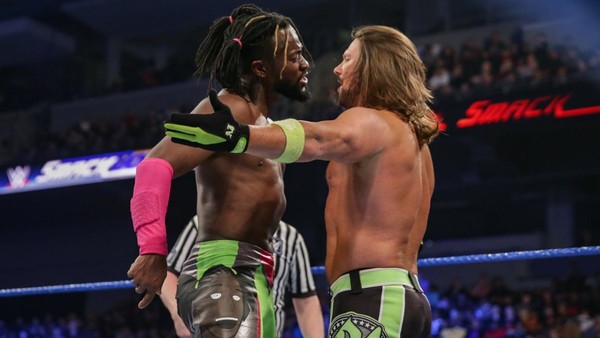
Kofi Kingston was already over - fans would not have cast him in the role of WWE Heavyweight Title challenger if they didn't give a sh*t about him - but there are levels to this.
Trust the genius of Stone Cold Steve Austin to deliver the perfect wording. In describing Seth Rollins' struggles to adjust to the babyface role, he said that Rollins wasn't "all the way over". Rollins fell somewhere between popular and unmissable. As did Kofi before his awesome exploits in that first, inspired Gauntlet match of February 12, 2019.
It was inspired because it doubled as a test of Kofi's credentials and a conditioning exercise to the audience. They needed to see him navigate the epic to truly take him seriously as a main event-level star. His transitioning from 12-minute tags to a WrestleMania-sized match against a Daniel Bryan in career form without this match may have been difficult to accept, but this acted as an abridged version of a committed, sustained push - ideal, really, given how WWE struggles with precisely that.
Kingston showed a range of selling ability and in the best moment fired up with profound conviction in the face of AJ Styles - shedding the remnants of his midcard New Day persona with clinical timing.