10 Wrestling Ripoffs Better Than The Original
These WWE ripoffs were 100% better than what came before. Inspiration? Nah, IMPROVEMENT.

Some wrestling ripoffs are downright weird, whereas others are downright terrible. The Renegade was a poor man's Ultimate Warrior who did nothing to distance WCW from 'WWF lite' claims in the mid-1990s, for example. Other rips, like Eric Young playing the role of TNA's Daniel Bryan and Asya mimicking Chyna (again in WCW), outright sucked too. Not every knock off is a wonky misfire though.
There are WWE ripoffs that actually bettered what came before. No, seriously. It's true. It's damn true.
All of the ones featured here improved on earlier prototypes. Several crossed over from one company to another, but many took place just a few years apart in the same promotion. Workers laid the groundwork for a successful character, then somebody else came along and pilfered what they liked most about it. The cheeky rascals! Those wrestlers then built upon the solid foundations to bag themselves some healthy TV time.
5 of the 10 included even turned their careers around to become WWE World Champions by rather blatantly erm...borrowing what had already happened. It was sneaky genius, being honest, and it's hardly like fans selling out arenas or buying merch by the truckload were bothered that their firm favourites or most hated heels could be considered retreads - they were far too busy enjoying themselves to notice and/or care.
They were still ripoffs. That can't be denied. Such "inspiration" isn't restricted to the roster itself either. Former members of WWE's upper management have nabbed from elsewhere to create better content on their own shows. Eagle eyes, sharp minds and those who tout controversy creating cash will know exactly what that's referring to.
10. Damien Sandow (The Genius)

Anyone who has ever caught some shoot interview footage starring Lanny Poffo could tell you that Randy Savage's sibling was a unique dude. Sometimes, it seemed like Lanny was still working interviewers just because he could, and it was clear he carried a cerebral quality that actually made him seem zany. Poffo was obviously a pretty intelligent fellow, so the Genius character he played on TV wasn't a stretch.
It was, however, less-than compared to Damien Sandow's own 'Intellectual Saviour Of The (Unwashed) Masses'. Sandow took the Genius blueprint as his own in 2011, honed it in WWE developmental, then brought it to the main roster in 2012. He was verbose in vignettes and delighted in ridiculing those who followed standard pop culture rather than educating themselves like he had.
Sure, Sandow was a stereotypically snooty pro wrestling heel, but he rode The Genius 2.0 thing all the way to the top of the WWE cards. Or...nearly to the top of WWE cards. Damien won Money In The Bank in 2013, and that seemed like his ticket to permanent main event status. Not quite. WWE bizarrely got cold feet on pushing Sandow, jobbed him out, then he tumbled back down the pecking order.
Despite that setback, he definitely improved on the formula Poffo had engineered with his poetical Genius guise in the WWF's late-80s and early-90s. Fans treated Sandow like a major star until his own company harpooned the push. Aesthetically, Damien and Lanny even sort of looked the same, which gave his 'Intellectual Saviour' gimmick a pleasing retro air.
What could've been, eh?
9. The Godfather (Flash Funk)

Honesty time: This writer adored the Flash Funk character as a kid in the mid-to-late-90s. He danced his way to the ring, seemed to be having the time of his life any time he appeared on screen, and he did flashy moves aplenty during his matches. What wasn't to like? Then, after growing up a bit, this same fan was stunned to learn that Funk was supposed to be a pimp.
The penny dropped. Of course he was. It was there for all to see, but the loudest words went unspoken on the still-family friendly WWF. Things had changed come the advent of the 'Attitude Era' later that same decade. The Godfather successfully pivoted from Nation Of Domination heavy to standalone, fun-loving party animal. The company were a little more forthcoming about his vocation, shall we say.
Godfather referred to himself as a "Pimp Daddy", and he was ridiculously over as a midcard act. Funk had been flashier in-ring, but he couldn't hold a candle to Godfather's connection with fans or his abilities on the live mic. Promos were laden with catchphrases a-go-go, and fans gobbled that up before settling down for the match at hand.
The Godfather was like Flash Funk without training wheels.
Naturally, this was all risqué, but that was commonplace during the peak of 'Attitude' sensibilities. Godfather's popularity endured right into the PG days, so much so that he was occasionally brought back as a Royal Rumble cameo artist. WWE didn't shout loudly about what he did for a living once ratings certificates changed though.
8. Charlie Haas (Big Show)

No, nobody's suggesting that Charlie Haas was a wrestling giant who flipped between heel and babyface more times than people flipped their pancakes on Shrove Tuesday. Haas did find fame by trading his functional technician role for something a little more off the wall in mid-2008, however, and that must've been at least partly inspired by Big Show's own impersonation-heavy gimmick from 2000.
Back then, Show dressed up as everyone from Hulk Hogan ("Showster") to Rikishi ("Showkishi") for comedy skits and matches. It was a riot, so it was surely only a matter of time before WWE would try it on again with somebody else. Haas was the least likely candidate, but he smashed the gig by working send ups of JBL, Steve Austin, Carlito, Bret Hart, The Great Khali and countless others.
Charlie also achieved something few thought he could: He bettered Show's Hogan impersonator bit by doing a stupidly great impression of Hulk. Live crowds roared with approval, and Haas's cosplay act was cleverly never treated as anything more than a midcard distraction from the more serious stuff. It showed that Charlie had charisma and personality too, which is something that had been levied against him throughout most of his career up until that point.
The impressionist thing was never going to last forever, but Haas made the most of it. He was a way more entertaining Halloween gag than Show had been years before. This was an increasingly rare example of WWE comedy flying in front of fans as well as with those camped out behind the curtain.
7. Sin Cara II (Sin Cara)
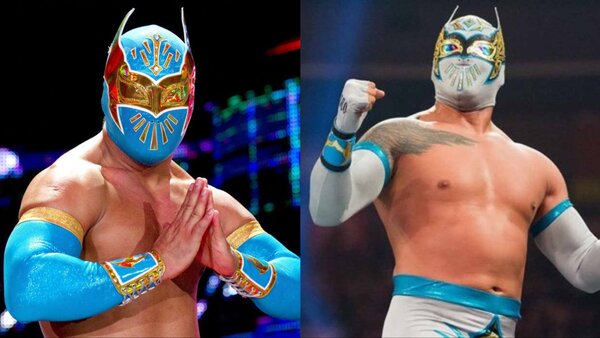
Does Sin Cara II count as a ripoff? Maybe/maybe not, but it's true that Hunico/Jorge Arias fared better than his counterpart Luis Alvirde had under the mask. Alvirde, otherwise known as Mistico, carried huge hype when he signed on the dotted line with WWE in 2011. Hopes he'd become the next version of Rey Mysterio were dashed quickly when the re-dubbed Sin Cara failed to fit into WWE's way of doing things.
He was gone by 2014, and Arias was theoretically saddled with a dying gimmick. Then, something wonderful happened. Sin Cara II found his place on the product by forming a fun tag-team with Kalisto. Together, as The Lucha Dragons, the pair showed terrific chemistry together on NXT. WWE management was impressed enough to call them up to the main roster after that.
The Cara character sustained until 2019. That's when Arias left the promotion after requesting his own release from contract. He could hold his head high, because he'd rescued a seemingly dead duck persona five years prior. Sin Cara never hit the heights expected of it in WWE, but the second "ripoff" version was a vast improvement on the clumsy and nervy original, and it'd still fit in on WWE's roster today.
It's hard to picture Alvirde lasting up until 2019 under the gimmick had he stayed put. Mistico argued that WWE chiefs wouldn't let him wrestle the same style he had back home in Mexico, but it's no stretch to say he flopped on the bigger worldwide stage. Sin Cara II, meanwhile, was never less than watchable in-ring.
6. Bray Wyatt (Waylon Mercy)

A quick glance at Waylon Mercy and Bray Wyatt side by side above reveals that they were both inspired by the Max Cady character from Cape Fear. The Hawaiian shirt is a dead giveaway, but there was more to it than that. As Mercy, journeyman pro Dan Spivey told fans, "Lives are gonna be in Waylon Mercy's hands". Sound familiar? Bray Wyatt's memorable ditty claimed, "He's got the whole world in his hands".
Both characters spoke in a hushed, almost-gentlemanly manner too. Bray had to take inspiration from Jake Roberts for that, but Mercy too. Fittingly, one of the characters from his future 'Fiend' expansion shared a name with Waylon. "Mercy The Buzzard". None of this could be coincidence - Wyatt was gently ripping off something that had been too far ahead of its time in the mid-90s.
Waylon was a black sheep kind of character on the roster back then, and that made it challenging for fans to get a grip on what he was going for. By 2012, WWE viewers were a little more in-step with what Bray was trying to do. He mixed elements of Roberts, Mercy, then Mick Foley's Mankind and Cactus Jack characters with his own God-tier creativity.
There's no doubting Wyatt's success compared to Waylon's. Bray became WWE Champion (although arguably at the wrong time) and was cherished as a creative force right up until his untimely passing in August 2023. That death shocked the industry to its very core. Bray is gone but not forgotten. He improved on the framework set by Spivey a few decades before Husky Harris turned into Wyatt.
Run.
5. Kurt Angle (The Patriot)
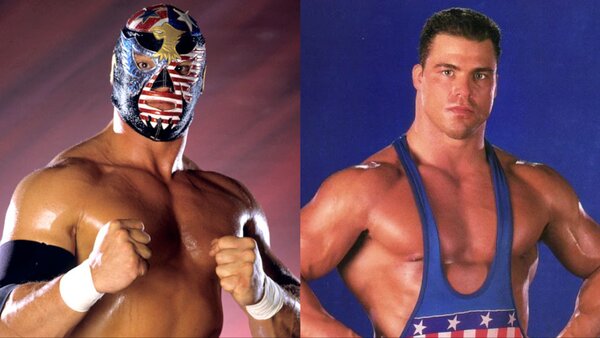
Kurt Angle wasn't the only wrestler to borrow/steal a lot from The Patriot. Hulk Hogan even did it when weaving his super-weird Mr. America character into WWE's product in 2003. That wasn't too successful. The same cannot be said for Angle's 'American Hero' persona. It resonated with fans, albeit initially as a detestable heel who was forcing patriotism down their throats.
Del Wilkes used a familiar tune as entrance music too. The Patriot's version was a little more Christmassy than Kurt's would end up being, but 'Medal' remains one of the most iconic tracks in company history to this day. Everybody knows who's coming through the curtain when it starts playing. No, it isn't The Patriot. It's Angle, and he's here to remind everyone he "won a gold medal with a broken freakin' neck".
'Medal' became something truly special once fans took ownership of it by chanting, "YOU SUCK!" in time with the beat. Edge encouraged that little singalong, then Angle embraced it once he'd turned babyface. For some reason, audiences still chanted that he sucked, and it worked. Figure that one out!
In many ways, Angle's 'American Hero' gimmick was a heel retread of something Vince McMahon had tried with babyface Patriot in 1997. The company put a neat spin on the idea, and it worked a treat. Kurt was an even more forced version of Wilkes without the mask, basically. He understood his role perfectly, and he turned both patriotism and a humble piece of entrance music into a Hall Of Fame career.
All together now. "YOU SUCK! YOU SUCK! YOU SUCK!".
4. Mr. McMahon (Eric Bischoff)
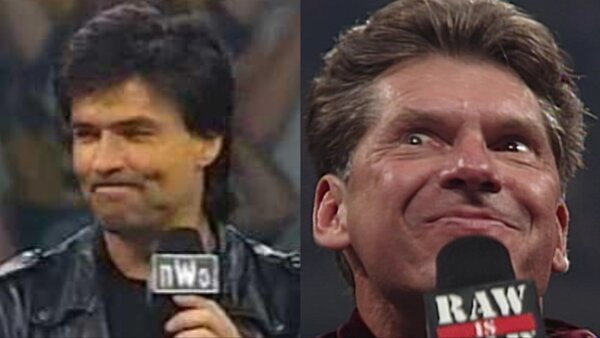
This one could be considered controversial, but then Eric Bischoff has always claimed that controversy creates cash. Here, it creates intrigue, because Bisch beat Vince McMahon to the punch when crafting an evil owner gimmick onscreen. Eric turned heel and shockingly joined the nWo in late-1996. By then, he was outed as a power player in WCW's hierarchy, so the villainous faction suddenly held huge sway behind the scenes.
Post-Montreal Screwjob in late-1997, McMahon decided to turn real-life drama into promotional dollars by becoming the evil Mr. McMahon character. This gave new blockbuster star Steve Austin an excellent enemy to bounce off of, and it helped turn WWF business around for the better. It might've been accidental, but McMahon was ripping off something Bischoff had already done over on WCW's side.
He was pretty much the same evil boss who undermined heroes and went above and beyond to be a tyrant.
This is a parallel Eric has drawn before on his '83 Weeks' podcast, but even he'd relent that Vince improved on the formula over time. Bischoff was great with a mic in his hands, sure. McMahon was better. It's really as simple as that. Vince perfected the evil owner/authority figure role, so much so that numerous names that followed the same path couldn't deliver the way he had.
It's rather interesting to imagine that Bischoff got their first before the WWF's braintrust did. He knew that playing the smug, borderline untouchable boss would garner tremendous amounts of heat. Then, McMahon came along and bettered it on the other channel.
3. Goldust (Adrian Street)
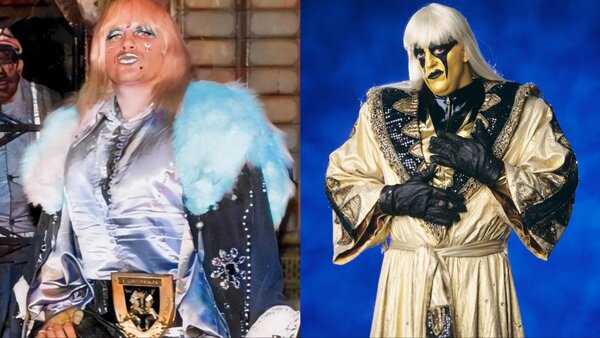
There was a splash of the 'Adorable' Adrian Adonis character about Goldust too, but Dustin Rhodes was surely inspired most by the work of UK wrestler Adrian Street. His flamboyant and androgynous gimmick was a smash hit in the 1970s and 80s. Of course, Street had lifted a lot from Gorgeous George (that character set the blueprint for flamboyance in pro wrestling) when looking to turn heads and elicit strong heat from fans.
Rhodes debuted the Goldust persona when he signed for the WWF in 1995. Not many knew what to make of it at first, and aspects of the heat generated do rank as a sad commentary on attitudes towards homosexuality. Eventually, the company downplayed that side of the gimmick by describing Goldust as more of a walking, talking shock artist who'd do anything to get attention and throw opponents off their game.
Famously, Street had posed for photographs with his father and colleagues at an old mine in Wales. The contrast between his garish colours, make up and image compared to their dirt-covered overalls and faces was striking. What's more, the look on their faces as Adrian did his best duck face for the cameras was something to behold.
Goldust upped the ante further. There were hiccups along the way ('The Artist Formerly Known As' days, for example), but Dustin managed to turn the character into an industry icon. He squeezed an impressive number of years out of something that easily could've been one note or bombed because it was too elaborate.
Goldy was an even more controversial Street, which is really saying something. Rhodes is still going strong on AEW's roster today.
2. Ric Flair (‘Nature Boy’ Buddy Rogers)
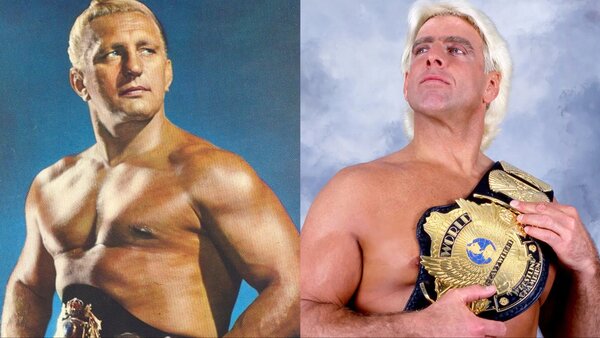
Everything from Ric Flair's figure four finish to the 'Nature Boy' nickname and even the aloof poise when posing for promo pics was lifted from Buddy Rogers. Flair had started using the 'Nature Boy' moniker in the mid-1970s, then feuded with Rogers before beating him to officially earn the tag in 1978. In short, Buddy agreed to pass the torch to a new emerging star, and Flair was off to the races.
He'd become an even better 'Nature Boy' in almost every conceivable way. A bevy of World Championships in groups like the NWA, WCW and the WWF followed. Flair tropes like his trademark "Woo", the "Flair Flop" and his loudmouth promo style became fast favourites with fans buying tickets. Between the ropes, Ric carved out a legacy for himself as one of the best professional wrestlers on the planet. If he was still in his prime today, then he'd surely be considered one of the best wrestlers in the world right now.
Flair patterned himself after Rogers. He bleached his hair blonde, wore similar ring attire, used a lot of the same moves Buddy had deployed during matches, and generally turned into the same 'Nature Boy' he'd enjoyed as a fan. Except he wasn't the same. Ric was better and left more of an imprint on the industry than his predecessor.
He arguably couldn't have done that without Buddy's blessing. Several other wrestlers used the 'Nature Boy' name, including Buddy Landel and Paul Lee, but none of them came close to matching what Flair achieved in the biz as a successor to Rogers.
1. Hulk Hogan (‘Superstar’ Billy Graham)
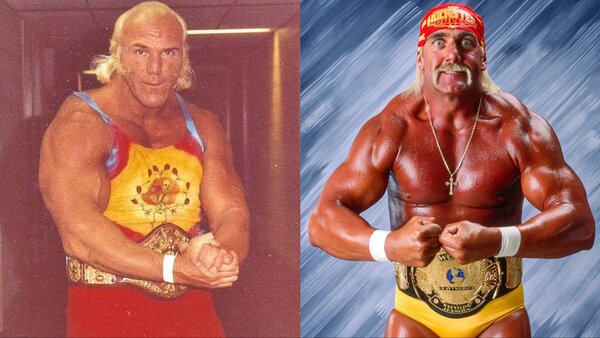
Both Hulk Hogan's red and yellow and nWo Hollywood variants owed a ton to 'Superstar' Billy Graham's body of work. Graham was larger than life in terms of physique and interview style. His promos were colourful rather than informative, and his bulging biceps stood out as some of the best peaks in the entire industry during his prime. A young Hulkster was watching from afar, and he was taking mental notes.
Soon, he'd claim Billy's throne as his own.
Hogan's early heel work played Graham's hits, but that didn't stop just because he'd turned into the biggest babyface in the WWF throughout the 80s. When Hulkamania surfaced, so did many of the tropes Hulk had watched 'Superstar' perform; they were just tweaked to be more appealing rather than aggravating. His own promo style was OTT and relied on grandiose promises laced with catchphrases over actual substance, and there's no denying that Hogan's physique was one of his main drawing powers.
Later, once he'd gone rogue in WCW and formed the New World Order, Hollywood Hogan reeked of Graham's overt heel swagger. If anything, he grew even closer to prime 'Superstar' than he had during the Hulkamania days. Hogan revelled in the chance to do his best Billy, and he knew he could push the envelope a little more now he was a despicable villain on Nitro.
It says everything for the range Graham had that Hulk was able to work effectively the same gimmick whether babyface or heel.
What other wrestling ripoffs were actually better than the originals that inspired them? For more WWE, check out 50 Fascinating Facts About WWE in The 1980s and 7 New Directions For WWE After Elimination Chamber 2025!