8 Most Powerful Backstage Politicians In Wrestling History
It’s all about the Game.

The general rule of wrestling politics is: you can only play the game if you’re a top star, and in a brand-dominated game, there are very few of those left.
These days especially, if you’re a known, egomaniacal malcontent, WWE won’t look at you. There are plenty of wrestlers desperate to join the Fed and pursue their dreams of winning World titles and headlining WrestleMania - even if, in the case of Mariah May/Blake Monroe, you are already pushed heavily by a major league, well-paying outfit capable of promoting its own shows in a stadium setting. You can challenge WWE’s booking. You can be passive aggressive and moan about your place on the card in a podcast setting. But you can no longer be what is known in wrestling circles as a “sh*t disturber”.
Consider CM Punk in the context of Paul Levesque’s WWE. Punk placed a pipebomb under the bridge in AEW, setting it ablaze, which might account for his current disposition. The new CM Punk must be careful. The new CM Punk was actually prepared to read from a script, like everybody else on the roster, before Levesque told him not to bother. The new CM Punk said upon returning to WWE in 2023 that he’d changed - a sharp and sad pivot from his legendary 2011 promo. The new CM Punk will happily apologise to the nation of Saudi Arabia ahead of a PLE.
The new CM Punk can’t really play politics. Somebody far more powerful has already won the Game.
Politicking very obviously still happens, albeit on a much smaller scale - but the stars of today can’t compete with the cutthroat monsters of old…
8. Shawn Michaels

Vince McMahon loved Shawn Michaels. Even though this demonstrably was not the case - Michaels was a poor draw as World champion, and many adult males in the audience were not fans - Vince, on commentary, would sell for Shawn’s entrance as if it was Beatlemania.
Shawn Michaels knew how much Vince McMahon loved him, and what he was thus able to get away with. And that, generally, was everything.
If Shawn and his enablers in the powerful backstage faction the Kliq deemed a certain talent a dud - or competition for their spots, which of course they’d never let on - they were demoted or all but gone. Shawn, infamously, had a predilection for losing titles without losing in the ring. He used his sway to bury Vader, via mid-match tantrum, and the ‘Mastadon’ was never again treated as a true main event-level concern.
Shawn’s influence was such that he effectively berated Vince into launching the Attitude Era. His influence was so toxic that he managed to reverse the intended outcome of One Night Only 1997, resulting in a brutal home country loss for Davey Boy Smith, even though he had promised to win in honour of his dying sister. Shawn Michaels even tanked a WrestleMania main event, when few took his apparent knee injury too seriously, and Vince cast him as a departing hero deserving of our deepest sympathy. Shawn came out top in the Bret Hart Vs. Shawn Michaels rivalry by gradually eroding Bret's worth in Vince's eyes.
Shawn was less successful in convincing Vince McMahon to ignore the talents of the Rock - but he tried.
Small pond stuff, you could argue - Shawn was at large when the WWF was low on star power - but you can only beat the competition in front of you…
7. Stone Cold Steve Austin

Ol' Stone Cold knew how good he was, and used this as leverage to hold onto his spot.
Steve Austin was the closest thing to Hulk Hogan in terms of drawing power, but wasn’t quite the same as a politician. He knew the value of a great, different, hard-working match. He also recognised how important it was to work alongside a great rival. The thing is, if Austin did not consider a certain rival great, they were f*cked.
Austin flatly refused to work a main event programme opposite Marc Mero in 1998. Sable - whom Austin dismissively referred to as a “chick” in an interview with Michael Landsberg - had struck Mero with a powerbomb. Austin didn’t want to take a heat segment from a guy who got beat up by a woman. It was shrewd, if a little harsh, since Mero did a lot for Austin in their stellar King of the Ring 1996 semi-final - but that’s the game.
Austin did the same thing to Jeff Jarrett, who buried Austin’s penchant for sacrilege in a worked-shoot promo. The dispute was informed by Jerry Jarrett’s treatment of an emerging Austin in Memphis. “Keep staring at that cheque, it ain’t gonna get any bigger,” is what Jerry is alleged to have remarked to Austin. Austin tasted in his mouth the potatoes he could only afford to eat when Vince Russo pitched that series. Russo never saw Austin as furious as he did that day.
Austin wasn’t convinced of Triple H’s star power in 1999, even if it wouldn’t take the Game too much longer to make it, agreeing only to drop the WWF title to transitional champion Mankind in a Triple Threat match at SummerSlam.
Austin wasn’t as antagonistic and insecure as his contemporaries in the field of pro wrestling politics, but he was paranoid about his spot - enough, according to Bruce Prichard, to loudly question why the Rock was out there singing nursery rhymes he called promos.
6. Antonio Inoki

In an incredible quirk of fate, New Japan Pro Wrestling founder Antonio Inoki and All Japan Pro Wrestling founder Giant Baba both made their debut on the same day: September 30, 1960. Before creating the respective groups in 1972, they wrestled for the Japan Pro Wrestling Alliance before the promotion tumbled into disarray.
Inoki was an early political rival of Baba, whose incredible size propelled him to the top in a trajectory unlike the typical Japanese novice. Inoki saw his future and decided it looked too bleak. Eventually, after returning to the JWA, Inoki formed a team with Baba, which very nearly extended beyond the ring: in a failed joint coup, Inoki was fired for attempting to overthrow the existing management structure (Baba, a major star, was convinced to stay before the whole enterprise fell apart).
Inoki was significantly more successful at the game when at the helm of Shin Nihon. That’s because he was able to get away with it; he owned and operated the company, and justified his top spot. It was said, at the time of his death on October 1, 2022, that Inoki was essentially Vince McMahon and Hulk Hogan combined. Inoki was a household name, and felt within his rights to win constantly throughout NJPW’s early years. He only lost in the most lousy and anticlimactic finishes. There’s an old cliché of movie dialogue: “If you want to take this from me, you’ll have to kill me”.
This was almost true of Inoki’s spot; in 1983, he only lost definitively to Hulk Hogan after an Ax Bomber removed him from the apron and the resulting bump knocked him unconscious.
Politics is a shadowy game, one that consequently spawns profound mistrust and, eventually, conspiracy theories. Inoki was the subject of much suspicion when, after funneling money from live gates into his failing Anton Hisel bio-tech supplement company, he was apparently “voted back in” under dubious circumstances after resigning as company president in 1983.
Beyond the usual power grabs and such, Inoki was an actual, shoot politician - he represented the now-defunct Sports and Peace Party in the House of Councillors between 1989 and 1995 - and managed to strike up diplomatic relations with, of all nations, North Korea.
5. Jerry Jarrett

The architect of modern episodic pro wrestling television and a major-drawing wrestler in his own right, Jerry Jarrett was one of the most intelligent and successful bookers ever; under his pen, Memphis throughout much of the 1970s and 1980s was the U.S. city that drew the most fans on a weekly basis.
Of course he knew his way around the political landscape.
According to Memphis wrestling folklore, Jarrett was part of a crime in which Jack Donovan was violently punished for refusing to screw over promoter John Cazana. Donovan refused to press charges against Jarrett (and Jackie Fargo and Tojo Yamamoto) in fear of getting blackballed. Jerry refused to ever talk about it.
In addition to very dirty old-world politics, the sort of the sh*t that’ll get your head split open if you’re not careful, Jarrett had a knack for the usual: almost as soon as he got the book, he positioned himself on top at the expense of leading star Dennis Hall.
To younger readers, Jarrett, in selected ways, wasn’t too dissimilar to Paul Levesque (although Jarrett would no doubt consider Levesque’s television shows tedious in the extreme). He booked himself on top and made bold moves at a very early age.
In a totally brazen power grab, Jarrett formed a competing promotion to Nick Gulas, the Continental Wrestling Association, convincing the NWA to side with him in the process. That is politicking on a near-unprecedented scale; the fabled “new party”, only it actually happened. Mapping the origins of pro wrestling TV as full-on soap opera, it was extraordinarily successful
“Politician” is to many a synonym of “liar”. When Mike Tenay first negotiated with Jerry Jarrett about coming into TNA, he wanted assurances that Vince Russo had nothing to do with the nascent outfit. He’d heard the rumours. Tenay was told that Russo was not involved (he was). Tenay was only made aware when he was easing into the role. Jarrett did tell Tenay that he could leave with no ill feeling, but he knew what he was doing with the timing.
4. Paul Heyman

Paul Heyman won in the end.
Older fans probably have difficulty reconciling it, but Paul Heyman outlasted Vince McMahon as a creative force in WWE.
Heyman was a seven-star backstabber, as manipulative as anybody in wrestling ever - and if a good politician is able to inspire cult-level devotion from their followers, Heyman was a brilliant politician. He was able to convince several wrestlers that they were idols in a fabled scene with the power to change the very world - and not drastically underpaid, if they were lucky enough to even cash the cheque.
He was an incredible campaigner, too, if you believe pro wrestling apocrypha: Heyman is alleged to have written to various newsletters under pseudonyms and using burner accounts to defend or endorse Extreme Championship Wrestling as a “fan”.
Politicians are often accused of barely doing anything, and letting other people do the hard work as they’re thrown “under the bus”; Heyman was accused of asking Tommy Dreamer to hold meetings with potential sponsors as ECW died a slow death in early 2001. At the exact same time, Heyman was making plans to defect to another party (WWE).
Politicians also accuse their peers of “playing politics” while indulging in the exact same behaviour themselves; Heyman was an expert at this, casting the WWF and WCW as villains on the same TV product on which he buried them to depict ECW as a counterculture revolution.
Heyman was, initially, poor at the game when making the move to WWE. He was twice ousted by Vince McMahon (in 2002 and 2006) after challenging his ideas with zero in the way of dark arts tact.
But then, Heyman did what the most successful politicians do: he joined up with powerful allies in Brock Lesnar and Paul Heyman, partnerships that allowed him into the big picture creative process.
Heyman is now an invaluable part of WWE’s creative process.
3. The Fabulous Moolah

It’s here where the key word “powerful” takes on its most literal - and sinister - definition.
The Fabulous Moolah was not merely a starring pro wrestler with the attendant leverage the spot affords - leverage that many talents use to placate their own skyscraper-sized egos and graphene-thin skin.
In an ultra-bleak irony, Moolah once went by the ring name ‘Slave Girl Moolah’. What we know about her life and career renders this quite possibly the most disgusting persona in the history of the industry. The audacity of that, Jesus.
Between the 1950s and 1980s, Moolah ran Girls Wrestling Enterprises: a booking office that controlled the fate of virtually every women’s wrestler of the era. Moolah held the recognised women’s title at virtually all times, at the expense of every one of her supposed proteges. Moolah trained them personally and loaned them across the United States territory loop. The women who turned up for a shot at stardom were very young and even more vulnerable.
It was well-known in wrestling circles that Moolah would take a mammoth cut from their cheque. A ruthless hunger for money and status was compounded by the fact that there was nowhere else for the aspiring women’s wrestler to earn. Moolah held a monopoly over women’s wrestling as, in parallel, the men enjoyed the relative freedom of the territory system.
Of course, those in the know knew what else was going on, but the extent of it was only exposed years after Moolah retreated from public life. Accomplished heel Penny Banner directly told author Pat Laprade that Moolah was a “pimp” who would get paid for renting out her trainees to promoters for sexual favours. Those who refused, Banner continued, were raped. The daughter of Sweet Georgia Brown alleged that Moolah and her then-husband Buddy Lee raped and drugged her mother in a bid to control her.
The fact that Moolah (as the Spider Lady) played an instrumental role in the ‘Original Screwjob’ - by holding Wendi Richter’s tights during an unplanned fast count - is quaint small-fry wrestling bullsh*t compared to her actual abuses of power.
2. Hulk Hogan

Hulk Hogan was a scizzarecrow: outstanding in the field of carny pro wrestling politics.
Unlike Triple H, who as the tippy-top star in the early 2000s presided over an enterprise in commercial decline, the “boys” loved working the same shows as Hogan. Their cheques were never bigger, and, during an era in which the World title barely changed hands, they were grateful for his presence. Even Bret Hart was a Hulkster of sorts throughout the 1980s.
Hogan developed his toxic reputation a decade later, starting the 1990s as he meant to go on. At WrestleMania 6, he was asked to pass the torch to the Ultimate Warrior. The match was actually very good by the standards of the time, but Hogan knew what he was doing at the finish. He kicked out at 3.1 and threw his hands up towards the sky, hysterically, as if to question God himself for the result. Hogan technically did the job, but framed it as a cruel trick of fate as opposed to a decisive loss he had to accept. A year later, with his star power on the wane and threatened by emerging, heavily-pushed rivals, he tried to destroy the confidence of the Undertaker. Hogan claimed Taker had hurt his neck during the Tombstone onto a steel chair with which ‘Taker took the belt from him.
Hulkamania ran wild in the WWF. In WCW, emboldened by the creative control clause inserted into his contract, Terry Bollea’s ego ran wild.
Hogan displaced Ric Flair as the company’s top star in record, immediate time; thought nothing of casting Flair as one of eight men he defeated in a single match to cling desperately onto his babyface run; allegedly implied to referee Nick Patrick that he shouldn’t count fast when Hogan was to pin Sting in the reversed finish of Starrcade 1997…
Hogan was a ruthless narcissist who, you could argue, politicked a company out of business to satisfy his ego.
1 - Triple H
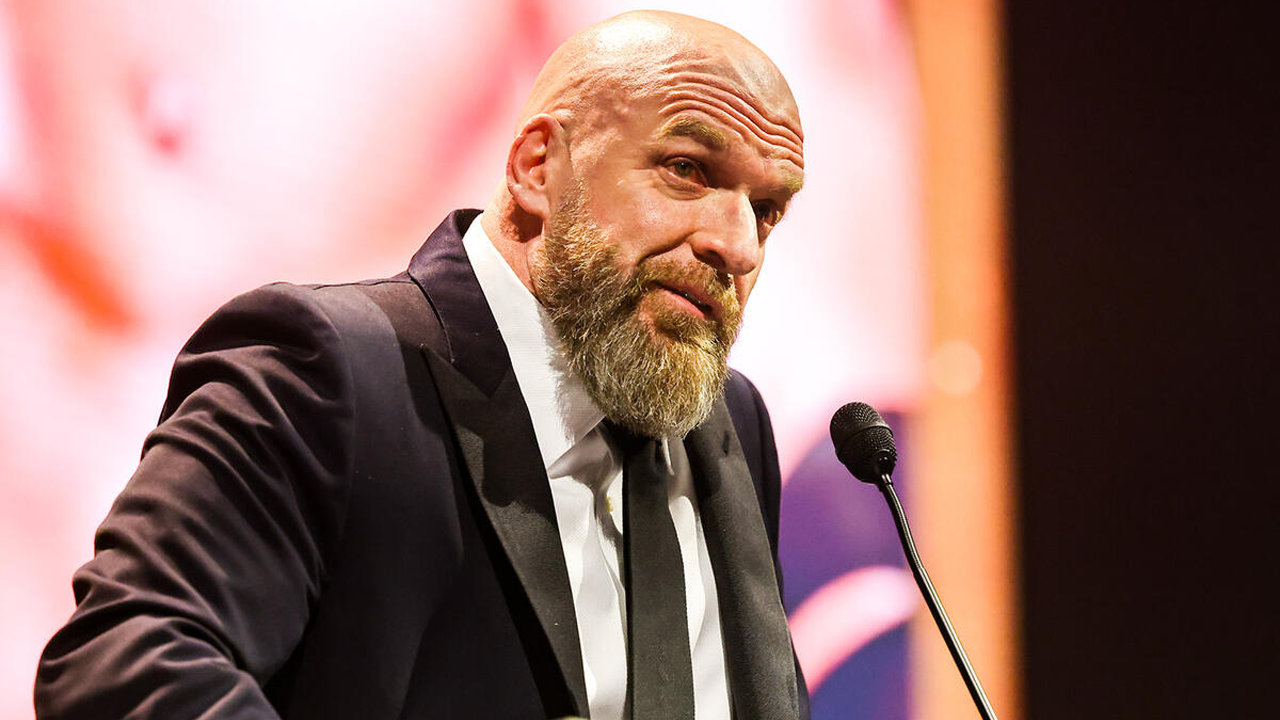
The most ruthless and successful politician in pro wrestling history, Triple H, if you believe the story in Matthew Randazzo V’s ‘Ring of Hell’, signalled his intentions to eventually take over WWE on his very first day.
Triple H, insofar as the creative goes at least, took over WWE in 2022.
His decades-long campaign was ballsy, you have to give him that, since the extent to which he was boring, barely-over wrestler can never be overstated. As early as mid-to-late 1997, Triple H, emboldened by his friendship with Shawn Michaels - who at least had the talent to justify his demands - started making moves.
He was clever about it, pacing his ascent with far more care and thought than he laid out his interminable WrestleMania matches. He started by chiding Bret Hart’s professionalism (!), when the Hitman (as was expected) arrived late to a house show in early 1997. By the end of the year, Triple H - who was only just getting somewhat over with a key pass from Cactus Jack - pitched the Montreal Screwjob.
When he started dating Stephanie McMahon, and magically drifting into production meetings, that’s when his true rise - and perhaps coincidentally, WWE’s creative decline - began. In late 2000, Triple H allegedly used his influence to kill off the love triangle story between himself, Steph, and Kurt Angle. Why would Steph choose Angle, when she’s already banging such a hot stud?
And why wouldn’t Triple H later reign with the World Heavyweight title throughout the early-to-mid 2000s? He was the modern-day Ric Flair!
Triple H was halfway subtle about it, on occasion. As an example, he lost a trilogy 2-1 to Brock Lesnar across 2012 and 2013. You can’t strictly say that he didn’t put Lesnar over, but Triple H got the win at WrestleMania. Which event does WWE put over, above all else, as the most significant and memorable occasion in the entire industry, the event that truly counts?
The answer to that is: not Extreme Rules.
There’s also his match structures to consider here. His politicking was sometimes subliminal, sometimes bold-faced. At Night of Champions 2011, Triple H defeated CM Punk, with the excessive interference scanning as an excuse - but Triple H, the heel, actually scored a visual pin. That’s a spot designed to protect a babyface, who should have won fairly, before the heel cheats to win. It wasn’t on September 18. When he took a pin from Jeff Hardy, he shrugged towards the hard camera, as if to say “Hey, it happens. Even I get beat, guys - even by much smaller wrestlers, like Jeff here!”
There was always something with Triple H in a losing effort. Only on very rare occasions did it feel 100% definitive. He played several tricks, some barely noticeable, to position himself strongly. Some were despicably noticeable; taking 23 seconds to pin Booker T at WrestleMania 19 remains the most egregious use of power in in-ring history.
Mostly, Triple H was as subtle as his dumbass sledgehammer. On occasion, during the 2000s, he seemed to flaunt his power because he could, using his vast influence to annihilate both members of a tag team at once. His influence even spanned the breadth of the multimedia landscape; it was instructed to the video game press in 2008 not to show Triple H’s avatar “in a defenceless or vulnerable position”.
As a corporate executive, Triple H was diamond-sharp, too. Remember that speech to the Undertaker, ahead of WrestleMania 27, when he said they had to wrestle one another because neither man “had any challenges left in the back”?
That was more likely than not a scathing indictment of the developmental system as overseen by John Laurinaitis. Guess who seized control of the programme that very year?
Triple H, now that he’s the king, is also very insistent on telling you who’s the king, portraying himself as the great auteur of this WWE “cinema” era.