The Secret History Of WWE’s Ruthless Aggression Era | Wrestling Timelines
March 1, 2003 - Paul Heyman Is Removed As SmackDown Booker
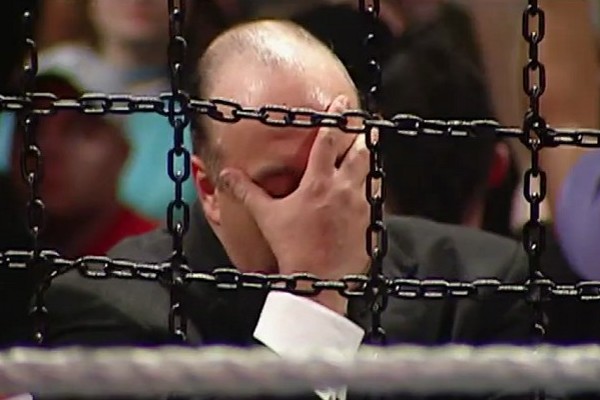
Paul Heyman’s SmackDown was incredible in 2002; f*ck Vince McMahon for ruining it.
The narrative painted by hardcore fans is always going to favour the Hall of Famer; he was responsible for the beloved and much-missed Extreme Championship Wrestling, and he pushes their favourite wrestlers, like Chris Benoit, Kurt Angle, Rey Mysterio and Eddie Guerrero. They, alongside Edge and Chavo Guerrero, comprise the ‘SmackDown Six’. Heyman doesn’t get to where he is by being stupid, though. He knows that he has to book some slop to appease Vince McMahon. Heyman almost tasks himself to “get away with” genuinely exciting, fan-friendly in-ring action. The terrible material elsewhere on SmackDown almost acts as a distraction.
This delicate balancing act, resulting in a wildly uneven TV show, is best exemplified by the November 7, 2002 episode. A terrible feud develops between Matt Hardy and Shannon Moore; here, Moore offends Hardy by mistakenly putting sugar in his coffee. Stephanie McMahon lingers over replays of a kiss she recently shared with Eric Bischoff.
In a chapter of an infamously awful storyline, the elderly Al Wilson, father of Torrie, tells Dawn Marie that she has made him feel virile and sexy all over again. He proposes marriage, threatening to kill himself if denied. Dawn accepts.
The idea that poor, browbeaten genius Paul Heyman is responsible for everything good on SmackDown is slightly exaggerated. It’s a convenient means with which to blame Vince McMahon. Rikishi is floundering. Heyman’s “accentuate the positives, hide the negatives” approach is deserting him. In 1995, Heyman would have packaged Rikishi effectively. In 2002, his catchphrase is ‘Piece of the ‘Kish’.
The main event, typical of the day, borders on the phenomenal. Kurt Angle and Chris Benoit drop the Tag Team titles to Edge and Rey Mysterio in a Two out of Three Falls match. This is a sequel to a straight tag from No Mercy, which is the pulsating, electrifying, impossibly dramatic Match of the Year across any promotion. The return bout isn’t quite as good, but it’s still absolutely wonderful, wrestled to a level you can scarcely believe WWE permits. The crowd goes banana for it. It would be naive to believe that this emphasis on action is the key to another boom period - but this intoxicating upper midcard fare, combined with hot and bombastic main event programmes, is surely preferable to the crass, tripe, Attitude Era leftovers served up elsewhere.
The numbers seem to reflect this take.
Heyman’s gambit does not work. Well, it does and it doesn’t. Commercially, Heyman’s SmackDown - significantly more exciting and coherent than Raw, which outside of 1999 has never been worse - is, for a brief time, a relative ratings hit in a down period for the business. In 2001, SmackDown, despite holding the advantage of airing on network television, only defeated Raw twice. This was no hot streak, either; the victories occurred on the week beginning November 4, and then December 23. SmackDown did equalise on occasion. In 2002, under Heyman’s pen, a sense of real momentum gathered.
By September, when Heyman is settling in, SmackDown does something that has never happened consistently. The show equalises or outdraws Raw for four consecutive weeks between September 7 and October 3. There is no full-blown paradigm shift, but SmackDown does higher numbers than Raw, or runs it very close, until the end of the year. Raw wins the overall head-to-head ratings “war” in 2002, but reversing the stigma of SmackDown as the ‘B’ show is hugely impressive. That cannot be overstated. Politically, Heyman might be too successful for his own good.
As revealed by Wade Keller of the PW Torch, Heyman is demoted in March 2003. The days of the SmackDown Six are just that; Heyman barely lasts a full year.
The hardcore fans reckon that Vince McMahon is petulant, afraid of the competition he himself encouraged, and demotes Heyman because he can’t sanction the idea that somebody is booking WWE better than he is (even though Vince, obviously, exerts full editorial control).
On Heyman’s ‘Ladies And Gentlemen…’ documentary, released years later, Stephanie McMahon is evasive, alluding to issues with Heyman behind the scenes. Wade Keller reports at the time that the reasons cited for the firing are various, including but not limited to an inability on Heyman’s part to meet deadlines and work “efficiently” with others. Keller also reports that, according to several insiders, a more motivated Vince McMahon wants writers who will “listen to his vision” and “do their best to script it out”. Vince also does not want his lead writer to be upset about being overruled”. This is a glimpse into the historically volatile working relationship between Vince and Heyman. Heyman has every right to defend what demonstrably is a successful vision; at the same time, it’s Vince’s operation. The parallels between the Vince/Heyman and Laurinaitis/Cornette relationships are noticeable. Both hint towards the same theme: WWE will do things their way, even if it’s not particularly sensible.
In his book ‘Ring of Hell’, Matthew Randazzo V recounts the experience of former creative writer Dr. Ranjan Chhibber, whose story suggests that the plan all along was to take Heyman down in a coup. Chhibber alleges that Triple H - partner of Stephanie McMahon, who it is believed is a political enemy of Heyman - once sat him down. This, despite Paul Levesque not holding an official corporate job title. Levesque, per Chhibber, encourages him to turn on his ally Heyman. Heyman could not care less about you, Ranjan. Do you want to be associated with a failing team?
Heyman is replaced by Bruce Prichard, but continues on in a vaguely defined capacity as “consultant to both Raw and SmackDown”. He remains an onscreen talent.
His vision for SmackDown withers away. The soap opera writers hired by Stephanie McMahon proceed with an ugly, patently phony approach. Brian Gewirtz and Dave Lagana, known as painfully unfunny suck-up stooges, set the tone and culture of WWE creative.