WWE Goes PG | Moments That Changed Wrestling Forever
1. The Before
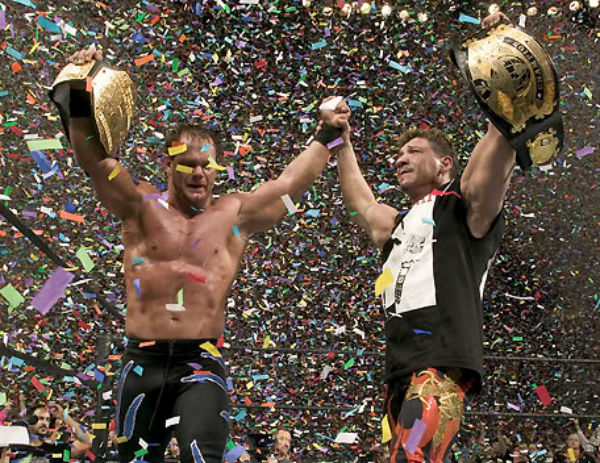
Before WWE attempted to start playing it safe, the product got far too needlessly dangerous for its own good.
Not creatively dangerous of course. That would imply that, post-2001 monopoly, risks were being taken with new wrestlers, new concepts and new ideas. Retroactively, the company did a good job of stapling a "Ruthless Aggression" label to this period of time, even though Vince McMahon only cut two promos about it, John Cena only said it once or twice, and then it was gone forever. Branding works though, and when assessing the era starting with McMahon bollocking his talents into magically becoming the next Rock and Stone Cold Steve Austin and the 2008 PG classification, Ruthless Aggression became the shorthand. And what a stupid shorthand it was. What was Ruthless or Aggressive, really, about those years?
Ruthless was running every competitor out of business, and that job was completed right as the Attitude Era came to a close. Aggressive was being willing to bury talents that worked elsewhere in an effort to promote your own, and that had been way more prevalent in the New Generation, of all timeframes. Squashing up-and-comers before they've even up or come? Marginalising women? Pretending to shag a corpse? This was just crass trash. The Crass Trash era might not have had as catchy a ring to it, but it would have at least been accurate.
Ultimately, before PG, WWE was just the Attitude Era-but-grosser. Again, not one that rolls of the tongue, but at least not some complete bollocks that doesn't tell the story. The mindset wasn't uncommon for promoters - McMahon and his cronies were chasing the commercial and critical highs of a time that wasn't long ago, but already felt like forever. There were some real cake-and-eat-it years at the turn of the century that found the company riding a mainstream wave despite some over-the-line content that worried advertisers and parents alike. Monday Night was a war zone, but Tuesday morning was where the damage was really felt. Kids flipping birds, telling teachers to "suck it" and jumping off their roofs for home movie submissions to Titan Tower became the norm, reflecting a counter-culture movement across teen America that alarmed the middle class and middle age but played into the hands of the faux-rebels in Connecticut.
1980s living was already catching up with some tenured performers by then, but the excesses that flowed through the industry in the 1990s left a trail of broken bodies and lost lives and wrestling plodded on through the dire early-2000s. Raw and SmackDown were bad way more often than they were good, and if kayfabe was bad, reality was worse. Wrestlers dying in their 30s, 40s and 50s became so common that the company seemed to have a house style for a tribute show and stories of the passing barely stayed atop gossip and newz sites for longer than a day before the wrestling universe simply moved on. Personal demons, the dirge and drudgery of the product, the foreboding hopelessness of an industry denying a global decline; everybody was desensitised to everything. Until, perhaps, November 2005.
On November 13th, Eddie Guerrero died of acute heart failure at just 38 years old, leaving behind his wife and two children. He wasn't just an active wrestler, but an ostensibly healthy one whose ongoing main event push was an acknowledgement of the bold and impressive recovery he'd made in regards to his physical, mental and emotional health. Fired in 2001 when his drug and alcohol problems were out of control, he was rehired less than a year later having proudly put his life back together, was an unlikely can't-miss prospect for a WWE Championship reign in 2004, and was set to climb the mountain again right before he tragically and unexpectedly passed away. He was, for all the public were allowed to assume, an image of pro wrestling wellness in a time where the industry looked to have so little.
In response to the devastation, concern, and a sense of reckoning on the horizon, WWE loudly and publicly introduced a Wellness Policy in 2006, but it's effectiveness was roundly chastised before and especially after - less than two years in - Chris Benoit murdered wife Nancy and son Daniel before killing himself. Tabloid reports of the Benoit murders occurring because of a "roid rage" or associated red mist were inaccurate, but the horrific nature of the situation shone a light on the industry that hadn't been as justifiably abrasive since, fittingly, the early-90s steroid scandal. It felt as though performers were being suspended on a weekly basis thanks to the recreational and performance enhancing drugs they were found to be taking in subsequent checks, with the Orlando-based Signature Pharmacy becoming well known by wrestling fans as where many of the workers were going for their scripts. Physiques shrunk rapidly, and such events were no longer mocked, as had been the case in 2006 when the returning-from-suspension Chris Masters got on-screen abuse from Triple H due to how much muscle mass he'd lost.
By 2007, WWE was often a place that tried and failed to manifest chaos. In the months that followed the murders of June, the chaos was too real for a fake world to cope with. Creative plans were ripped up with such regularity it's a wonder one Raw ever linked to the next, but when John Cena's blockbuster return from injury at the Royal Rumble 2008 coincided with a company-wide move to High Definition, it felt as though the company were attempting the biggest ever "New Year, New Me" glow-up.
There was eventually a form of stability again, particularly following WrestleMania, when the company often fell into a weird, mutually agreed-upon lull. The chaos, scandal and ugliness of 2007 had subsided, but what remained was a product that remained no better and only slightly less grubby.
The philosophical shift had to be denoted by something real. And that something real had to result in real change.