12 Shocking Real-Life Incidents That Affected Comics

Murder, AIDS, Anonymous and Arse Face... Oh My!

It could be said of most cultural products that their socio-historical context goes a long way towards shaping what they become, and it is especially applicable to comics, which have long reflected the technological, scientific, political and social contexts of the contemporary world in ways other mediums haven€™t quite explored. Perhaps this vibrant strand of commentary is down to the fact that comics aren€™t as financially restricted as cinema, or that they are inextricably linked to the idealism, and positivity of youth? Young people have long been at the vanguard of social and cultural change, and the extrapolating of real life issues into cultural output, is a key aspect, of any youth movement. That is not to say comics are strictly the reserve of youth, but they are an art-form connected to young people in a way that is only comparable to popular music. Whatever the reason, laying comic history, over our own Real-World timeline, draws interesting parallels, and illustrates the extent to which reality has long inspired the fantastical. What follows are twelve examples of real life incidents that have had a direct impact on the evolution of comics, directly shaping storlines and ideas and helping to shape the comic book into the challenging and innovative medium it continues to be.

12. The Murder Of Kitty Genovese And Rorschach€™s Origin

On the night of March 13th 1964, Kitty Genovese was sexually assaulted, and murdered, outside of her apartment building in Queens, New York. One of the most notable and oft-repeated aspects of the murder is the notion that many of Genovese€™s neighbours would have heard the incident taking place, but reacted by doing nothing. This idea has been disputed, but the murder was further significant in that it gave rise to the social-psychological study of the €œby-stander effect€. In Watchmen it is this idea, that the local residents did nothing, which is the partial inspiration for Walter Kovacs to become Rorschach: he recognises Genovese€™s name in the reports about the murder, as the woman who ordered the uncollected viscous fabric dress, which he would later use to create his inkblot mask. The murder would give him his €˜face€™, but it would also inspire his zero-tolerance attitude, and complete mistrust in humanity, and in that dynamic, one of the most enduring comic book characters of all time was born.

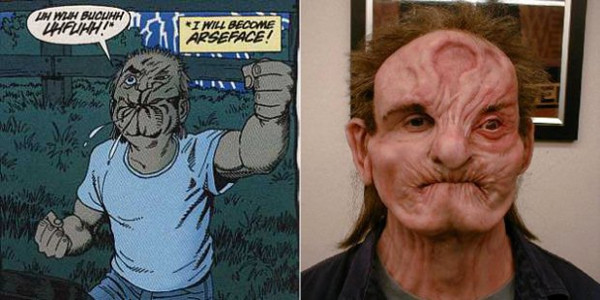
11. Kurt Cobain€™s Suicide Inspiring Arseface

With the creation of Garth Ennis€™s affable suicide survivor Arseface, it can be said that at least one positive thing resulted from the Nirvana singer€™s premature death. The Preacher one-shot title €œThe Story Of You Know Who€ relates the tale of how Cobain€™s suicide inspired Arseface and his friend Pube, to form a suicide pact and blow their own brains out. However, by placing the shotgun under his chin, the teenager isn€™t as successful as Pube or his famous idol, and ends up with the face that earned him his unfortunate moniker. On the plus side, it is implied that the partially lobotomising effects of his failed suicide is the reason for his perpetually sunny outlook. It will be intriguing to see if Arseface makes it into the upcoming Preacher TV series, and if he does, whether the same Cobain inspired back-story will be used? Given that the origin was fairly contemporary to the time of Preacher€™s publication it may be a detail that is omitted, even with the suicide hitting the press again this year when new information and pictorial evidence was released.

10. Senate Subcommittee Hearings Into Juvenile Delinquency And The Comic Book Code

One of the starkest examples of reality impacting upon the four colour world, occurred in the wake of the 1954 publication of Dr. Frederic Wertham€™s book 'Seduction Of The Innocent'. Wertham became the medium€™s most vocal opponent during the McCarthy era, protesting against perceived depravities, such as the homoerotic subtext of the Batman and Robin relationship and the supposed corrupting influence of E.C. Comics€™ violent horror and crime titles. Rather than being pilloried for his puritan views, Wertham was commended, and his work led to the damning 1954 Senate Subcommittee Hearings on Juvenile Delinquency. Comics were dragged over the coals, and the subsequent inauguration of the Comic Book Code censorship body followed shortly after. Ironically, the Code allowed for an absence of reality to seep into the pages of comics, which had previously sought to address the reality of the world around them. However, it could also be seen to have had a positive long term influence: it was recognising the fact young people could no longer relate to anodyne versions of Batman and Superman fighting Dinosaurs, which led directly to Stan Lee creating the Marvel Age of flawed heroes who could be easily identified with.

9. Kennedy€™s Moon Speech

When John F. Kennedy gave his €œWe Choose to go to the Moon€ speech in 1962, he could not have envisioned that his words would also lead to the ushering in of the cosmic comic age. This defining moment of the space race ignited the imaginations of comic creators, resulting in space-faring cosmic characters such as The Fantastic Four, Thanos, Galactus and his herald the Silver Surfer. Comics had long been fantastical but the closer humanity moved to the stars, the more the universe opened up as a tapestry for telling stories. The power of science also began to emerge from the shadow of the bomb, and characters such as Reed Richards brought the nerd front and centre. It is testament to the imagination of those stories that it has taken cinema 50 years to catch up. Only now are we beginning to see the spirit that emerged in that cosmic period, escape from the printed page.

8. The Outbreak Of AIDS And The Legacy Virus

One of the clearest analogies for an incident occurring in our world appears in X-Men, a comic that has been analysed in terms of its subtext perhaps more than any other. The outbreak of an AIDS-like virus strikes Mutant-kind in the form of the deadly Legacy Virus leaving a string of second tier victims and survivors in its wake. Legacy reflects the effects of AIDS on the human immune system by targeting the X-Factor within a host€™s genetic coding. In humans the virus is harmless as there is no X-Factor to detect but in Mutants the effects are deadly, eventually rendering the body incapable of generating healthy cells. The parallels to AIDS are obvious, but as the X-Men have long been read as emblematic of marginalised groups within society it is worth considering that Legacy offers an extension of reading the X-Men as an analogy for the impact the outbreak of AIDS had upon the gay community in the 80s and early 90s.

7. The Comics Code Authority Refuses To Approve Amazing Spider-man #96-98
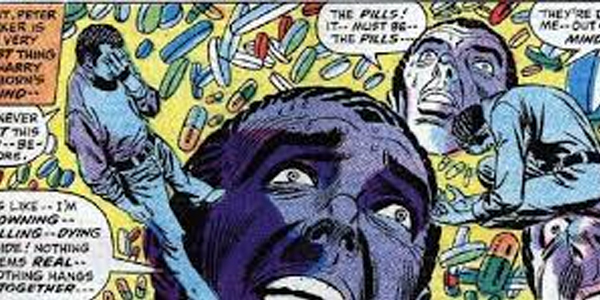
Good old Stan the Man - or should he be known as €˜The Codebuster€™? In 1971 Lee was asked by the U. S. Department of Health, Education, and Welfare to create a story that tackled the escalating dangers of drugs. The resulting €˜Green Goblin Reborn!€™ story arc saw Peter helping Harry come down from a bad trip and became the first mainstream comic to depict drug use. Because the Code forbade showing the use of drugs - even in a negative context, - it refused to give the comic its all-important seal of approval. Lee was unmoved, and felt because of the importance of the subject matter that Marvel should go ahead and publish the story without the seal. Fortunately Marvel€™s publisher Martin Goodman agreed with him, and the arc went on to be one of the most significant stories ever published. Furthermore, the success of the story brought about a relaxing of the code€™s policy towards negative drug use, allowing for legendary stories such as Denny O€™Neill and Neal Adams€™s seminal Green Lantern/Green Arrow tale €˜Snowbirds Don€™t Fly€™ to be told.

6. The Gunpowder Plot And V For Vendetta

Whilst this entry requires delving into a much earlier historical incident it is included due to its continued relevance and for the fact that it is the one entry on the list that could also be included in an article entitled €œ12 Comics That Shaped Real Life Incidents€. When Alan Moore wrote his V For Vendetta appendices €œBehind The Painted Smile€ he included a list of influences that he hoped to bring to V and his world. Whilst Guy Fawkes was not amongst the list, which included Judge Dredd, Batman and The Prisoner, John Lloyd€™s depiction of V in a Fawkes-like costume led to the influence of the Gunpowder Plot being central to the anti-establishment tone of the series. The incident also acts as the basis for one of the comic€™s key scenes where V atones for Fawkes€™s earlier failing by successfully destroying the Houses of Parliament. With the activist group Anonymous later adopting the V/Fawkes mask as their symbol, V for Vendetta has become one of the greatest examples of the interchange between reality influencing a cultural artefact, which subsequently goes on to influence reality.

5. The Bombing Of Pearl Harbour And The Popularity of Captain America

Captain America first appeared, socking Hitler and taking on the Axis powers, in December 1940; a full year before the attack on Pearl harbour and America€™s entry into the war. Although the character was an immediate sales success, the politically charged motivation behind his creation by two Jewish immigrants became a divisive issue amongst an American public split on opinion - primarily on whether or not to enter the war. Pearl Harbour changed all that and a character that had previously provoked demonstrations and threatening letters came to symbolise and promote the American War effort more succinctly than any other character of the era. If history had panned out differently, it is easy to imagine Cap being lost in the annals of culture; a relic of a particular Zeitgeist, rather than an increasingly relevant character that enjoys a popularity comparable to his wartime heyday and early 60€™s revival.

4. The Bombing Of Nagasaki And Hiroshima And The Creation Of The Hulk
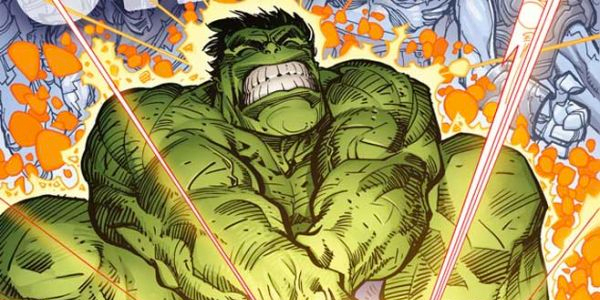
Whilst overtly referencing 18th century horror fiction such as Frankenstein and Dr Jekyll and Mr Hyde, the Hulk was essentially a product of post-Cuban missile crisis America, and a response to the atomic anxiety that pervaded the era. As an example of both the perceived positive and negative effects of radiation, The Hulk€™s creation can also be traced and connected to the H-Bombings of Hiroshima and Nagasaki. It is interesting to consider that while the victims of the bomb, the Japanese, responded culturally by creating a monstrous creature Gojira, which reflected the destructiveness of the Atomic Bomb, American culture gave us a powerful, hyper-masculine hero like the Hulk - albeit with similar destructive capabilities. Although the Hulk could be seen to be an indirect cultural response to that incident, other comic book heroes were also closely associated with the bomb, notably Superman acting as an Airborne cinematographer, documenting a Pacific test detonation, as famously depicted on the cover of Action Comics No. 101.

3. The Invasion Of Afghanistan And The Birth Of Iron Man

Tony Stark has seen his origin story retrofitted several times, since he was originally depicted as suffering his heart injury during the early days of the Vietnam War. The most recent update has placed his defining injury as occurring during The Afghanistan War. It had previously been altered from Vietnam, to take place during the first Gulf War, but with this version of Stark€™s origin being used as the basis for the first Iron Man film, Afghanistan has come to be viewed as the definitive setting for the birth of Iron Man. Consequently, given the mass-growth in popularity of the character, it is this contemporising that has helped establish the character so firmly in the popular consciousness. It is no accident that referencing real world events in a way that the reader can relate to is one of the things that made Marvel great in the first place and contributes to their enduring appeal.

2. 9/11, Spider-man And Marvel€™s New York

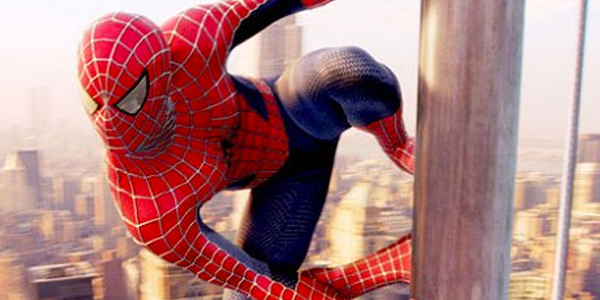
It could be argued that New York is THE central character in the Marvel Universe, so in that respect it is obvious that the events of September 11 2001 would have a seismic impact across the majority of Marvel€™s titles. In the direct aftermath of 9-11, the crossing over of events in real life New York to Marvel New York could be seen most pertinently in The Amazing Spider-man Vol.2 No.36, (commonly referred to as the "Black Issue" due to it€™s all black cover) which examined directly the impact of the tragedy, not just on Peter Parker but other Marvel luminaries such as Captain America and Daredevil, and even villains such as Dr Doom and Magneto. It is of course irrefutable that one of the most significant events of 21st Century has had a tremendous impact and effect on Western cultural output as a whole. Its effects still resonate in the majority of comic book movies that exist today, up to and including, the €˜inside job€™ sub-plot of Captain America: The Winter Soldier, which reflects some of the Burning Of The Reichstag conspiracy theories that surround 9/11. This is just the latest example in a genre that has become replete with the familiar imagery of city-wide destruction. Be it Marvel or DC, the imagery and ghosts of 9-11 remain a firm fixture of the comic book world.

1. Superman Was Created After Jerry Siegel€™s Father Died During A Robbery

In 1932, Superman creator Jerry Siegel€™s father, Mitchell Siegel, suffered a fatal heart attack after his Haberdashery store in Cleveland was the target of an armed robbery. It has been suggested by noted comic book historians Gerard Jones and Brad Meltzer that this incident became the inspiration for Siegel and his creative partner Joel Schuster to create the invulnerable Man Of Steel only a year later. Given that the character was initially conceived as a bald villain, hell-bent on World Domination - more Lex than Kal-El - this theory could be challenged, but it is entirely conceivable that shifting the focus of the character from antagonist towards superhero could have been a reaction to the loss of Siegel€™s father. As Meltzer suggests "Your father dies in a robbery, and you invent a bulletproof man who becomes the world's greatest hero." It is a compelling theory, and perhaps the first example of comics being used as a form of catharsis, in addressing a real life tragedy. Which other real-world moments have shaped the history of comic books? Share your own thoughts below in the comments thread below.

Contributor
Contributor

As well as the odd article, I apply my "special mind" to scriptwriting for Comics, Films and Games... Oh and I cut down trees, I skip and jump, I like to press wild flow'rs, I put on women's clothing, and hang around in bars. Follow me on Twitter @DrRobertOtnik