8 Terrible Mistakes That Almost Ruined Superman For Everyone
Evil Superman had a good run, but don't you think he's gotten a bit stale now?

Superman was DC's first ever superhero, and has remained the company's most pivotal character since he was introduced in the pages of Action Comics #1 all the way back in 1938.
And contrary to what edgy edgelords may argue, Superman is both awesome and cool, actually, and not for the reasons other superheroes are. There's a certain uniqueness to the character, in that he brings a message of hope and goodness that goes beyond the kind usually seen elsewhere.
Kal-El is quite possibly the most powerful figure on planet Earth, but he chooses to use his gifts to uplift those around him, always believing in the best of humanity and willing to put everything on the line to protect his adoptive world even when it comes at a great personal cost.
This in mind, you'd think that Supes' most enduring qualities would be easy enough to retain throughout the decades. After all, they're what has largely endeared the character to the masses since his creation; echoing that formula, albeit with obvious and necessary innovations now and then, should be an easy enough thing, right?
Well, nah. Not really. Like all comic book characters, Superman has suffered more than just the occasional bungling at the hands of a misguided writer or creative. Whether on the page or off it, people just keep finding more and more creative ways to mess up the character, and they don't look like stopping anytime soon...
8. Pre-Crisis Superman's Expanding Powers And Continuity

The Silver Age of Comics was a bit of a wild time. Okay so "a bit" might be putting things lightly (you wouldn't describe DC having to limit their monthly output of comics featuring gorillas as "a bit", would you), but whatever, the point is that things were pretty weird. Great in many ways, but also incredibly, ridiculously weird.
DC in particular got up to some truly wild things during the fifties and sixties, which stemmed from a mix of having to appease the Comics Code Authority (thus leaning into more outlandish material), and also the sci-fi craze dominating wider media. Superman, unsurprisingly, was right at the centre.
As Grant Morrison details in their expert study of superhero fiction, Supergods, the Man of Steel transitioned from the working class, anti-establishment hero seen in the 1940s, to one whose stories entailed, "super-science fiction about how it felt to be twelve".
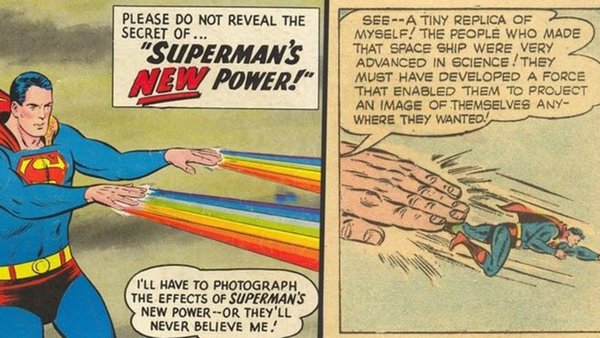
Superman rapidly developed an expanding arsenal of super-powers and supporting characters, each crazier and more colourful than the last, until DC were left with a disparate continuity that eventually had to be axed in 1985's Crisis on Infinite Earths. Crisis gave way to John Byrne's Man of Steel comics, which reimagined Supes with a vision that married the best of the Golden, Silver and Bronze Age depictions, to give way to a version of the character many readers would call definitive.
And, to be clear, the Silver Age Superman books absolutely did enrich much of Kal-El's mythology. The issue is that the contemporary understanding of Superman as we know him would never conjure miniature versions of himself to fight crime, or shapeshift, or wipe people's memories with a kiss. The character has to be vulnerable in some ways, which is thankfully a lesson DC's creators applied to Supes post-Crisis.
7. Superman Red/Blue

Now, contrary to consensus, I'm actually partial to a bit of nineties Superman. The mullet is a great look (fight me), Reign of the Supermen is pretty fun, despite Death of Superman not being all that, and the character also gets his due in Grant Morrison and Howard Porter's brilliant JLA series that kicked off in 1997.
However, for all that I can extol the virtues of nineties-era Supes, there are definitely some, err... creative liberties taken with the character. Arguably the most infamous was Superman Red/Blue, a storyline that reimagined one of Supes' weird Silver Age arcs where the character was split into two halves - a red half,and a blue half, who are both super intelligent - only this time they had snazzy new electric powers.
The reasons for the split differed massively from the sixties incarnation, with the reason this time being that Supes had lost the solar energy needed to fuel his powers. This led to him fashioning a new containment suit that could better handle the nascent different abilities that emerged to compensate for the lack of his old ones.
Now to be fair, the actual electric blue Superman suit is pretty cool, and the idea of Supes having to relearn what he's capable of with new powers at his disposal isn't that bad either. The issue mainly is that the change felt contrived and, in retrospect, borne out of that quintessential "X-treme!!" vibe most nineties super books were going for.
Things only got weirder when Red came onto the scene, with Dan Jurgens contrasting the more contemplative "Blue" Supes with the more brash and aggressive "Red", and it wasn't long until DC reverted the character back to his old self, sparing the details along the way.
6. Literally Every Bad Superman Game Ever

Folks will tell you that Superman is a difficult character to build a video game around, thanks mainly to the idea that his powers grant him nigh invulnerable status. Given most action-adventure video games entail some kind of risk for the protagonist - otherwise where would the challenge be? - the general conception is that the Man of Steel just doesn't lend himself well to the medium.
Not that video game studios haven't tried, of course. More-so than Batman, Spider-Man, or any of the other DC and Marvel heroes, Superman has been the subject of some seriously stinky video games. Whereas those aforementioned characters can point towards a select few underwhelming releases, though, Supes' entire gaming library is chockfull of them, with only a few managing to exit the bracket of "bad" or "mediocre", to enter the dizzying heights of, "it's okay, I guess."
By far the most infamous of these terrible Superman games is Superman 64, a title developed in 1999 that was based on the seminal Superman animated series from the 1990s. The entire game just revolves around flying Supes into rings and... nothing else. (Lex Luthor was clearly feeling low on inspiration.)
Subsequent efforts faired only marginally better, with other projects meeting cancellation, but it's still wild that developers haven't been able to crack the character when it comes to video games - probably because publishers have bought into the idea that Superman is simply way too powerful, even though said idea is just plain wrong.
5. The DC Extended Universe

If you were asked to name a few words that defined Superman - whether the character or the actual comic itself - a select few would likely spring to mind. "Hopeful" would for sure would be on there, along with words like "colourful", "inspiring", and maybe even "tragic", once you consider the character's origin, but certainly not words like "dour", "washed-out" or "cynical", although you could certainly understand why someone would, given most mainstream depictions of Superman from 2013 onwards have failed to convey the character's most inspiring qualities.
2013's Man of Steel - a production spearheaded by filmmakers Zack Snyder, Christopher Nolan, and perennial superhero-misunderstander David S. Goyer - kicked off what was a fairly miserable decade for Superman, due in part to an effort to 'un-bore' the character after 2006's disappointing Superman Returns reboot.
Snyder, who brought a visual pomp to previous comic book adaptations in 300 and Watchmen respectively, was seen as the man to do the un-boring. Warner Bros. were increasingly desperate to catch up with the Marvel Cinematic Universe after the disaster that was Martin Campbell's Green Lantern, and so Man of Steel had to do two things. One: it had to "modernise" Superman (lol), and two; it also had to lay the foundations for a new onscreen superhero universe.
Man of Steel is the film the rest of the DCEU is founded on, and given it's such a miserable film, both visually and narratively speaking, it shouldn't have come as any surprise that subsequent entries in the franchise also stumbled. Those first few films after Man of Steel all had to follow its style visually and tonally, setting DC Film back years in the process, but arguably the biggest victim here is Henry Cavill, who so obviously has the potential to bring to life a more colourful and heartwarming version of Superman, but has yet to be given the opportunity to do so.
4. Getting Rid Of The Trunks

The New 52 was a huge, crazy deal for DC Comics when it launched in 2011. The publisher strolled up to comics readers with all the gusto of Steve Buscemi in skater garb and proceeded to ask, "how do you do, fellow kids", introducing brand new designs for its roster of characters in a bid to get in touch with a new audience.
The problem, however, was that in attempting to reach new readers, DC editorial lost sight of what made their comics unique in the first place. The new tone and aesthetic divested from classic DC and a few characters in particular suffered dramatically, with Superman - once again - stuck in the middle.
Supes was a frequent target of DC's critics and tended to be seen as the visual embodiment of the publisher's supposedly dated characters, and so it's no surprise he bore the brunt of the reboot's retcons, starting with his costume.
The trunks were gone, a more armoured look was introduced, and the suit was given a bunch of random lines and accents because... detail, I guess? Either way it didn't work, and in five years' time the entire New 52 experiment came crashing down.
3. ...And All Those Other New 52 Retcons

But of course, the trunks themselves weren't the only things on the chopping block when the New 52 dropped. The entire initiative reset much of DC's continuity back to square-one, which meant that some of Supes' most iconic storylines were no longer canon.
Among the most egregious changes made, though, involved Clark Kent's supporting cast. In the new continuity, Ma and Pa Kent were killed when Clark was just a teenager, as opposed to the post-Crisis canon which featured Jonathan and Martha prominently until the former's death in 2008.
Then there was the matter of the character's marriage to Lois Lane. The New 52 did away with that too (along with many other iconic DC relationships), deciding instead to make Supes and Wonder Woman an item and Lois a passive observer.
2. Almost Everything About Superman Lives

There have been a lot of famous comic book movie cancellations over the years, but none more chaotic or notorious than Superman Lives.
One of two failed Superman projects to emerge in between the release of Superman IV: The Quest for Peace and Superman Returns, Superman Lives (formerly Superman Reborn) was put into production in the 1990s with Tim Burton attached to direct and Nicolas Cage (who's actually a massive comic book fan, and even named his son Kal-El), in the role of the Man of Steel.

The film itself was primarily inspired by the Death of Superman arc from the early 1990s (a comic Batman v Superman would also lift inspiration from), and would've seen Brainiac, Lex Luthor and Doomsday as the main villains. Several treatments of the film were developed by different writers, with one in particular, Kevin Smith, eventually leaving the project once Burton came aboard and decided he wanted greater ownership of the story.
Smith has revealed key details about Superman Lives' troubled production in the years since it fell apart, but if anything could sum up just how weird a project it was, then it would have to be producer Jon Peters' desire for Smith to insert a giant spider - among other, offensively reasoned things - into the story. This same spider would eventually show up in 1999's Wild Wild West, also produced by Peters.
1. The 'Evil Superman' Trope

Big, big qualifier here first before I get stuck-in: 'Evil Superman' stories can and absolutely have worked before, and there's obviously still a place for them in the wide array of different DC comics told every single year.
Two of the best DC works of the previous decade - Injustice: Gods Among Us and Justice League: Gods and Monsters - revolved around Supermen of varying not-so-good morality, and serve as proof that 'Bad Superman' absolutely is a worthwhile interpretation of the character that can co-exist alongside the more traditional incarnation.
Unfortunately though, as more audiences have bought into the cliche that Superman is "boring" or "old-fashioned" or "unrelatable" or whatever else, 'Evil Superman' has become a regular feature of various DC works. Injustice opened the floodgates in that regard, leading to a decade of darker Superman stories which saw the Man of Steel go evil on numerous occasions, whether that be via mind-control, or some other kind of multiverse-related shenanigans.
These evil depictions of Superman have gradually bled into the character's mainstream self, with the New 52 version, both artistically and narratively, taking a leaf out of Evil Supes' book. The evil looking glowing red eyes Superman shows up again and again, while other writers have felt the need to "ground" the character by making him angrier and more impulsive.
It works for Elseworlds, but let's maybe leave the "WhAt If SuPerMaN... bUt BaD??" stories alone for a while, yeah?
Watch Next
DC Quiz: How Well Do You ACTUALLY Know Superman?
