10 Best Movie Characters Not Introduced Until The End
Not showing up until the final act took nothing away from the quality of these performances.

It is no mean feat constructing and bringing any memorable cinematic character to life, let alone one who doesn't appear until the movie reaches its conclusion.
Only appearing in a film's climactic scenes means that the actors who have been charged with embodying these characters have less time to work with - and subsequently - less time to deliver a performance worthy of note. This is particularly true of films that feature ensemble casts, as this makes it even easier for one to get lost in what swiftly becomes a muddled sea of A-list faces. While an increased run-time may help to provide for more artistic freedom, it simply does not change the fact that the most impressionable characters are the ones who feature from the very beginning.
Accordingly, it speaks volumes to the inherent quality of a few select performances - who did not appear until the final sequences of their respective movies - that they were able to produce such a memorable turn in the short stretch of time that they had to work with. These characters have left an indelible impression on viewers over the years through a shameless exploitation of every human emotion in the book, the extent of which is genuinely staggering when one considers that they were not featured in proceedings from the get go.
10. Kincade - Skyfall

In a film steeped with mystery surrounding 007's past, it makes sense that the human best served to provide insight on the man himself doesn't show up until events immediately preceding the last showdown of 2012's blockbuster outing Skyfall.
Portrayed by the late great British character actor Albert Finney, Kincade is the gamekeeper of the titular childhood home of James Bond, where Bond and M choose to take a final stand against Raoul Silva. A long and secluded existence in the Scottish Highlands might have robbed many of their taste for adventure but evidently not Kincade; the gamekeeper gleefully sets about assisting Bond in setting up a variety of delightful booby traps for the inevitable arrival of Silva's heavily armed forces.
Bond's pleas to leave the fighting for him fall on deaf ears and the old man takes part in the defense of Skyfall with his trusty shotgun. "Welcome to Scotland" is the last thing several of Silva's thugs hear before being dispatched by Kincade and the elderly Scotsman also helps get "Emma" to safety after she is wounded in the battle. Additionally, any character who invites James Bond "try and stop me, you jumped up little sh*t" is a character clearly worth of further examination.
Despite only featuring briefly in the crowning sequences, viewers won't forget the formidable Kincade in a hurry.
9. The Bride - Bride Of Frankenstein

It seems bizarre that a film centering around the titular Bride of Frankenstein would only feature the would-be Mrs. Frankenstein in the final act.
James Whale's 1935 outing has been critically acclaimed as one of the greatest horror films of all time, featuring Boris Karloff in his second appearance as the creature based on the monster from Mary Shelley's novel. The film seeks to explore a subplot of Shelley's original story; as no living thing will accept the monster in its current state, it demands that a mate be created for it, a request eventually obliged by Dr Septimus Pretorious, a mentor of Henry Frankenstein. This is a notable diversion from Shelley's novel, in which Henry initially agrees, before becoming horrified at the notion of multiple monsters and destroying his latest creation.
Despite being the focal point of Whale's film, the Bride does not appear in her living form until the film's final act. It's a heartbreakingly ironic entrance as well; the horrified Bride rejects Karloff's monster, leading him to destroy the laboratory with both of them still inside. Regardless of Elsa Lanchester's exceedingly brief appearance within the film however, Bride of Frankenstein holds a proud reputation as one of the most significant and progressive horror movies of all time. The film was selected for preservation in the US National Film Registry on the basis that it was "culturally, historically or aesthetically significant".
None of these lofty accolades would have been possible without the contribution of the eponymous Bride herself.
8. John Lennon - Yesterday

In the most heartwarming appearance on this list is the late introduction of John Lennon, in Danny Boyle's lighthearted Beatles love letter, 2019's Yesterday.
The film's protagonist Jack is hit by a bus in Yesterday's early going; he swiftly discovers that in a mind boggling turn of events, this version of reality is one in which the Beatles never made it to the big time, allowing him to shamelessly pass their music off as his own.
No Beatles film would be complete without John Lennon appearing in some capacity and do so the legendary late musician does as Yesterday winds down, portrayed by the cinematic icon that is Trainspotting's Robert Carlyle. Jack meets two people who also transferred from his original reality, who thank him for keeping the Beatle's music alive and give him Lennon's address - he was never murdered in this branch of reality, enjoying a contented and peaceful existence with his wife.
"It's an honor to meet you", a dumbstruck Jack feebly mumbles as a bemused Lennon opens the door. While clearly confused as to why this befuddled young man has shown up on his doorstep, Lennon proceeds to deliver an uplifting monologue regarding the necessity of happiness to deem one's life successful and inspires Jack to get Ellie back - which he ultimately does in a feel good conclusion to the film.
While Yesterday arguably failed to make the most out of its unique premise, the late introduction of Carlyle's Lennon was an unquestionable high point of a charming cinematic offering.
7. Colonel Mackenzie - 1917
Benedict Cumberbatch has a tiny amount of screen time in Sam Mendes' epic war outing 1917, but the veteran actor makes the most of it in his usual impressive fashion.
While Cumberbatch is as polished in his performance as audiences have come to expect, the significant impression that Colonel Mackenzie leaves on viewers is primarily as a result of the apocalyptic landscape that audiences first meet him in. Viewers have just sprinted full tilt through no man's land alongside Will Schofield, taking in every devastating detail of the war torn landscape, as he desperately races to deliver a message to Mackenzie, telling him to call off the attack.
Having witnessed this harrowing scene - and the sacrifices Will had had to make to get to this point - viewers are sent into a horrified frenzy when Mackenzie, eyes glinting at the prospect of what he appears to be an impending glorious victory, initially refuses to believe that the orders are genuine. It's a perfect snapshot of a man so singularly focused on his end mission that he is willing to risk the lives of thousands of his men. Mackenzie's nerve wracking case of red mist comes perilously close to causing a massacre before he ultimately sees reason and calls off the attack.
A brief outing at 1917's tail end, but one so thrilling that it left viewer's hearts pounding out of their chests.
6. Unnamed Arkham Prisoner - The Batman

Not only is this character not introduced until the very end of Matt Reeve's neo-noir masterpiece The Batman, the fact that only his voice and silhouette are featured within the film speaks volumes to the impact that he has in such a brief cameo appearance.
Riddler, locked in his cell and wailing dementedly at the demise of his deviously intricate plans, finds an unexpected ally; an unseen prisoner in the cell next to him who tells him a riddle about friendship to comfort him. The identity of this soft - almost childishly - voiced villain is never firmly established, but everybody knows exactly who the man is when he breaks into his trademark cackle of maniacally evil laughter.
Indeed, a deleted scene from the film reveals the true extent of the malevolence housed within the cell; one that arguably resulted in more Internet chatter than Reeve's blockbuster (Reeves ultimately opted to discard it, believing that focusing on this villain would distract audiences from Batman's origin story.)
In it, Batman visits Arkham for an eery Hannibal Lecter-esque consultation; the green haired, hideously scarred visage sitting before him is the same man in the cell next to Riddler, instantly recognizable as a gruesome new take on arguably the most iconic villain in cinematic history, the Joker.
Barry Keoghan's cameo at the very end of The Batman, aided by the notoriety of the chilling deleted scene, means that although he is limited to what is essentially a voiceover, Keoghan's "Unnamed Arkham Prisoner" is one of the more impressionable late arrivals within a film to date.
5. John Doe - Seven

"You're looking for me."
Audiences often catch a glimpse of a serial killer in the events that lead up to their inevitable on-screen capture. Perhaps what makes Seven's John Doe so utterly terrifying, though, is the fact that the killer is never seen once until the second he walks into the police precinct covered in splatters of blood. Even better, this instance does not occur until one hour and 35 minutes into David Fincher's critically acclaimed neo-noir thriller.
Up until that point in proceedings, the only thing viewers had to go on were the mangled, bloodied corpses that the killer had left behind, the murders all carried out in a warped parody of one of the Seven Deadly Sins. The utterly horrifying nature of Doe's modus operandi combined with his complete anonymity made for a terrifying spectral presence looming over Brad Pitt and Morgan Freeman.
As such, the fact that John Doe only appears for 20 minutes during the film's final act highlights what an impressionable character the chilling villain is. The vile murderer oozes twisted malevolence from every pore during his stunning performance in Seven's nail biting climax and devastating final twist.
4. Harry Waters - In Bruges

Martin McDonagh's riotous dark comedy In Bruges is a manic triumph of a motion picture. Colin Farrell and Brendan Gleeson helm an outing that alternates between deep introspection and laugh out loud silliness, complemented by some of the sharpest script writing and wackiest characters in recent memory.
While Farrell and Gleeson take to their respective roles as Ray and Ken like ducks to water, the true star of McDonagh's masterpiece only features in the final act, despite his purring tones over the phone being a constant presence throughout the movie. This of course is Harry Waters, played in a side-splitting performance by the inimitable Ralph Fiennes.
Ken refuses to execute Ray on Harry's orders - following a botched assassination that left a young boy dead - prompting Waters to take matters into his own hands and travel to Bruges. Waters only appears onscreen for the first time in the last third of the film, introduced with one of the more unforgettable debut one-liners as his wife attempts to stop him from destroying a telephone in frustration:
"Harry!"
"What?"
"It's an inanimate f*cking object!"
"YOU'RE AN INANIMATE F*CKING OBJECT!"
In Bruges is a brilliant, surprisingly moving and unashamedly f*cked up film and Fiennes proves to be the perfect villain for this underrated gem of a black comedy. While the actor may be known for his more serious roles, the Englishman is wickedly funny as Waters. Combining sinister ruthlessness and razor sharp one liners dripping with sarcasm, Fiennes' introduction is the perfect way to cap off the final act of an exemplary film.
3. Wilford - Snowpiercer

Snowpiercer's Wilford is the equivalent of the titular train's "final boss" and the man who created and maintains the Engine.
Snowpiercer depicts a dystopian tale of survivors of an extinction event, aboard a train endlessly circling the frozen wasteland that was once Earth. Chris Evans' Curtis Everett leads the lower-class passengers - relegated to the sub-human conditions of the train's "Tail" - in a bloody revolution against the wealthy occupants of the front carriages in a desperate fight to get to the front of the train.
An enthralling, visceral commentary on survival and inherent human nature culminates in a stand off with the train's mastermind, Wilford, played in a sublime turn by Ed Harris. The most sinister aspect about Wilford is his relaxed matter-of-factness, chuckling and tucking into his meal as he informs Everett that the revolution was no more than an engineered ploy to reduce the crowded population of the Tail to levels easier for him to manage. Wilford then proceeds to have 74% of the remaining survivors executed to achieve his desired total.
Wilford's status as an insidious villain of nightmarish proportions is solidified when it is revealed that he has children from the Tail manually operating the dangerous machinery within the Engine. It's a whole lot of evil to cram into the end of a movie, but Ed Harris manages to do so in his typically polished fashion. A film of such stature and quality deserved a despicable villain of the highest order and Harris achieves this despite only appearing briefly in the film's climactic sequence.
2. Colonel Kurtz - Apocalypse Now
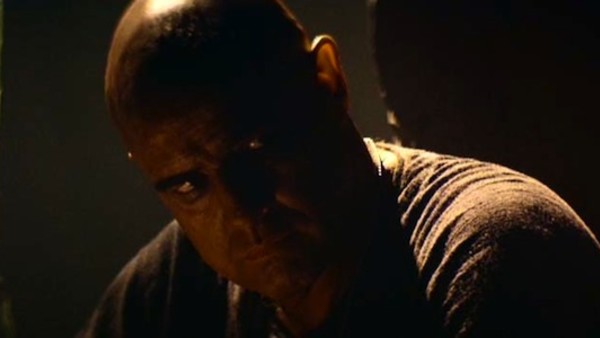
Marlon Brando received top billing as Colonel Kurtz in Francis Ford Coppola's revered outing Apocalypse Now when the film was released in 1979. Despite this, the legendary actor only actually has 15 minutes of screen time throughout the entire film, finally appearing for the first time as the Vietnam war epic reaches its thunderous conclusion.
After Kurtz breaks away from the US army, building a cult of personality around himself in the process, Captain Benjamin Willard is assigned to terminate the rogue colonel. After a harrowing journey upriver encountering all manner of wartime horrors, the Captain eventually finds himself face to face with the man himself, in a temple so dark that one can barely make out Brando's features for large chunks of the scene.
Cinema icon Brando makes the most of his brief time on-screen, delivering an epic soliloquy on the intricacies of warfare; while he acknowledges Martin Sheen's Willard's right to kill him, he scolds the Captain as nothing more than an "errand boy" in an unforgettably poignant monologue. Despite being brutally dispatched by a machete wielding Willard in Apocalypse Now's relentlessly intense psychedelic finale, Brando even manages to cram one of the most iconic lines in cinematic history into his fleeting performance as the enigmatic Kurtz.
"...The horror...the horror..."
1. Private Ryan - Saving Private Ryan

The supposed focal point of Steven Spielberg's unforgettable war saga Saving Private Ryan is only presented to audiences just before the culminating battle sequence of the film.
Tom Hank's group of Rangers finally find Ryan, part of what remains of a depleted unit entrusted with holding the strategically vital town of Ramelle. Matt Damon's character immediately endears himself to audiences; despite the devastating news of his brothers' deaths in combat, the young soldier adamantly refuses his ticket away from the traumatic devastation of the war, citing his complete unwillingness to abandon his comrades. Ryan is such a principled individual that he is unswayed even when regaled with the stories of the soldiers who died attempting to find him, despite being visibly moved.
Ryan fights bravely in the battle against overwhelming German forces but is ultimately reduced to an almost catatonic state by the seemingly endless destruction raining down around him, Damon's exemplary performance adding an unflinching layer of authenticity to proceedings. The anguish in the actor's shocked eyes as he surveys the devastation around him following the battle - which he perceives to be as a result of his own actions - is absolutely gut-wrenching and one of the most moving sequences in what is arguably the greatest war film ever made.