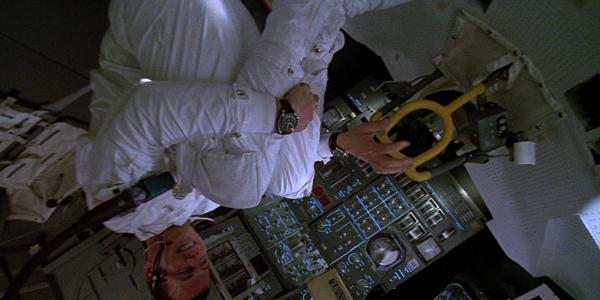
10 Insane Ways Classic Movie Scenes Were Filmed

How did they do Inception's spinning hallway? They...spun a hallway...
Actors have to go through a lot when they're working in Hollywood. It may look like a cushy job, but there's always the risk that you might cark it on set, or worse - have to deal with genius, visionary directors who come up with totally bonkers ways to create unique visual styles, mind-boggling stunts or pull of crazy special effects in their films. You'd think that nowadays all that sort of thing is handled by CGI and other such visual effects, with the actors left to chill out in their trailer until they're called upon to dance in front of a green screen for a while. Then they add all the inventive stuff during post-production. Well, that's how they made Sin City and Avatar, but not every film is Sin City or Avatar. Thankfully. In fact, most films are the exact opposite of Sin City and Avatar, opting to use some innovative - and almost always insane - methods to capture certain shots, sequences or stunts. And not all of them are lethal, so that's nice. Some of them may surprise you, too; everybody knows that the lunatic car stuff that happens in a Bond film are handled by stunt drivers who actually do barrell rolls over rivers and the like. Did you know how much similar time and effort went into making, say, The Godfather, though? Or Apollo 13? Probably not. They're not showy with their weird camera moves, but some of the most iconic sequences in Hollywood history have been pulled off using some truly bizarre methods. We'll come across car chases, dinosaurs and shower scenes alike as we go through the ten insane ways movies produced classic scenes.

10. The French Connection Car Chase Was Totally Illegal
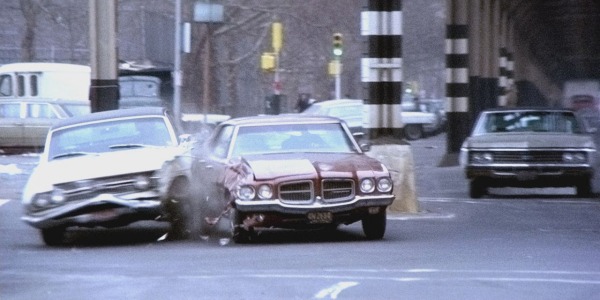
William Friedkin's seventies crime drama is famed for its cinema verite film style, with Gene Hackman's attempts to foil an international drug smuggling ring filmed like it was a documentary (possibly because the film was, albeit loosely, based off a true story). That level of realism that Friedkin was going for stretched to the celebrate car chase that, when you ask your dad about The French Connection, is probably the first thing he'll remember about it. It's a pretty sweet car chase. Not the same technical flair of, say, Bullit or Ronin, but where it has them beat is the frenetic energy and genuine tension you'd feel if you actually watched such a thing happen. An effect they produced by literally staging a car chase in real traffic. Friedkin has something of a reputation for, ahem, interesting directorial decisions, such as slapping a priest in the face to get him to cry at the end of The Exorcist. His most reckless call, however, was when he decided to film The French Connection's car chase on the streets of New York. Without closing any of them off. The stunt drivers just had to deal with the real-life traffic clogging up the shots. There's even a part when Hackman sends a car spinning off the road, and that was an actual person who just happened to be in the wrong place at the wrong time. They did make on concession to safety: they put a police siren on the roof of Hackman's car, to alert drivers to move out of the way of the 90 mile per hour car with the crazy director in the back seat.

9. James Caan Had His Skin Pulled Off For The Godfather
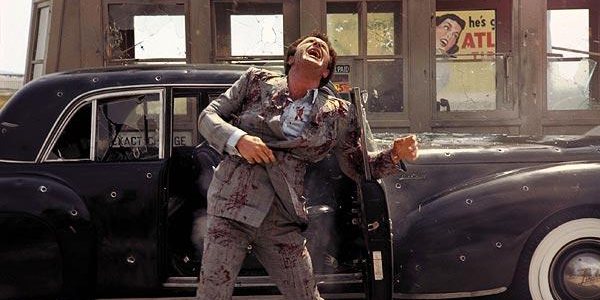
Let's be honest: The Godfather is a bit of a slog. 200 minutes and most of that is Marlon Brando stroking a cat and inventing mumblecore (at least, that's how we remember it). When director Francis Ford Coppola actually remembered to include some of the characteristic violence that comes part and parcel in a story of the mob €“ the murderous, nasty mob €“ though, he went the whole hog with it. And the long build up probably helped make the scene where James Caan's Sonny Corleone gets riddled with gun fire all the more shocking and effective. A bunch of standing around in dark rooms, talking in comedy accents, then BOOM! More gore than you can shake a Texas chainsaw at. It's an amazing, breathtaking scene, and not just because it comes out of nowhere. There's also the rather impressive fact that James Caan looks like he's actually being gunned down by multiple assailants; part of that is the actor's performance, and part of that is the innovative special effects that still hold up to this day (and you can't say that about many films made in 1972). To accurately portray the complete decimation of Sonny's body, James Caan had fishing wire attached to bits of fake skin all over his face, so that when he stepped out of his car and the triggers were pulled, the crew would yank all these prosthetics off, let the fake claret fly, and create the illusion that the bullets were actually tearing through Caan's body. Yeesh.

8. Inception's Actual Spinning Hallway
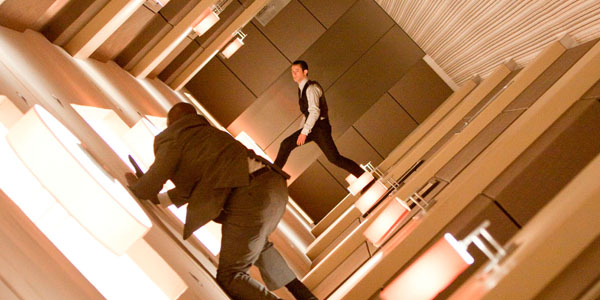
Christopher Nolan is a sucker for the practical effect. The technology-obsessed director may have given up on traditional film in favour of digital, and his new film Interstellar is going to be stuffed full of CGI out of necessity (it is about astronauts exploring an alternate universe, after all), but for the most part he kicks it old school with his special effects. His brain-bending dream-cracking blockbuster Inception featured a fair amount of computer graphics, too, but a surprising amount of in-camera work as well. Like, you know the bit where Leo and Ellen Page are chatting on that Parisian street corner, and then suddenly everything freezes and stuff starts exploding? All done for real. And diCaprio probably deserves that Oscar just for not flinching when pressurised guns were firing vegetables off near his face. Most impressive of all, however, is how they pulled off that dizzying, spinning hotel hallway scrap between Joseph Gordon Levitt and a goon. As the dreamers tumble in real life so does the room they're imagining, going through a full 360-degree rotation as JGL and his enemy scrabble for a gun. CGI or something, right? Nope, they built a full, spinning rig, and the actors just had to deal with it. Well, they got two weeks of training beforehand, but still. Crazy!

7. The Dark Knight Tumbler Chase Happened For Real
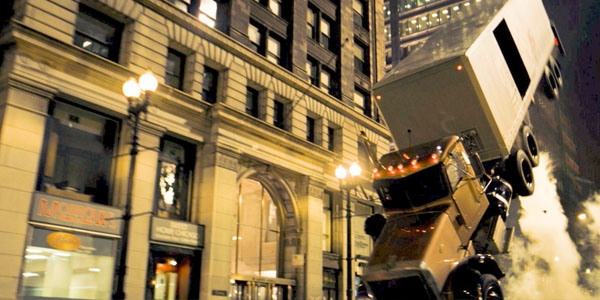
Sure, Nolan opted to do some crazy practical effects for Inception, but there's no way he could do the same for the Dark Knight films, right? They must be full of CGI. How else would you pull of all those superheroic stunts? You couldn't, say, actually drop a plane out of the sky like they do at the start of the Dark Knight Rises. Except, erm, they totally did do that. Well, okay, but dropping a heavy object isn't that difficult. Ill-advised, but not difficult. What must be full of camera trickery, computer magic and miniatures is the epic car chase across Gotham City that appears in the Dark Knight, complete with the Joker firing a rocket launcher, multiple eighteen wheelers doing somersaults through the air, and Batman crushing traffic beneath the treads of his huge €œtumbler€ Batmobile. Well, believe it or not, that chase was the French Connection of superhero films. Sort of. They didn't do it in actual traffic, because that would be insane (you hear us, Friedkin? INSANE). But they absolutely did film the bit where the Batmobile drives under and flips up a garbage truck, and the part where the Caped Crusader uses a grappling hook to send the semi-truck the Joker was driving flying into the air to land on its roof. They did that. On an actual street. With an actual truck. No computer wizardry, just a huge steam-piston mechanism in the trailer that propelled it several feet into the air and onto its back. Which, by the way, they actually filmed in downtown Chicago. Thankfully Nolan had the good sense to actually close the street off, however.

6. The Matrix's Bullet Time Used Hundreds Of Cameras
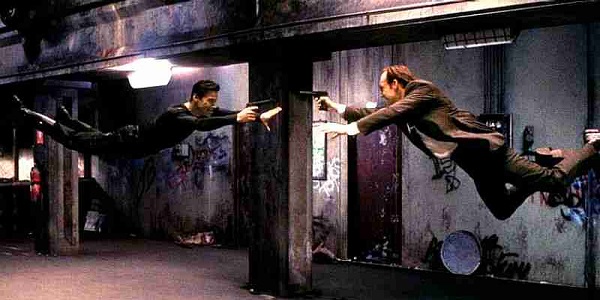
It's weird to think now €“ with the legacy tarnished somewhat with the cack sequels and the increasingly bizarre careers of the Wachowskis afterwards €“ but upon its release, The Matrix was the most pioneering action films produced; if not one of the most pioneering films, full stop. Part of that was the martial arts, part of that was the co-opting of Baudelaire for a Hollywood sci-fi thriller, but mostly it was the bullet time. The creation of visual effects supervisor John Gaeta (who won an Oscar for his work on the first film), this was the special effect that was spoofed in every kid's film, advertisement and Matrix knock-offs produced for years after. The actor appears to move in slow motion, whilst the camera spins around them at a seemingly impossible speed. How do they do it? When Neo is grappling with Agent Smith in mid air, or doing a limbo move to dodge bullets, they've been slowed to almost a halt. The camera would have to be going, like, lightning speed around them to capture it. Turns out the solution is way more simple (sort of): all the bullet time sequences were shot on green screen, with a rig of cameras placed in a circle around the action. It was filmed in regular time, but each camera took a picture in sequence, then animated together in slow motion. So bullet time, the greatest innovation in action movie camerawork since the introduction of the steadicam, basically used the technology of a flip-book.

5. Children Of Men Had The Craziest Car Rig Ever

Alfonso Cuaron is a confirmed crazy person. At least, that's the conclusion we have to draw after watching the special features for his underrated dystopian sci-fi movie Children Of Men, a classic of the modern era if we've ever seen one. For the most part Children Of Men shirks Hollywood bluster in favour of a bleak, character-driven film about a world where infertility has struck all men and women, and this hopelessness about the future of the human race has permeated through into a grimy, unhappy society full of political unrest and heavy-handed parallels to Guantanamo Bay and the war in Iraq. Still, Cuaron finds room for a couple of boss action sequences amidst all the glum faces and tears, as Clive Owen's civil servant Theo Faron is charged with shepherding a surprisingly pregnant young girl to safety. The first bit of resistance Theo comes up against is the radical nutjobs who want to use the girl as a pawn in their fight against the repressive British government. The gang scarper under cover of darkness in a crappy Fiat, and are instantly besieged by said nutjobs on foot and bike, as they try to grab the girl and put Theo out of comission. It's a thrilling scene, the tension ratcheted up by the illusion that it's one long, uninterrupted shot (something that happens a couple of other times throughout Children Of Men), all filmed from within the car. How did they do it? More CGI and green screen? Nope, they built a ridiculous high-tech and complex right that involved camera men hiding in the floor, seats falling back so actors would leave room for other cameras, and a roof that could come off for other shots. Seriously, just look at it. It's crazy. And brilliant.

4. Jurassic Park Basically Starred Real Dinosaurs

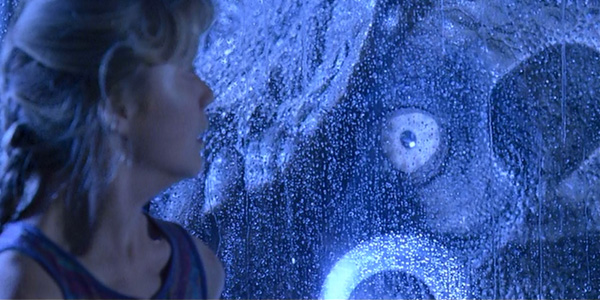
One of the things that has us pumped for Jurassic World €“ besides trusting star Chris Pratt and director Colin Trevorrow, who previously helmed the brill Safety Not Guaranteed €“ is the promise that they're going to be using practical effects. That means explosions, puppets, and animatronic dinosaurs. Which, believe it or not, is how Steven Spielberg populated the original Jurassic Park. There was some primitive CGI used during the production (you can kind of tell when they use it, like in the velociraptor kitchen scene), but for the most part they tried their best to go full Hammond and actually create dinosaurs to star in the film. Which sounds absolutely bleeding terrifying to us. So during the iconic scene where everything starts to go wrong, the T-Rex bursts through the electrified fence and starts menacing those two annoying kids? The fear on their faces was at least halfway real. Because the special effects geniuses/sadists had actually built a full-scale dinosaur that could walk, swing its tail and €“ crucially €“ roar. Jeff Goldblum is waving a flare at a sorta real dinosaur. The T-Rex that crashes through the roof of the upturned car on the kids? Also sorta real. It wasn't just the actors who were peeing themselves when brought up against an actual tyrannosaur, either; the rain-soaked scene eventually got to the animatronics, meaning it had to sit out for a while. During one lunch break it malfunctioned, came to life and sent the crew screaming and running for their lives. Life always finds a way...

3. The Psycho Shower Full Of Chocolate

Arguably Alfred Hitchcock's most famous film €“ in a career that's not exactly short on cinematic classics €“ which single-handedly created the slasher subgenre of horror films, Psycho nonetheless had a lot of trouble getting made. To the point that it very nearly didn't get made since, whilst Hitchock was one of the most bankable directors during the Golden Age of Hollywood, he wanted to make a film which would feature implied incest, voyeurism, buckets of blood, a shower scene and (worst of all) an unmarried couple sharing a bad together in their underwear! This was, like, 1959. The most egregious scene for the execs was the shower bit, which ended up becoming one of the most iconic scenes in the history of films, which just goes to show you what your average Hollywood suit knows. It's still a terrifying, exhilarating three minutes to watch today, but the story of how it was made is even crazier. Utilising fifty cuts in that short sequence, to heighten the horror and cover up any censor-unfriendly nudity or gore, Hitchcock basically also invented the €œMTV€ style of editing scen in Requiem For A Dream and every Michael Bay film. For such a short scene to have that many cuts, however, meant shooting a lot of footage. The scene took something like two weeks to film, shot from December 17 to December 23, 1959, and features 77 different camera angles. It also used Bosco chocolate syrup for the blood, because it showed up better on the black-and-white film stock they were using. So that's how one of the most famous movie scenes ever was filmed €“ over the course of a very long time, with chocolate sauce.

2. Apollo 13 Used Real Zero G

Having built one of the most complicated camera rigs in cinema history for Children Of Men, Alfonso Cuaron took it one further with last year's Gravity, which had its production delayed for years because the director was waiting for technology to get to the point that he could create even more complicated rigs in order to simulate Sarah Bullock's very bad day spent in the zero gravity environment of space. He needn't have bothered. Because years before his things-go-wrong-in-space blockbuster Ron Howard has produced the definitive film in that admittedly niche sub-genre. The Award-winning Apollo 13 reconstructed the actual events of the 1970 moon flight which very nearly went totally pair shaped for its crew. Who just so happened to look a bit like Tom Hanks, Kevin Bacon, Bill Paxton and Gary Sinise. Howard wasn't quite as big a stickler for realism as Cuaron in some ways (case in point: Bacon's Command Module Pilot Swigert actually said "Houston, we've had a problem here€, rather than the better-known present tense €œHouston, we have a problem€), but in other ways he had the Spanish director totally beat. So if it took until 2013 for Gravity to have the right technology to accurately simulate zero gravity environments, how did they do the same with Apollo 13 in 1998? Simple. They actually filmed in zero gravity. Hanks, Bacon, Paxton, Sinise and the crew took rides in NASA's very own €œvomit comets€, those planes which fly really high and then plummet to create the effects of zero g. So every scene with zero gravity in Apollo 13 was filmed in thirty-second bursts, presumably with breaks for everyone to throw up. It's not just a name, you know.

1. All Of Tron Was Painted

Tron is a wicked film. Forget the slightly shonky sequel, or that Strokes video which straight-up steals the unique visual style, the original Tron is the bomb. It's crazily ahead of its time, too, both in its taking computer technology and video games seriously enough to base a whole film around them (in 1982, no less), and by representing that setting with a look that has never been replicated, and rarely bettered. Again, this is 1982. Now, computer graphics certainly existed back then, but they weren't the norm as they are in the modern Hollywood blockbuster €“ mainly because it would have looked, like, an Atari 2600 level of realistic. Which is to say, no very. So how did they do it with Tron? How did they give pretty much this entire film the weird, surreal visual style where everybody is grey-skinned and white-suited, the landscapes are black blocks, and everything is highlighted with the circuit board-like glow of electricity? Not with computers, as we say. So, obviously, the next logical method is to hand paint every individual frame of the film in post-production. They took each frame, blew it up to the size of a animation cell, and painted in all that detail. After filming the entire movie in black and white. Can we just highlight how bonkers that is? When Richard Linklater insisted his adaptation of Phillip K Dick's predictably druggy sci-fi A Scanner Darkly be rotoscoped, it took bloody ages, but at least the people doing it could use computers to paint over the film. The people who made Tron had to hand paint every frame. Tron isn't a particularly long film €“ just shy of 75 minutes €“ but if you go by the going rate of films running at 24 frames per second, that's around 108,000 individual cells. A two-minute reel of test footage took two months to produce. Which is probably why they shipped the rest of the work off to 85 poor suckers in Taiwan (although, in the end, more than 569 people were involved in the post-production work). At least it paid off...?

Contributor
Contributor

Tom Baker is the Comics Editor at WhatCulture! He's heard all the Doctor Who jokes, but not many about Randall and Hopkirk. He also blogs at http://communibearsilostate.wordpress.com/