10 Mistakes That Actually Improved The Final Films
These happy little accidents led to some iconic scenes.

To paraphrase Mark Twain, accidents can sometimes turn out to be the greatest inventors of them all. Not every error leads to disastrous consequences. Sometimes, when we get things wrong, a situation can turn out even better than we'd ever imagined. These are the best kinds of mistakes. Instead of leading to misfortune, they give us something wonderful and totally unexpected.
If a petri dish hadn't been left open in Alexander Fleming's laboratory, for example, the world might have had to wait many years for the invention of penicillin, and that's just one example of many amazing things throughout history which came about purely by accident. This even applies to the world of Hollywood. Some of the most successful movies and iconic scenes might never have existed without a few 'happy little accidents' along the way.
Movie-making is normally a pretty strict business, with countless workers and executives painstakingly perfecting each shot and line of dialogue, but unexpected accidents happen on every set. Often, they don't lead to anything good, but they can sometimes actually make the movie even better than it was before.
10. Farts And Laughter Changed The Tone Of This Scene

Bryan Singer's The Usual Suspects is arguably his greatest work. With just a $6 million budget, the film went on to make over $34 million at the box office and earn actor Kevin Spacey and screenwriter Christopher McQuarrie Academy Awards.
One of the film's most iconic scenes is the lineup, memorable for the moment when the unintelligible Fenster, played brilliantly by Benicio Del Toro, steps forward and delivers his line, much to the amusement of his colleagues.
Singer originally wanted this to be a serious scene, but the story goes that Del Toro had a bad case of gas on the day of filming, with Kevin Pollak recounting how "Del Toro farted like 12 takes in a row". The actors kept giggling and putting each other off their lines, and Singer got mad after an entire morning was wasted trying to film the scene.
Even after the cast got yelled at by the director, they still couldn't keep it together and Singer decided to just keep the laughter in the final cut, using it as a way to develop the characters and establish the beginnings of a bond between them.
9. A Filming Error Led To An Extra Special Ending

At the very end of Martin Scorsese's controversial religious epic The Last Temptation of Christ, we see Willem Dafoe as Jesus on the cross. As his eyes close and the life fades from his body, the screen flickers with red and white light, going cloudy and fading out.
This remarkably-timed effect was actually a total accident. Scorsese later explained that he knew the crucifixion scenes were going to be tough to film, so he saved them the last days of shooting. The film had already gone past its deadline and they needed to get the scenes done quickly.
In the rush of production, the celluloid of that final shot was accidentally exposed to sunlight by "some kid", according to the director, creating the bizarre effect. Scorsese didn't find out about what had happened until the team had packed up and gone home, but he fell in love with it and thought that the distorted image actually made the ending even more special, deciding to leave it in the final cut.
8. A Stand-In Director Helped To Make A Fantastic Finale

Mike Nichols' The Graduate is another film with an iconic ending that only came about due to a total accident. An editor was filling in for the director and forgot to yell "cut", leading to a highly memorable scene that made it into the final film.
Like any good romantic comedy, the film ends with the couple riding off into the sunset after our hero, Benjamin Braddock (Dustin Hoffman) declares his love in dramatic fashion, interrupts the wedding of Elaine Robinson (Katharine Ross) and battles his way out of the church, using a huge cross to barricade an angry mob in the building before jumping on the nearest bus with Elaine.
The pair rush to the back seat and laugh joyously as they drive away together. But the camera then lingers for a moment, and the couple's smiles fade a little, replaced with slightly awkward, contemplative expressions.
Viewers interpreted this as the couple suddenly starting to worry about their uncertain future. In reality, Hoffman and Ross were just sitting there and trying to stay in character while wondering why the cameras were still rolling.
7. A Clumsy Actor Creates A Comedic Clip

Part of what makes Guardians of the Galaxy such an enjoyable film is the unique cast of characters and their special sense of humour. Unlike other heroes, the Guardians are a little weird, a little flawed, and fully capable of making mistakes. Nobody exemplifies this better than Star-Lord (Chris Pratt).
The first movie opens up with Star-Lord dancing around, and the movie is littered with little charming moments like that which help the audience grow attached to the character. One of those moments, however, was purely accidental.
During one of the film's scenes, Star-Lord and co meet up with the Collector in order to sell an orb stolen earlier on. In a perfectly in-character moment, Star-Lord reaches out to hand over the orb, accidentally dropping it in the process, but reacts quickly to snatch it back up and keeps a straight face like nothing happened.
It's a moment that only lasts a second but got big laughs from audiences all over the world, and it was entirely unintentional. Pratt really did accidentally let the orb fall but caught it quickly enough and decided to stay in character to finish the scene. Director James Gunn really enjoyed the shot and chose to leave it in.
6. A Faulty Hose Created An Iconic Blood Effect
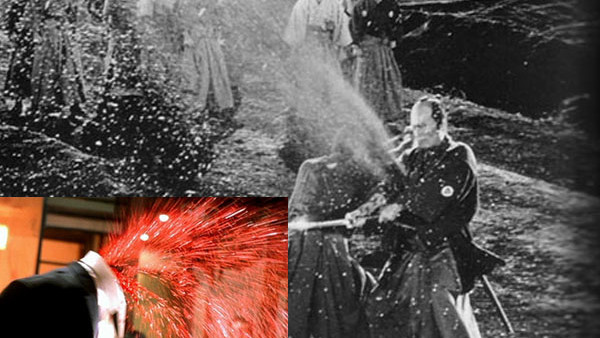
Legenday Japanese filmmaker Akira Kurosawa was hugely influential on other directors all over the world. Western films like A Fistful of Dollars and The Magnificent Seven were direct remakes of Kurosawa's work, while movies like A Bug's Life or even Star Wars also owe great debts to the Japanese director. Modern movie violence was also influenced by Kurosawa's work, but one of his most famous and bloody scenes was actually a total accident.
Sanjuro, the sequel to Yojimbo, ends with the titular hero finally facing off against his nemesis, Hanbei. The pair prepare for a climactic duel, but it's over before it even begins as Sanjuro kills Hanbei in a single strike. A blast of blood shoots out of Hanbei's chest and he falls to the ground. It was a striking effect that had never been seen before, but it was totally unplanned.
A hose attached to the actor playing Hanbei broke, shooting out way more 'blood' than it should have done. The force of the hose nearly sent the actor off balance, but he stayed in character and finished the scene, with Kurosawa leaving it in the final cut. This effect wowed audiences at the time and has become a staple of samurai movies, as well as being used in plenty of Western exploitation films and horrors.
5. Producers Found A Perfect Mask In An Unlikely Place

Few horror movie symbols are more iconic than the Scream 'Ghostface' mask. It's right up there alongside Freddy Krueger's claws and Jason's hockey mask as one of the most easily recognisable images of the horror genre. So you might think that a huge amount of thought and planning went into the design of it, right? Nope, they just stumbled onto the mask totally by accident.
Leading up to filming, the script for Scream mentioned a "ghostly white mask" and the film's designers and prop experts were coming up with all sorts of weird ideas to match that description, but none of them seemed to be sticking with director Wes Craven.
Fortunately, while scouting out an old lady's house as a possible filming location, producer Marianne Maddalena spotted an old Halloween mask lying around. She picked it up and showed it to Craven, who thought it was perfect for the film.
However, as the mask was made by a costume company, the Scream production team wasn't legally allowed to use it. They made a bunch of different versions based on the design, but none of them felt right so Craven chose to just shoot with the original and get in touch with the costume company to work out some sort of deal.
4. A Real Injury Made This Scene Even Better

Leonardo DiCaprio has amazed audiences time and time again, adapting to a wide variety of roles with astonishing ease, and his turn as the villainous Calvin Candie in Django Unchained was one of his more memorable performances of recent years.
One of the most famous scenes involving this character comes when Candie, ruthless owner of the Candyland plantation, invites Django and Dr. Schultz to finish up negotiations for the sale of one of his slaves.
Calvin, who has realised that Schultz and Django are tricking him, suddenly changes his tune, slamming his hand down on the table and changing the deal, while threatening to kill Django's sister right there and then. As he hits the table, Calvin smashes a glass with his hand and blood is seen pouring between his fingers for the rest of the scene, adding a gruesome element to an already disturbing sequence.
This wasn't planned, and that wasn't fake blood. DiCaprio was only meant to bang on the table but accidentally hit a glass in the process. Despite being in a lot of pain, he stayed in character, finished the scene, and Quentin Tarantino loved it.
3. The Lightsaber Sound Was Made By A Broken Microphone

The power of sound is often overlooked, but it plays a vital role in countless films. Horror movies, for example, rely on good sound effects and music to build tension, while many classic films contain iconic sound effects that have become parts of popular culture over the years.
One of the best-known sound effects of them all is the lightsaber "swish". It's easy to imagine that tons of work and testing went into the creation of this sound, with designers and experts going through all sorts of tests and trials before finally settling on a noise that worked. In truth, the effect was, once again, made by accident.
Sound designer Ben Burtt was tasked with bringing the lightsaber to life. It was Burtt's first big film and he was ready to do whatever it took to get the right sounds, even recording a bear's growl to capture a sound effect for Chewbacca.
For the lightsaber, Burtt walked past a TV while holding a broken tape recorder. The microphone picked up a weird buzzing sound from the TV and Burtt thought it would work perfectly as the basis for his lightsaber effect. He still had to modify it a little and mix it with another sound he'd developed, but that random accident helped to bring about one of the most iconic noises of cinematic history.
2. Viggo Mortensen Broke Some Bones In A Memorable Scene

Viggo Mortensen made the character of Aragorn his own in Peter Jackson's The Lord of the Rings movies. The Danish-American actor even performed many of his characters stunts, putting himself in real danger on numerous occasions. This resulted in a couple of on-set accidents that turned into great movie moments.
In the first film, The Fellowship of the Ring, an Uruk-hai tosses a knife towards Aragorn, who deflects it away with his blade. This wasn't actually intentional, and the knife was meant to miss Mortensen's head altogether, but the actor reacted quickly to parry the shot.
Then, in the second film, Mortensen really did get injured, but it resulted in one of his most powerful moments in the entire trilogy. While tracking Merry and Pippin, who had been kidnapped, Aragorn and co discover a pile of burning bodies and worry that their friends have been killed.
In a fit of rage, Aragorn kicks a helmet and screams to the heavens as he falls to his knees. This sequence was scripted, but Mortensen's scream was real. When he kicked the helmet, he actually broke a couple of his toes in the process, resulting in a scream that was part-performance, part-genuine pain.
1. Bad Props Made Jaws A Scarier Film

Steven Spielberg's Jaws is an undisputed classic but was apparently a real nightmare to film. Shooting a movie at sea creates a whole host of problems, and the special effects back in 1975 just weren't as good as they became in the decades to follow.
Production primarily struggled due to constant malfunctions with the three pneumatically-powered prop sharks used in the film. The issues with the sharks actually caused Spielberg to rethink his shoot and rewrite parts of the film.
Originally, the director planned to have the shark appear on screen much more frequently, but the final film only contains a few minutes of shark screen time in total. In addition, instead of actually showing the shark's full face or body, many scenes were altered to simply show the fearsome fish's dorsal fin, creating much more tension and dread. All of this only came about because the props proved unreliable.
Spielberg himself was pleased with the changes, saying that his film transformed into more of a Hitchcock-style "less is more" thriller over time. The reduced emphasis on the shark also forced the actors to work harder at conveying genuine fear through their performances, rather than simply having to react to constant shots of a big plastic shark.