10 Awesome Video Games Where The Gameplay Is The Worst Part
Yakuza is insanely entertaining, but the combat stinks.

If you ask the vast majority of gamers what the most important aspect of any video game is, they'll most likely tell you that it's the gameplay, with only a few exceptions.
Though video game stories have certainly been getting better in recent years, a poor narrative can still be easily excused by first-rate gameplay, because more often than not the gameplay will comprise the bulk of your play-time.
Yet sometimes the gameplay ends up being the worst part of the package, and the storytelling, characters, world-building, and general aesthetics are so damn fantastic that it's still a thoroughly entertaining experience regardless.
This isn't to say that every game on this list has bad gameplay, but simply that it's the least-appealing part of the experience, that its rote, over-familiar, unambitious mechanics are left in the dust by the creative story, eye-watering visuals, and so on.
These 10 video games, the majority of them major AAA smash hits, have all succeeded because they did so much so well, but the gameplay was the absolute least of it, serving as a necessity that players dealt with in order to enjoy everything else...
10. Uncharted

Ever since its inception, the Uncharted franchise has basically prided itself on being a spiritual adaptation of the Indiana Jones movies, defined by its charming cast of characters - namely a roguish Nathan Drake - globetrotting seat-of-the-pants plotting, and gloriously over-the-top action.
And as entertaining a combination as this all adds up to, the moment-to-moment gameplay is by far the worst part of the package.
This is no truer than in the first game, Drake's Fortune, where the brilliant characters and loopy plot give way to tedious, overdone shootouts, and yes, those horrendous jet ski sequences.
Uncharted 2 placed a far greater emphasis on melding cutscenes with actual gameplay, lending the game a more appealing cinematic style, even if it only ramped up the incidence of excessive, frustrating gunfights.
Uncharted 4 finally decided to tone down the repetitive combat in favour of stealth and traversal, but even then, the constant need to use crates for platforming soon became a real drag.
In the last few games in particular, the cutscenes and performances are so fantastically persuasive that the gameplay itself really can't begin to compare. The fairly generic, so-so combat and exploration is elevated massively by the A+ presentation and the cinematic creativity of the set-pieces.
The earlier games in the series especially feel like a chore to play today, and you couldn't really blame someone for just watching a Let's Play instead.
9. Red Dead Redemption 2

A possibly controversial pick, but as much as Red Dead Redemption 2 may well be one of the greatest video games of the last decade, it achieves this distinction in spite of its own infuriating gameplay.
Where storytelling, characterisation, world-building, and presentation is concerned, Rockstar's western sequel is a stone cold masterpiece, and one of the best things the studio has ever produced.
But the core gameplay elements add up to a frustrating slog, because performing even the most basic actions, such as walking, picking up items, mounting your horse, and so on, take so damn long.
Rockstar made a colossal effort to ensure that every single movement feels realistically hefty, but when there's such a mesmerising and huge open world to explore, you can't really blame people for wishing the character animations were faster and "less realistic."
On top of that, the combat is once again relatively mediocre - a constant problem for Rockstar - and arguably the least interesting thing in the entire game.
And yet, the world is so meticulously constructed that it manages to succeed regardless of how truly irritating it can feel to play.
8. A Plague Tale: Innocence

A Plague Tale: Innocence was a surprise hit when it was released back in 2019, a gorgeously straightforward action-adventure game set in 14th century France and centered around two children attempting to outrun both French Inquisition soldiers and swarms of rats.
In terms of atmosphere, tone, and emotion, A Plague Tale is one of the most diverting and unforgettable gaming experiences of the last few years, enough that expectations are enormously high for the upcoming sequel, A Plague Tale: Requiem.
This isn't to forget, however, that basically every aspect of the gameplay pales in comparison to its narrative and aesthetic elements.
The heavy focus on extremely basic, stealth-centric mechanics ensures the general gameplay loop is thoroughly uninspired, even dull, relying on the most simplistic stealth tropes we've all suffered through countless times over the years.
The setting is so beautiful and the characters so wonderfully wrought that leaning on such formulaic, charmless gameplay is a real shame, though somewhat understandable given that Asobo is an up-and-coming studio rather than a flush AAA outfit with the resources of, say, Naughty Dog or Rockstar.
Even so, hopefully Requiem will push the boat out a little more and diversify the gameplay, or in the very least make the stealth more nuanced and fleshed-out.
7. L.A. Noire

L.A. Noire is undeniably one of the most ambitious video games of the last decade-or-so, albeit one that just doesn't quite stick the landing where its gameplay is concerned.
As a hard-boiled neo-noir story, Team Bondi's epic, sprawling action-thriller is riveting from first minute to last, situating its sharply drawn, complex cast of characters within a thickly atmospheric Los Angeles.
Period detail has almost never been done this well in video games: the architecture, costume design, vehicles, and music all feel thoroughly of their time, adding up to one of the most richly convincing game worlds you'll ever play.
It's a shame, then, that the base gameplay itself just doesn't feel much good at all. The widely-hyped interrogation mechanic turned out to be a totally mixed bag, with the misleading options often causing players to accidentally select the wrong one through no fault of their own.
Add to this running and shooting mechanics that don't feel good at all, and the generally repetitive nature of the interrogations and exploration, and you've got a game that, despite its phenomenal presentation and fascinating story, is often a genuine bore to play.
6. Hellblade: Senua's Sacrifice

The case of Hellblade: Senua's Sacrifice is pretty similar to A Plague Tale: Innocence: it's also a lower-budget title that became a surprise success, more off the back of its incredible atmosphere and narrative than its by-the-numbers gameplay.
Superficially, Hellblade has everything a game needs to succeed: a jaw-dropping art style, an interesting story, and an awesome title character.
But the three main pillars of gameplay - stealth, puzzles, and combat - all feel like perfunctory afterthoughts here, as though developer Ninja Theory didn't really want to include them at all.
In addition to offering little sense of challenge, these aspects are presented with no variation on the norm. Ultimately they're bitter pills that players need to swallow to keep chugging through the infinitely more gratifying story and style.
A fair effort is made to make the overall package look more sophisticated, veiling the simple gameplay beneath those incredible visuals - an illusion which sustains well enough thanks to the game's relatively short play-time.
But make no mistake, the elementary combat in particular couldn't feel like much more of an imposition upon everything else the game does so, so well.
5. Shenmue

Perhaps no video game series in history has more successfully traded on the strength of its sheer charm than Shenmue.
The original open world adventure game was an almost unfathomably ambitious title for 1999, and while not much of a commercial success, won itself a swell of committed fans who loved the vibrant character of its world, its mysterious story, and its idiosyncratic tone.
But it's tough to deny that, even over 20 years ago, Shenmue's gameplay was pretty rough.
From the clunky controls to the awkward camera, and tireless commitment to dull "realism," Shenmue matched its gorgeous world and sheer array of Things To Do with maddeningly boring, time-consuming nonsense.
Add to this the fact that combat is infrequent and the QTE sequences are aggravatingly unforgiving, and Shenmue is clearly a game overwhelmingly elevated by basically everything outside of its minute-to-minute gameplay.
And yet, Sega effectively doubled down on this for both sequels, most amusingly the near-20-years-later Shenmue III.
Many players and critics were surprised - if not also annoyed - that director Yu Suzuki made virtually no effort to move the gameplay forward, opting instead to replicate the same rough-around-the-edges, clumsy feel of its predecessors.
A lot of fans continue to fly the flag for Shenmue's methodical gameplay, but it's by far the worst part of an otherwise spectacular package.
4. The Last Guardian
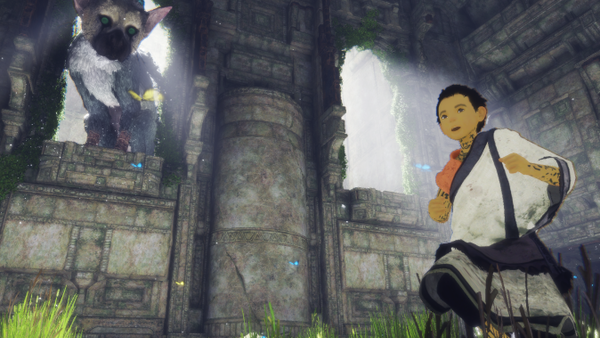
Fans had spent years and years and years waiting for the release of Team Ico's spiritual follow-up to Shadow of the Colossus, and in 2016 The Last Guardian finally hit stores.
The end result was largely accepted to be a for-the-fans outing, delivering the same overwhelming sense of atmosphere as its predecessor, if also struggling with gameplay that left players hugely divided.
The Last Guardian's core loop required players, who control a young boy, to interact with and instruct a fantastical winged creature known as Trico, each employing the other's help to traverse this mysterious land.
Despite its peerless aesthetics, The Last Guardian stumbles where Trico's A.I. is concerned: convincing him to do basically anything is awkward and frustratingly unresponsive.
Though some have defended this as an intentional flourish to reflect the uneasy growing relationship between the boy and Trico, it can make even simple manoeuvring and puzzle-solving a major pain in the ass.
As successful as the game is at building a wordless bond between boy and creature, the gameplay tries its damnedest to undo that by driving players to rage at Trico for not doing what they ask.
And so, it's a game liable to leave you tearing your hair out in frustration while also being profoundly moved by its subtle, environmentally-driven storytelling.
3. The Witcher 3: Wild Hunt
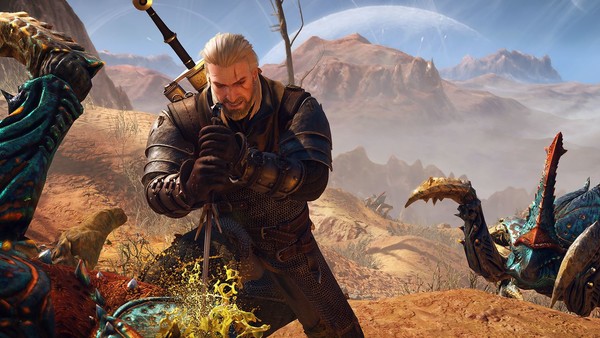
The Witcher 3 is unquestionably one of the most beloved action-RPGs of all time, and a generally phenomenal achievement from CD Projekt Red.
The sheer breadth and depth of the game world, the story and lore, characters, and aesthetic elements are all absolutely masterful, but powered forward by aggressively mediocre gameplay that just can't begin to measure up.
When both walking and riding, The Witcher 3 simply doesn't feel good, which in a game that can easily devour 100+ hours of your life is a real problem.
But far more disappointing is the character-less, repetitive combat. Fighting in The Witcher 3 is most often boring and an unfortunately necessary barrier to continue soaking in its rich world.
Beyond this, the UI is a slog to work with, and ever since launch players have reported countless bugs which, at their worst, can actually prevent further progress.
So much of the gameplay feels like busy-work rather than just leaving players free to giddily explore one of the richest video game worlds ever created.
2. Yakuza

The Yakuza franchise has enjoyed a major uptick in popularity since the release of Yakuza 0 a few years ago, though this has been more thanks to the outlandish storytelling, larger-than-life characters, and ridiculous side content than the unremarkable gameplay.
Prior to the recently released Yakuza 7: Like A Dragon, which shifted the series to a turn-based RPG format, the franchise was defined by its blunt beat 'em up gameplay.
Though many of the games in the series allowed players to select different fighting styles and level up their various abilities, it was still possible to more-or-less button-mash your way through most encounters, especially if you had a massive supply of health and stamina items on your person.
Generally speaking the combat just doesn't feel very intuitive, especially during boss battles where you're often just trying to steamroll your way through their many, many health bars by any means necessary.
It's particularly frustrating when you have to fend off enemies with ranged weapons, and as such the combat pales massively in comparison to the story, characters, and overall vibrancy of the world it's situated within.
Like A Dragon did wonders for the series with its inspired RPG shift, which only makes going back to play the earlier games in the series even less unappealing.
1. Grim Fandango
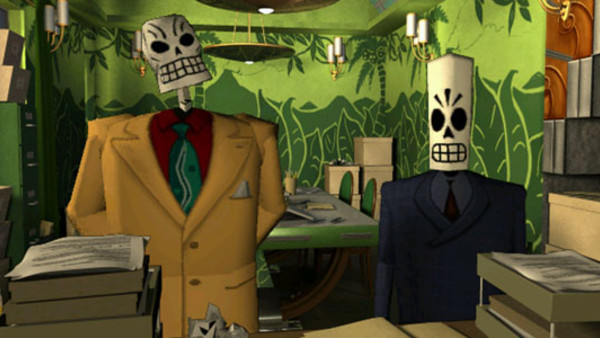
Grim Fandango is basically Tim Schafer's magnum opus - an endlessly witty dark comedy set within a superbly realised, totally unique gaming world, albeit one which requires players to suffer through its insanely aggravating gameplay.
Though the 2015 remaster mercifully fixed the original release's horrendous tank controls, the infamously frustrating puzzles were left entirely in tact.
Even for the standards of decades-old adventure games, Grim Fandango's puzzle design is obtuse as hell, and so all but the most patient of players today will likely end up hitting YouTube for solutions in many cases.
Ultimately the puzzle solutions are often more maddening than satisfying, because they're so aggressively concealed from the player.
Add to this the sheer busy-work that is moving around the game world and Grim Fandango is a game whose narrative and aesthetic accomplishments are undermined by its wilful wading-through-treacle gameplay.
As much as the remaster thankfully didn't change a scrap of the story, it absolutely could've done more to cut down on the time-wasting and general irritation factor.