10 Disturbing Moments In Non-Horror Video Games
10. Lemmings Tackle Dead Giants
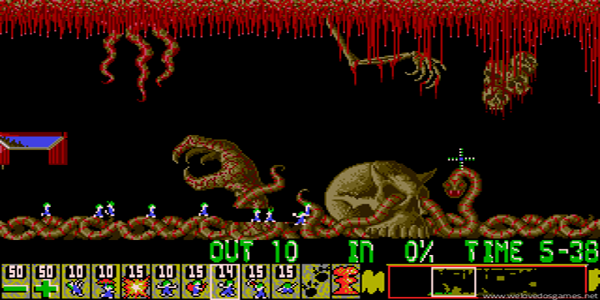 For a game where the central concept revolves around preventing the little critters from accidentally committing mass suicide, Lemmings is actually fun, challenging and surprisingly child-like. Like most devilishly addictive video games, the aim is extremely simple: your Lemmings will move in a single straight line and you have to help them reach their destination safely; all set to maddening FM sound synthesis. It may not sound like much, but Lemmings was the Angry Birds of 1991. So, what's so disturbing about Lemmings? Lemmings had a lot of levels (numbering well over 100), all of which took place in a variety of innocuous environments like Egyptian tombs, tundra and ravines. The art style is about as technical as a doodle on a bar napkin; but like most 16-bit games, it retains a certain whimsical charm. Sure, there are a more than a few strange level designs - including Tricky Level 20, which looks like the Doom interpretation of hell - but the weirdness is usually restricted to M. C. Escher levels. And then you get to Tricky Level 14 (Menacing!!). Now I was a little young to have played Lemmings when it was first released, but this level creeped me out back in 1997. It's pretty tame by modern definition, but the snakes coiling in and around the skull and the bloody goo dripping down from the ceiling are completely at odds with the rest of the game's tone. The change in tone is equally reflected in the music, which shifts from charmingly offbeat, to heavy guitar chugging. And in the middle is the centrepiece of the madness: a gargantuan corpse and writhing mass of tentacles that looks like something out of a H.P. Lovecraft novel. It's as though the Lemmings are causally cruising through Shub-Niggurath's pad with careless disregard. Which, in turn, gets you thinking, "these Lemmings do not give a f**k." Forget memes about sexually deviant sloths, Lemmings will burrow through straight the corpses of Great Old Ones.
9. Max Payne and His Fevered Dreams
 Ah Max Payne, a man who has been cursed to live a hilariously tragic life, but blessed with a haunting, lyrical spirit. The Max Payne games are hard-boiled detective fiction as directed by John Woo. It seems awfully trite now, but its Hong Kong action thriller style choreography was a genuinely ground-breaking mechanic in video games - having only just been popularised in western films by The Matrix two years previously. So, what's so disturbing about Max Payne? Being heavily inspired by film noir and the works of authors like Mickey Spillane and Dashiell Hammett, Max Payne is heavily steeped in pathos, cynicism and is, quite literally, dark. It is in essence an exploration of Max's suffering, as well as the negative aspects of the Human condition. But the power trip that comes from being able to slow down time and shoot an enemy mid-air prevents it from ever being too melancholic an experience. That is until... I dreaded the 'nightmare sequences' for two reasons: firstly, I was a mere snot nosed ten year old not prepared for this kind of nightmarish labyrinth. And secondly, these levels featured confusing navigation, awkward balancing sections and precision jumping. But it is for the first point that it goes on this list. We already knew that Max is a mentally broken man, but here we get a clear insight into his clouded mind and it's like Walmart on Black Friday. There are rooms filled with blood - with trails of it leading out into bottomless chasms - the sound effects are unsettling (Max's wife sobbing, Wilhelm Screams, etc.) and the whole experience captures the canny, yet ethereal, quality of lucid dreaming rather well. I'd hate to imagine what the man daydreams about, considering he permanently adorns an expression somewhere between winning the lottery and realising you are your own father.
8. Exploring Dying Monsters with Banjo
 Despite whatever you think of Rare now, they were once one of the most celebrated developers for the N64, developing some of the systems best games: Goldeneye, Perfect Dark, Conker's Bad Fur Day, Donkey Kong 64 and Banjo-Kazooie/Tooie. Of all of those Banjo-Kazooie was my favourite; it was one of the strongest platformers of its time, and took place in a fantastically rich setting. I mean Spyro may have had dragons, but this game had a snarky bird that lived in a backpack. So, what's so disturbing about Banjo-Kazooie? I anticipate being mocked like some medieval prisoner being carted through the streets; "Banjo-Kazooie, disturbing? Oh no, dear boy," they'll proclaim with ceaseless derision. Banjo-Kazooie is like a Pixar flick (child friendly but packed with adult references), it's funny and cute in equal measure. Sure, there's a haunted house level, a killer shark and a machine that extracts youth from one user to another; but can any part of Banjo-Kazooie be considered disturbing? When it involves this guy, it most certainly can. Based on appearances alone, Clanker was pretty unsettling for this N64 player. The NPCs of Banjo-Kazooie are anthropomorphic creatures, personified inanimate objects or fantastical beings. Basically, typical cutesy, 90's platformer stuff. Clanker, however, is a huge, monstrous, mechanical sea creature - and the first time you see him he lunges forward slightly, letting off a loud groan. He even outdid that frigging eel from Super Mario 64 in the scares department. But his role in the game is actually more disturbing than appearances would suggest: he lives a sad, torturous existence. Grunty, the game's primary antagonist, has imprisoned him and reduced him to garbage grinder; something he isn't too happy about, due to its degrading toll on his body. The entire Clanker's Cavern level revolves around fixing him in small ways, or attempting to avoid the effects of dangerous corruption done to his body. Pretty heavy stuff for a game that opened up with a hearty musical number.
7. Solid Snake and the Corridor of Death
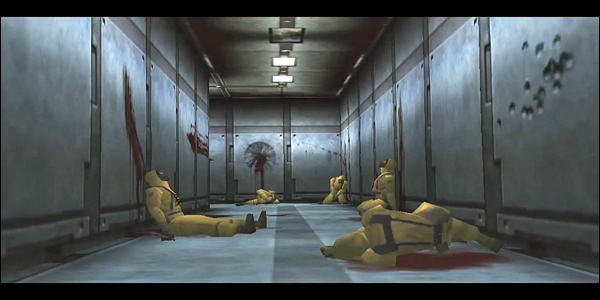 Metal Gear Solid spent more time trapped in my PS1 tray than the Robeson children did under the stairs. It was a revelation when it came out: "ah, so you don't always have to kill your opponents." The quality of the series may have waned over the years, but the original still remains a landmark in gaming - perfectly marrying stealth and action together. MGS also saw the Solid Snake's ascension from badass to badass with a majestic voice. So, what's so disturbing about Metal Gear Solid? Aside from everything about Psycho Mantis, MGS' main source of weirdness came from its hammy antagonists and dense conspiracy thriller plot. If you discount those two aspects, it's actually a pretty grounded stealth 'em up. And whilst the Psycho Mantis stuff does get pretty bizarre, I was too busy having my mind blown by his memory card reading trick to be disturbed by him - even though he does look like he came straight from a Voldo cosplay convention. So nothing too disturbing. But then Snake heads down a certain corridor... What made this scene so effective is that it came out of nowhere. Discounting a few brief appearances from the psychic powered Psycho Mantis; there was nothing too bizarre about Metal Gear Solid. And then we have this grisly image laid on us. The directing of scene is what makes it so effective; Snake enters the hallway and we are shown the bodies through a series of sharp jump cuts, not too dissimilar to an episode of CSI. When the player actually encounters the perpetrator - the samurai sword wielding cyborg ninja, Gray Fox - it's done in such a way that heightens his intrigue: we initially see him as semi-invisible and in the middle of holding an enemy up on his sword. The remake (Twin Snakes) upped the ante and violence as we get to see the entire battle taking place, though this ruined the beautiful simplicity of the original scene. It probably didn't help that by the time Twin Snakes came out, the series' storyline was as convoluted as the average pub story; with robotic ninjas being one of the less questionable elements. Bonus round: Let's not forget the ghost photographs. They're one of those gaming oddities assigned to a long forgotten an era before the internet became truly commonplace. When that one kid from school would tell you that if you took a picture of the urinal in the men's room you would get a super-secret awesome weapon, and you had no choice but to take it at face value. So you took a picture, and, much to your horror, you end up with some utterly creepy results...
 When you realise the 'ghosts' are just the developers blowing off steam by pratting around they do lose some of their effect-
 Good lord.
6. Fable Meets Lovecraft
 The Fable games are Peter Molyneux's substitute for buying a sports car for his 45th birthday. He clearly has ambitious, innovative ideas, but the games he wants to create are similar in scope to the ones you dreamt up as a kid - "I want the game to be like Grand Theft Auto but in space, and you can go to every planet, and every planet has its own economy and society. Oh and the player can turn into a dragon." The latest game, Fable III, is essentially the same as its predecessors, but this time around you get to be King! So, what's so disturbing about Fable III? Well to be honest, Fable III is still a Fable game, so I could pick about ten things off the top of my head that are weird. The games are set in a world where the inhabitants have the social skills of a Sim. Why does it matter if I save the world if I can fart out a rendition of H.M.S Pinafore, and become the biggest social darling since Mr Darcy went to beach without his shirt? But uncanny NPCs notwithstanding, Fable III is just too generic low fantasy to be anything close to creepy. Which all changes when the player visits Aurora. This Eldritch Abomination is The Crawler, the primary antagonist for the second half of Fable III. Its inclusion in the game's events isn't foreshadowed in any way - even though such a lurking threat explains the actions of the previous tyrant king Logan - so when the character ends up stranded on a desert island and is forced to travel through a 'rather ominous cavern,' I was fully expecting to encounter yet more Hobbes or Hollow men. The build-up to encounter The Crawler is fairly atmospheric, with the player discovering diaries written by the now dead explorers which describe the place as home to 'Darkness Incarnate.' And when you actually do encounter the creature, it's a completely different kettle of fish to the game's usual gallery of light hearted monsters; whilst, at worst, they savagely mock the protagonist, The Crawler's dialogue is extremely grim, and more psychological in nature, for example: "The light you bring will die. The light inside you will die. All that you are will die," and "We will snuff out every last light, smother every breath from every mouth, and stop the beating of every heart." It's like Hannibal Lecter guest starring on Mister Rogers' Neighbourhood.
5. Hyrule's Dark Side
 The Legend of Zelda is one of Nintendo's longest running flagship series. It features recurring protagonist Link (that's Link, not Zelda), who is locked in a perpetual battle with Ganondorf. Occasionally the series deviates from the formula, with the greatest offering coming from Majora's Mask - which saw Link do battle with a Skull Kid and his mysterious mask to prevent the apocalypse, and featured time travel elements. So, what's so disturbing about the Legend of Zelda? The series has a long standing tradition of containing dark aspects - some well hidden, some not so - in an otherwise normal fantasy world. When you stop to question why the people of Hyrule allow someone who's obviously a serial killer to run a mask shop and deal with children, you'll probably realise that Link is spending his time saving a rather disturbed kingdom. Here are a few such moments. The Well Dungeon/Shadow Temple

 Without a doubt the most pant wetting sections of Ocarina of Time, which surprisingly take place in the homely Kakariko village. The bottom of the well section, is clearly an ancient prison/torture dungeon, containing: a St. Andrew's cross covered in blood and chains, skulls and skeletons littering the rooms and prison cells and trick floors. There's a strong implication the place is full of tortured spirits, which Link is able to hear. If the ambience wasn't already terrifying enough, you then encounter Dead Hand...The Shadow Temple is more of the same - though heavily suggested to be built as a celebration of Hyrule's hatred - but is also home to the Phantom Shadow Beast: Bongo Bongo; a massive, drum beating monstrosity. The Twilight Realm
 Appearing in Twilight Princess, the Twilight Realm is literally Hyrule's dark side. It was created to imprison a group of dark magicians (with massive balls) who tried to usurp the gods themselves, and steal the Triforce. It's portrayed as a pretty depressing place to 'live,' essentially being a void shrouded in darkness. To make matters worse, it's ruled over by an insane despot (Zant) who mutilates his own people into twisted beings, which look like a Digimon as drawn by Team Silent. He's also working for Ganondorf, so it's basically what would have happened if Hitler didn't break his pact with Stalin. Fact. Mass Death
 Perhaps the most disturbing aspect of the Zelda games is how often the villains actually carry out mass murder. Prior to Wind Waker's story the old Hylian Kingdom is flooded by the Gods, due to Ganondorf being a dick; the Castle Town is destroyed in Ocarina (again by Ganondorf), and its inhabitants turned into Re-Deads. These are canonical events; as in 100% happened in the game's setting. Wind Waker also suggests that Tingle (that 35 year old man fairy) is a mass murderer - to the surprise of absolutely no one. In Majora's Mask the whole objective of the game is to prevent the apocalypse by way of demonic moon - though pretty much everyone in that game is harbouring some dark secret. The murder rate in the Zelda universe puts Midsummer Murders to shame.
4. Psychonauts Explores Millas Secret Room
 Psychonauts is a quirky platformer by Double FineProductions. It's also the internet's go-to game when arguing that the majority of gamers are an unappreciative bunch; because, like most modern Tim Schafer projects, it did lousy in the sales department - but became a cult classic. So, you play as young psychic Raz, who runs away from the circus to become a Psychonaut, and explore the minds of the many zany characters he comes across. Picture Inception written by Dr. Seuss, and you'd be half way there. So, what's so disturbing about Psychonauts? Lots. It takes place in the warped minds of some down-right bizarre characters after all; so you end up exploring places like the Meat Circus. There's a lot of eclectic ideas mashed together, but it's all done in a cartoony way so it doesn't end up any stranger than watching an episode of Courage the Cowardly Dog. Just don't look at what's in the sky during the Asylum level if you want to keep your sanity. As the game progresses the tone gets progressively darker; so when you go into the mind of the Brazilian Milla, it's quite a pleasant surprise to discovering it's essentially an uplifting seventies dance party. But then you find the obligatory secret room. Well, what can be said about this? It's quite a shocker and packs an emotional punch. We learn that Milla was once in charge of looking after children at an orphanage, which was burnt down during an accident killing the children. This is obviously something that haunts Milla, which would be disturbing enough, but the game goes one step further. Upon entering the chest in the room Raz is teleported to a carousel/fiery cage hybrid. Strange creatures - that I'm assuming are manifestations of the children - circle the outer area and cry out several disturbing phrases: "Save us... Save us!" and "Why did you let us die?" It comes across as pretty mean-spirited for a game that's largely a laugh a minute; like whenever a sitcom does an infertility episode. But at least when compared to most games, this little tale is deeper than the sunken city of R'lyeh.

3. Strange Metaphors Abound in Earthbound
 Earthbound is pretty much the defining example of when it's okay to use the severely overused phrase, "are you afraid of making money?" It's officially the second game of the Mother trilogy, but is (so far) the only one to be released outside of Japan. I have no idea why this is, Earthbound is a cult classic, and there have been countless requests and petitions for the other two games to be localised. Like I say, it's almost as though Nintendo are terrified of making money - something which could well be true, if their current direction is any indication. So, what's so disturbing about Earthbound? Nothing. Nothing at all. It's a cartoony, traditional RPG involving aliens, and an assortment of other critters. Seriously, it's all sunshine and lollypops, and devoid of any references to wombs or abortions or primordial evils powered by the tears of abused kittens. Nope. Nope. Nope. Okay so, Giygas may be a rather obvious choice considering that - along with loss of anonymity and Slender Man - he's scared the jimmies out of the internet collective; but I just couldn't leave him off this list. Everything about him screams disturbing: he's symbolic of an aborted foetus, he was inspired by a rape scene in a film which traumatised Shigesato Itoi as a child, and he's appearance is just downright malevolent. Like most of the entries on this list, he comes out of nowhere. Yes, we know the aliens are behind the events of the game, but the aliens you encounter and battle throughout the game are cutesy and thoroughly Nintendo-esque. Giygas is meant to be evil personified. But that there is the rub: Giygas is merely a tool of Pokey, who abused the fact Giygas has lost his mind and imprisoned him, hoping to use his power for his own nefarious purposes. So the embodiment of every negative trait is now a slavering beast? Seems like a somewhat undeserved reputation there. Giygas is shown to have at least some redeeming qualities - despite being terrifying - seeing as how he seemingly cared for his adoptive parents; whereas Pokey is simply a traitorous little bastard.
2. Snake's Sorrow
 And again we have a Metal Gear Solid game on this list. Snake Eater, or MGS 3, takes place in the mid-sixties and explores the formative years of the legendary Big Boss (at this point known as Naked Snake). Given that it takes place thirty years before the Solid game, it served as a breath of fresh air after the multi-threaded mess that was Metal Gear Solid 2's story, whilst still building up the series' complex lore. The game built up on the already strong stealth aspects of the previous instalments and added survival mechanics (like hungry and individual wounds to heal), but kept the emphasis on fun, tactical gameplay. So, what's so disturbing about Metal Gear Solid 3? Snake Eater is one of the wackier MGS games, taking its established setting and plonking it straight down into the sixties - in a sort of Connery era James Bond/Rambo spoof. And it's for that reason why Snake Eater is my favourite game in the series - Hideo Kojima knew the franchise was bonkers, so clearly just decided to have fun with it: why not have a boss that's so old you could just wait a week until he died; or let Snake have a playable nightmare about vampires. It's like a Naked Gun game that has you fight a giant mecha at the end. Still, it is a Metal Gear Solid game, so some of the weirdness is a bit too 'out there.' Though this peculiar river sequence takes the biscuit. The Sorrow is one of the game's bosses, and is a member of Snake Eater's equivalent to Foxhound. He continues the tradition of having a Psycho Mantis like opponent in every instalment (Vamp - MGS2, Screaming Mantis - MGS4), though his powers and abilities relate more to manipulating the spirit world than the real one. What sets him apart from his contemporaries is that the entire battle with him is essentially a mini-judgement day. He is punishing Snake for every murder that he - or more accurately, the player - has committed throughout the game. Depending on how many people you killed prior to this point, you could potentially be wading through a never-ending river of hundreds of ghosts. It's quite an interesting game mechanic; one that causes the player to reflect on the ridiculous kill counts that we rack up in games. The Sorrow also taunts Snake with a lot of foreshadowing towards the destructive chain of events he will become a part of (leading the birth of Les Enfants Terribles). You can't kill him either; in fact the only way to end the battle is to let him kill you - or kill yourself. That's right; a stealth game that berates you for killing then expects you to kill. Make up your mind Kojima.
1. Cradle Snatching in Thief
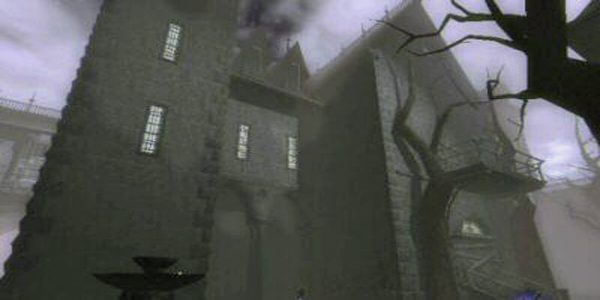 Few games have ever done stealth as perfectly as the Thief series. Looking Glass Studios/Ion Storm understood that what made for good stealth wasn't forcing in mandatory sneaking sections, or slapping a half-baked mechanic in as an afterthought to appease those bored of the constant shooting, but establishing a fluid, flexible that rewards patience and ingenuity whilst still be forgiving. Some of the best moments I had in my early PC gaming days were played out on Thief games; because there's nothing more satisfying than playing with the minds of oblivious guards. So, what's so disturbing about Thief III? The Thief games have always managed to maintain a tense atmosphere throughout -unsurprising, considering you are relieving questionable types of their possessions - but they have a rich tradition of having at least one utterly terrifying level per game. And although they ostensibly take place in a dark fantasy setting, they're not exactly horror games. The third entry into the series sees Garrett attempting to deal with the internal struggles of the Keeper Organisation (balance keepers of sorts), only to end up against a serial killer of legend - who turns out to be very real. Despite this, I wouldn't say the game is particularly creepy; at least not until you go to Shalebridge Cradle. And then it cranks the horror up to eleven. The history of Shalebridge Cradle is already dark and twisted enough to scare the beard off Action Hank; it started out as an orphanage (check), before becoming an insane asylum/orphanage (check again) where horrific experiments were carried out on the inmates (that's a perfect trifecta), helping to establish a simmering resentment between staff and inmate that later led to an extremely destructive fire. Shalebridge is also the place where Inspector Drept, as an orphan, first encountered The Hag. So essentially, you're being asked to explore a creepy, abandoned building that has haunted written all over it. The level is known for its oppressing atmosphere, with large portions of it spent entirely alone wondering if the discordant noises are merely for ambience, or a sign that something unpleasant lays ahead. As you progress the level becomes increasingly horrific, as you encounter the inhabitants of the Cradle - the repugnant, mutilated former Asylum patients, and the ghosts of the staff - and are forced to realise that the building has some sort of sentient presence that is somehow aware of your being there. But the crowning moment of disturbing comes when you have to pretend to kill yourself by jumping out of the window. That's the only way you can escape the evil machinations of The Cradle; which is something of a metaphor for modern life really.
