10 Genius Ways Video Games Fixed Their Own Mistakes
It wasn't supposed to be this way.

With the utterly mind-boggling number of variables that go into creating even a terrible video game, it's little surprise that mistakes are made, and often these mistakes will only scarcely be papered-over in the final game, if at all.
But smart devs know how to pivot and take a potential limitation and turn it into a win, be it a technical constraint requiring a creative workaround, transforming an erroneous line of code into an actual feature, or even just embracing the jank because the fans love it so damn much.
These 10 games were all beset by major technical issues either during development or once the game was out in the wild, requiring the devs to think quickly and come up with seamless solutions.
The results speak for themselves, creating iconic moments nobody could've seen coming, enlivening the player-base and maybe even creating a classic game in the process.
As a testament to ingenious problem solving, these 10 fixes for nagging issues, combined with a little luck and good timing, contribute to these games being as memorable and beloved as they are...
10. Thick Fog Was Used To Conceal Poor Draw Distance - Silent Hill

Apart from Pyramid Head, what's the most iconic visual element of the Silent Hill franchise? Fog, of course, which has been used throughout the series to layer the titular town in a literal air of mystique as you venture through it.
But for Konami, this wasn't so much an artistic concern as it was a technical one, as the limited nature of the PS1's hardware meant that it couldn't continually render the entirety of Silent Hill while the player moved around it.
The fog was conceived as a mask, then, to conceal the fact that the game was only rendering the environment in the player's close vicinity, a fact that would be painfully obvious without said fog.
Ultimately it was praised by critics and fans as an atmospheric device, steeping the player in the unknown and forcing them to tread carefully as they explored the town, even if it started out as nothing more than a technical necessity.
Though later games in the series didn't need the fog, it became so iconic with fans that Konami sensibly kept including it.
9. Hardware Limitations Created Gaming's Difficulty Curve - Space Invaders

In another classic example of developers turning a technical limitation into a classic gameplay feature, Space Invaders was actually created with the intent that the aliens would all move towards the player at the same speed throughout a level.
However, the devs discovered that, as aliens were destroyed and the hardware had less objects to render on-screen, the aliens' movements would increase in speed. Oops.
They quickly realised that this added a challenging, intense wrinkle to the core gameplay, and decided that it would stay in the game.
It of course became an iconic staple of the series that even those who've never played Space Invaders might be aware of, though of course, in subsequent entries the speed increase had to be specifically coded into the game rather than merely relying on deficient hardware.
8. Erratic Cop A.I. Gave Birth To Grand Theft Auto

The Grand Theft Auto series is an unstoppable commercial juggernaut today, and it's impossible to imagine the modern video game landscape without it.
But the series' existence as a blood-soaked cops 'n' robbers "crime simulator" was very much a happy accident, as what would become the original GTA was initially conceived by DMA Design (aka Rockstar North) as a top-down multiplayer racing game called Race'n'Chase.
Race'n'Chase bore a passing visual similarity to GTA, albeit without much of its eventual visual personality, and internal play-tests were generally met without much fanfare.
Until the cops started glitching out, that is.
Indeed, a seemingly random glitch caused the game's police cars to act hyper-aggressively towards the player, desperately attempting to ram them off the road at any cost.
Testers were naturally amused by this, with their enthusiasm for the glitch prompting DMA to re-shape the entire game around the tension between cops and criminals. And thus, GTA came into existence, and grew to become the AAA mainstay we know it as today.
7. Reverse Friendly Fire Trolled The Trolls - Rainbow Six Siege

Say what you want about Ubisoft, but their post-launch support for Rainbow Six Siege has been nothing short of exemplary, despite soft sales out of the gate.
Nevertheless, one of the game's most pervasive complaints for literally years was how freely it allowed griefers, namely teamkillers, to troll players free of substantial punishment.
Ubisoft received flak for their failure to address this until, earlier this year, they finally introduced Reverse Friendly Fire.
If one player kills a teammate, the victim has the choice of confirming that the kill was malicious or forgiving it for being genuinely accidental.
If the player doesn't forgive, RFF is activated for the offending TKer, meaning that any further damage inflicted upon their team would simply be mirrored back at them.
Though like any anti-griefer system it's not a perfect remedy - as trolls will always find a way - it is nevertheless a smart way to discourage mischievous players from ruining everyone else's fun.
6. A Virtual Epidemic Became An Emergent "World Event" - World Of Warcraft

The Corrupted Blood incident was a virtual plague that spread throughout World of Warcraft for a week in 2005, after Blizzard updated the game with a new raid.
The raid concluded with players battling the boss known as Hakkar of Zul'Gurub, who could hurt players with a debuff called Corrupted Blood, which could spread between party members and kill lower-level players within seconds. Though the debuff was supposed to disappear upon a player's death, many reported that their pets would remain infected upon resurrection, and the "disease" quickly began spreading through several of the game's servers courtesy of these afflicted pets.
Skeletons littered the streets, and while chaos reigned, Blizzard made the decision to hard-reset the servers to fix the issue.
Blizzard eventually stopped the plague by making pets immune to Corrupted Blood, yet even once things returned to normal, players debated whether or not the outbreak was indeed a glitch or not.
The plague proved popular enough that it was even studied by disease prevention institutions and Universities worldwide, in order to further track how infections spread and humans behave during a crisis scenario - even a digital one.
While for many games such a glitch could've been the kiss of death or at least presented a major PR problem, World of Warcraft's fiercely loyal player-base toughed it out and even embraced the insanity, as did Blizzard themselves.
5. A Poorly Programmed Pig Was Turned Into The Creeper - Minecraft

Creepers are among the most infamous and annoying enemies in Minecraft, given the green blobs' tendency to sneak up on players, explode and either kill the player or deal damage to their creations.
But Creepers are in fact another case of an error during development that was re-worked into an actual feature.
According to Minecraft creator Markus "Notch" Persson, he was trying to create a pig, but accidentally coded the incorrect dimensions, resulting in a creature that was tall rather than long.
Notch ultimately decided not to scrap his abominable creation, instead shading it green, coding some aggressive attack routines and inserting it into the game, whereafter it became a legendary - and legendary annoying - Minecraft mainstay, and still is a whole decade later.
4. Tiny Tina's Lazy Eye Glitch Became A Character Trait - Borderlands 2

Loopy thirteen-year-old explosives expert Tiny Tina was introduced to players in Borderlands 2, and quickly won over fans with her colourful - that is, insane - personality.
Her distinctive appearance also made her a tough NPC to forget, compounded by the fact that she had a lazy eye, occasionally causing her to look in two different directions at once.
Intriguingly, this wasn't actually intentional, but a glitch in one of Tina's eyes. However, Gearbox's devs decided that it fit her scatter-brained character so well that it wasn't worth fixing.
No word yet on whether or not Tina's affliction will be "fixed" for Borderlands 3, but given how little representation there is for sufferers of amblyopia in the video game world, hopefully not.
3. Gandhi's Accidental Bloodlust Became A Running Franchise Gag - Civilization

Surely the greatest running gag in the beloved turn-based strategy franchise Civilization is the fact that, despite his real-life reputation being that of a strident pacifist, Gandhi is one of the most blood-thirsty playable leaders in the Civ games, with a greater penchant for firing nukes than anyone else.
And while many fans no doubt accepted this as an ever-intended, playful gag sending-up Gandhi's peaceful nature, in the original 1991 Civilization game, it was actually a mistake that developer MicroProse transformed into a feature that's pervaded throughout the franchise ever since.
Gandhi was originally supposed to be coded as the least-aggressive leader in the game, with a rating of just 1, while the highest possible aggression rating was a possible 255.
But when the player achieves Democracy, a leader's aggression rating drops by 2 points, resulting in Gandhi's rating looping back around to 255, rather than -1, making him by far the most aggressive entity in the entire game.
Though Gandhi's aggression wasn't anywhere near as cartoonish as this in future Civ games, the devs nevertheless maintained his fondness for dropping nukes well above the norm as a cute little enduring reference to their initial screw-up.
2. A Player Name Glitch Inspired The Spy Class - Team Fortress

Spy is one of Team Fortress' most popular classes, given his ability to turn invisible, feign death, and even disguise himself as any class on either team, allowing him to easily murder unsuspecting enemies.
But Spy's genesis dates back to the original version of Team Fortress, which was of course a mod for Quake.
During testing, the dev team discovered a glitch where a player's name would randomly appear in the incorrect colour, implying that they were on the opposite team.
The bug was fixed sharpish, but this planted the seed of what would eventually become the Spy class, noted for his penchant for confusing the opposing team as much as possible.
Spy remains a fan favourite class two decades later, no doubt in part because of another mistake that made its way into the follow-up, Team Fortress 2.
Spy returned in his shinier new form (pictured above), but a glitch allowed players to perform a bizarre and hilarious walk called the "Spycrab", by equipping the Disguise Kit, holding down the crouch button, looking up and walking forward.
The absurd results speak for themselves, really.
The glitch was beloved enough by fans that Valve didn't have the heart to patch it out, and over a decade after its discovery, it's still in the game.
1. Rocket Jumping Became A Core Gameplay Strategy - Quake
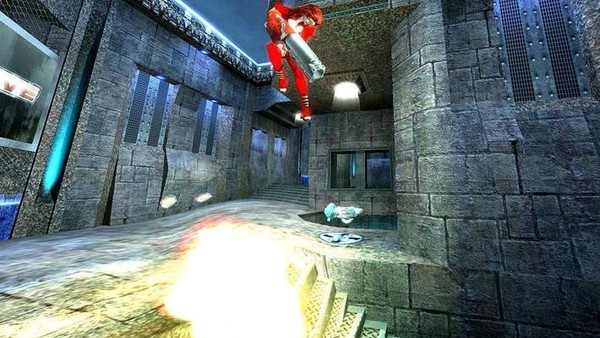
Rocket jumping is a simple exploit, by modern standards at least, that players quickly began to manipulate in the original Quake for the purposes of moving faster and higher around the map.
All it required the player to do was point their rocket launcher at the ground and jump as they fired it, the perfect timing of which would catapult players across ridiculous distances in record time.
Once developers id Software learned of this, they began designing maps with rocket jumping in mind for future games, and even had the A.I. opponents perform their own rocket jumps in the incredible Quake III Arena.
In doing so, id took a cheeky exploit of the game's physics engine and transformed it into a legitimate, recognised gameplay option that's used in a massive number of FPS titles today. If that's not embracing your flaws in the most awesome way, what is?