10 MORE Harsh Ways Video Games Punish You For Rage Quitting
Don't be a dunce.
No matter how calm your temperament might be, we're all guilty of a gaming rage quit every now and then, be it fleeting anger at an opponent's inexplicable comeback, or getting decisively stomped in your fifth consecutive FIFA match.
Players taking their ball and going home are so common in online multiplayer games that many devs have come up with their own novel solutions to combat them, whether ruthlessly efficient or brilliantly creative.
Though the primary goal is typically to provide a smoother experience for those gamers playing by the rules, the best way to do this is often to de-incentivise rage quitting through punishments for the offending lot.
Pretty much any popular game is sure to be rife with this behaviour if left unchecked - just check out the recent Apex Legends debacle - and while it's impossible to ever fully stamp it out, there are certainly clever ways to minimise the disruption to everyone else.
You have to feel sorry for those poor souls genuinely suffering through connection issues, but in order to provide a quality experience to as many players as possible, these measures were absolutely necessary...
10. Mortal Kombat 11's "Quitality" Makes Your Body Explode

There's perhaps no genre more prone to infuriating rage quitting than the fighting game, and though developers have sought various means to penalise those who bail out after taking an early beating, NetherRealm came up with a more creative punishment for their Mortal Kombat games.
Mortal Kombat X introduced the concept of a "Quitality", where a rage quit or disconnection would instantly cause the offending player's head to explode, raining the grisly, bloody mist down over the remaining player.
The recent Mortal Kombat 11 took this one step further, with the re-worked Quitality now coming in two forms: either the player's entire body would explode into a fountain of glorious gore, or they'd be impaled from behind by a giant spike totally out of nowhere. Nice.
Rage quitting is always going to frustrate beat 'em up fans, but at least this gives the player left behind a gnarly conclusion to the fight rather than an abrupt return to the menu complete with a "connection lost" text box.
9. Dark Souls II Removes Players' Summoning Abilities

Dark Souls II's online multiplayer allows both co-operative and PVP play with fellow adventurers, but because some players want to flat-out avoid being invaded by others, it's not uncommon for people to force-quit the game (as the conventional "quit" option disappears once connected to another player).
Do this a few times in quick succession, however, and your online experience will be dramatically altered with all summoning privileges being revoked, meaning you can't call players for help nor be drafted in to help out others.
Hilariously, though, you can still be invaded, and the only way to restore a good faith connection is to use an item, the Bone of Order, one of which is given to players at the start of the game, presumably for the sake of those suffering through genuine connection problems.
Once the Bone of Order is used, however, players won't get another chance to retrieve one for an estimated 10-14 hours of play without incident, making things decidedly less fun for the habitual rage quitter.
8. Super Smash Bros. Ultimate's Lack Of Host Migration Punishes EVERYONE

As wonderful as Super Smash Bros. Ultimate is, its lack of host migration during online multiplayer matches is absolutely infuriating.
When you combine the quit-happy nature of fighting games with the fact that Smash online fights typically involve at least four players (and therefore at least four connections), the inability to migrate connections between hosts is a massively fatal flaw.
As a result, if the host decides to rage quit, the server instantly dies.
This is especially infuriating in Battle Arena mode, which allows 8-player lobbies with 4 players fighting while 4 players spectate. If the host gets bored while waiting to fight, they can ruin everyone's game.
The only slight positive to this is that it presents a unique punishment of sorts for the rage quitter, emphasising the selfishness of their actions and perhaps guilting them into not pissing off the other players.
Granted, the anonymity of Smash online makes it easy for hosts not to care about bailing out on a game, but maybe it'll give some players a moment of pause before quitting.
7. League Of Legends Puts The Player In A Low Priority Queue For 5 Games
There's no question that a game as absurdly popular as League of Legends is going to invite its fair share of bad actors - and, let's be honest, emotionally immature teenagers - who upon the first sign of defeat will pull the ripcord and take the easy way out.
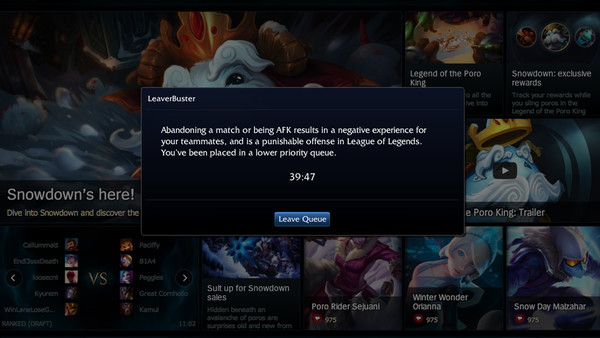
The game's developer, Riot Games, came up with a novel system called "LeaverBuster" to de-incentivise rage quitters, by placing offending players in a "low priority" queue.
Rage quitting is rife enough in the game that Riot freely admits even just a few honest disconnections is enough to get you in the queue, but here's the kicker - to exit the low priority bucket, you need to play 5 matchmade games without further incident.
Given that these games can last from 20-40 minutes, that's quite a time investment in order to clear your name.
Further still, if players continue to rage quit while in low priority, the wait timer between matches will increase from 5 minutes all the way up to 20, at which point you may as well just make a new account, honestly.
Riot's hilariously stern FAQ about LeaverBuster also makes it abundantly clear that there are no circumstances where they will remove players from the low priority queue manually, which is really the ultimate indication of just how pervasive rage quitting is throughout the game.
6. Grand Theft Auto Online's Dunce Hat For "Bad Sports"
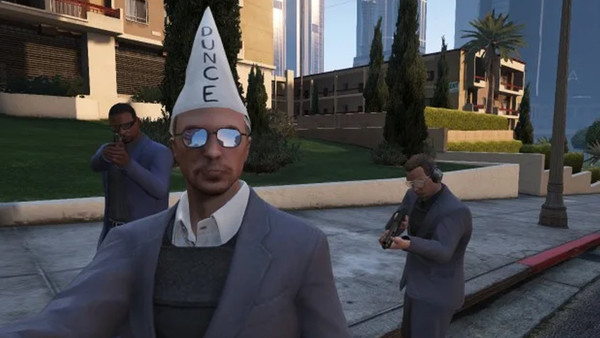
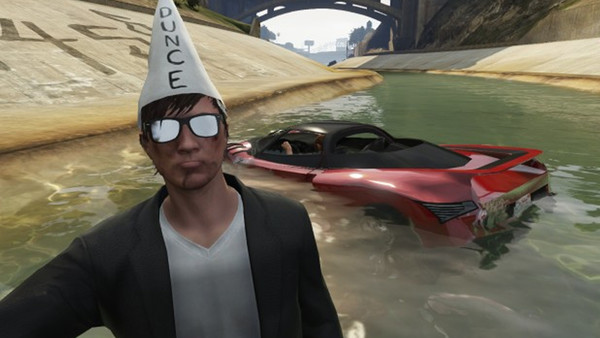
Grand Theft Auto Online was always going to invite its fair share of trolls and petulant players, yet in typically tongue-in-cheek form, Rockstar Games came up with a unique way to shame these "bad sports."
Players who routinely act as sore losers by rage quitting from Jobs or partaking in anti-social behaviour such as blowing up other players' personal cars will quickly find themselves labelled a bad sport, which includes the humiliation of having to wear a dunce hat.
Worse still, you'll be matchmade with other bad sports, with the first offence lasting around two days, while each subsequent bad sport designation increases the punishment time.
5. Destiny 2 Bans Players For 30 Minutes (Or 2 Weeks)

After the feature was long requested by Destiny 2 players, Bungie finally decided to issue stern punishments to rage quitters last year in the game's PvP multiplayer component the Crucible.
The penalty system typically issues "habitual quitters" with 30-minute temporary bans, with Bungie insisting that the context of the quitting/disconnections didn't matter and the policy was one of no-tolerance - they would give them even if players were "getting the door for a food delivery." In extreme cases, however, players have been banned for up to two weeks.
Given the ludicrously addictive nature of the Crucible, it's certainly a solid punishment, though disappointingly only applies to Competitive playlists, which don't replenish team members who quit.
This effectively ensures a rage quit leaves the remainder of a match fundamentally unbalanced.
Fans are still hoping Bungie might bring the punishment to the Quickplay playlist eventually, because that's where it's really needed most.
4. Mario Kart Wii Docks Players Excessive VR Points

Mario Kart Wii introduced the versus rating (VR) system for multiplayer races, with points earned based on your performance. Place well and you'll earn fat stacks, but end up in last place and you'll lose a huge chunk.
The system was rather controversial with fans at the time of the game's release, if only because it became extremely tough to continue building up VR after passing the 6-7000 mark.
You'd need to win multiple times in a row to compensate for one merely mediocre fourth-place performance, for instance, and the exact mathematics behind calculating your final score weren't easy to figure out.
The game did make smart use of this system to penalise players who rage quit, however, docking them potentially hundreds of points for a single incomplete race, impacting them far worse than had they just taken their last place loss with dignity.
This did prove infuriating for honest disconnections, though, with the resulting point loss potentially wiping out hours of progress.
3. Guitar Hero Live Deprives Quitters Of Hard-Earned Tokens

Guitar Hero Live's online functionality was sadly switched off by Activision late last year, killing not only its online multiplayer but also its much-loved GHTV mode, where players could strum along to an ever-rotating series of songs complete with their music videos.
But in order to pick a specific GHTV song rather than cycle through the randomised playlists, players needed to spend a Play Token, one of which was earned after playing a few songs in succession.
Given how not-generously they were doled out, and how aggressively the game was trying to nudge players into spending real money on the tokens, they were naturally extremely valuable.
And so, Activision decided to use these tokens to punish nuisance players, with those who rage quit in the competitive Rivals Arena mode being docked tokens, while also being matchmade with other quitters.
As much as Guitar Hero rage quitters suck, Activision was ultimately enacting this punishment more for their own capital gains than to benefit the fanbase, if we're being honest.
2. Splatoon 2's Strongly Worded Message (And Temporary Ban)
Though Splatoon 2 is one of the most adorable AAA shooters on the market, don't assume that Nintendo would simply prove themselves a soft touch with rage quitters.
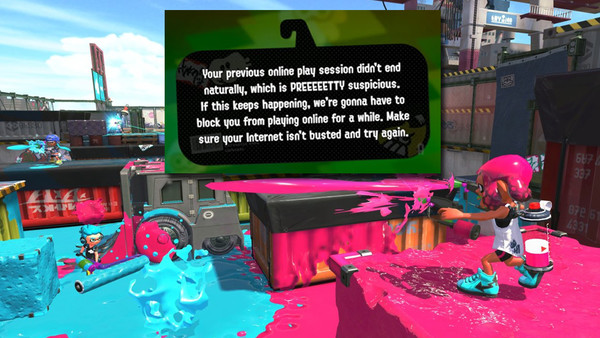
If players quit or disconnect numerous times in succession, they'll receive this stern yet hilarious message, insisting that their behaviour is "preeeeetty suspicious", and warning that if it keeps happening, a temporary ban will be enforced, before advising the player to sort their Internet connection out.
Granted, you'd need to be a bit of a loser to rage quit during Splatoon 2 anyway: the rounds are incredibly short and you're still rewarded with points even in defeat.
The lack of differentiation between rage quitting and disconnections is admittedly a bit of a shame considering how rubbish the Switch's WiFi is, though.
1. Tekken 7 Basically Makes You An Online Leper
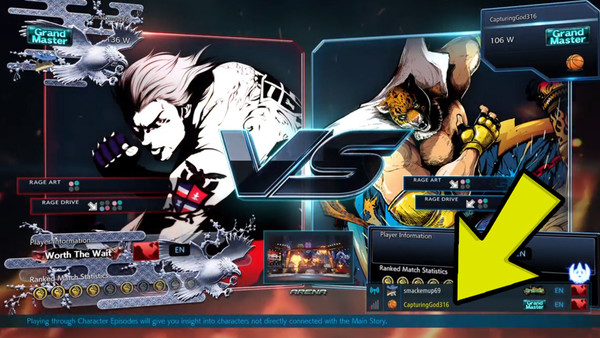
Though it wouldn't suit the Tekken franchise to start exploding players' heads or impaling them with giant spikes, the latest entry into the classic fighter series came up with a simple yet elegant way to earmark troublesome players to potential opponents.
During matchmaking, players with a high disconnection rate will have their name highlighted in yellow, and if they persist with rage quitting or disconnecting, their name will turn red.
Better still, this information is presented to players before the fight, quickly allowing them to reject a suspect fighter and immediately return to the matchmaking pool.
Rage quitters having to sit through multiple rejections from fellow players before finding a successful match is surely all the incentive they need to stop being a baby, right?
These demotions can eventually be undone, but only by playing nice and lowering their disconnection %.