10 Most Controversial Video Games Of All Time
Stalking scantily-clad young women in a house? That's 90s video games.

Adult-themed games date back to the early days of home computing, but by the 1990s, graphics and sound were sophisticated enough to take this to a new level.
It was during the 16-bit era, when the SNES and Mega Drive ruled the roost, that the authorities decided the depiction of graphic violence and sex on consoles was cause for concern, leading to the creation of the Entertainment Software Rating Board - a body charged with assigning movie-like certificates to games.
An industry watchdog was long overdue, but it did little to stem controversy in the medium. In fact, some of the more notorious games came out in the wake of its formation, from ultra-gory shooters that were blamed for corrupting impressionable teens, to crime sims that rewarded players for being downright gratuitous.
Like any entertainment medium, video games have rattled its fair share of cages over the years, and some of the more contentious titles have found themselves banned in numerous countries, or they're hacked to bits through censorship.
While it's important to remember that there are countless beneficial titles out there - scientifically proven to boost things like hand-to-eye coordination, memory and problem-solving - it's usually the games that caused uproar and sparked moral panics that stick in our minds.
10. Grand Theft Auto (Series)

No gaming franchise has courted controversy quite as consistently as Grand Theft Auto. It even has an entry in the Guinness Book of World Records for doing just that.
From the 1997 original to 2013's GTA V, Rockstar's crime simulations have allowed players to commit every immoral act under the sun, and usually rewarded them for it.
This includes carjacking, gun crime, torture, drug dealing and even a bonus sex mini-game called Hot Coffee, which had US politicians spitting out theirs in disgust.
Although such content has seen some countries outlaw certain entries in the series, only one nation has banned Grand Theft Auto outright and that's Thailand, which blamed it for the murder of a Bangkok cab driver in 2008.
The eternal firestorm of controversy has done nothing to harm GTA sales, however, with the latest instalment making more than a billion dollars in three days and continuing to rack up impressive sales to date.
9. Carmageddon

As Carmageddon was based on mowing down innocent pedestrians, it came as no surprise when the game's road to home consoles turned out to be a bumpy one, paved with contention.
Stainless Games's drive-em-up was your standard vehicular combat affair with one key difference: it rewarded fans for knocking down members of the public and killing them.
Given that courting controversy rarely hurts sales, publisher SCI submitted the game to the UK's BBFC in the hope of earning an 18 certificate, but this quest for infamy hit a snag when the watchdog refused to classify the game, only passing it uncut after months of appeals.
The original Carmageddon was censored in numerous countries and only cleared for release in these territories when the developers swapped out the human pedestrians for zombies and robots, two things that have provided gamers with guilt-free targets since time immemorial.
8. Mortal Kombat (Series)

GTA may hold the official record for igniting the most controversy, but Mortal Kombat caused bloody murder in its day and the uproar it sparked was a driving force behind the creation of the Entertainment Software Rating Board.
The fighting series, which debuted in 1992, gave parents nightmares with its blood-soaked battles and grisly, over-the-top fatalities. And to be fair, it earned its MA-13 rating with Subzero's trademark decapitations alone.
Gory finishing moves became a tradition for Mortal Kombat over the years and they only got more graphic as gaming hardware grew more sophisticated, with the most recent instalments scoring a hard 18 certificate in the UK.
Needless to say, these games are not for kids and never have been, but that hasn't stopped countires including Korea, Malaysia, Germany and Brazil from banning them.
7. Custer’s Revenge

It's impressive that developer Mystique managed to cause so much offence with little more than a few dozen primitive pixels and a limited colour pallette, but that's literally the only impressive thing about Custer's Revenge.
Tawdry sex games were the industry's dirty secret in the Atari 2600 era, and this one was sold in a sealed package with "not suitable for minors" emblazoned across it.
In truth, Custer's Revenge shouldn't have been sold to anyone because it wasn't just a sex game: it was a rape game with added racism and the epitome of bad taste.
Players took control of the eponymous American Civil War general and were tasked with assaulting a Native American woman as many times as possible. For obvious reasons, the game was met with protests from Women’s rights groups, Native American groups and other activists.
Mystique was even sued by Atari for releasing the game and it was eventually pulled from shelves, but not before the media attention and notoriety sparked a sales spike among consumers with absolutely no scruples.
6. Night Trap

With the advent of the CD-ROM, video sequences powered by FMV became possible on home consoles, and that came with its own set of problems in the absence of an industry watchdog.
Case in point, Night Trap for the Sega CD used the technology tastelessly in the eyes of some, as its depiction of scantily-clad women was deemed sordid enough to hold a Senate hearing about such content in games.
Despite coming across as slightly smutty at times, Night Trap was tame in hindsight and actually tasked players with saving said girls from sci-fi-style vampires by setting traps for the evil predators.
This mix of schlock horror and half-naked women still rattled cages and Night Trap was pulled from shelves at Toys “R” Us and F.A.O. Schwarz. Sega also slapped it with sales ban for a while, only to later reissue it with new box art.
Along with Mortal Kombat, Night Trap can claim to have been partially responsible for the creation of Entertainment Software Rating Board. At least it's famous for something.
5. Postal 2

Postal 2 isn't so much a first-person shooter - it would be more accurate to describe it as a first-person murder simulation that isn't quite tongue-in-cheek enough to escape gratuitous territory.
It was one long exercise in bad taste that allowed players to murder innocent civilians in various gory ways and even urinate on their corpses, in case you still had some sadism left in you post-slaughter.
The game was roundly criticised for its tasteless humour and the nation of New Zealand was particularly offended by it. Not only was it banned for sale there, possessing a copy was made an offence.
Postal 2 could have gotten away with some of its graphic and lewd content if it had been any good, but sadly it wasn't. How bad was it?
I'll say this - Uwe Boll made a film out of it.
4. Call Of Duty: Modern Warfare 2

When Call Of Duty: Modern Warfare 2 was released in 2009, there was one mission in particular which stole the headlines, and not necessarily for the right reasons.
The No Russian level finds the player deep undercover with a group of Russian terrorists, and they must take part in a civilian massacre to maintain their cover.
Although the sequence can be skipped and it comes with a content warning, this is a particularly unsettling moment in FPS history. Sure, gamers had gunned down countless enemy soldiers before, but never a group of innocent bystanders as they ran and screamed.
It sparked outrage among some, particularly those who refused to take it in context, and was removed entirely from the Russian version of the game, and modified elsewhere to serve players with a 'game over' screen if they fired on the civilians.
3. Manhunt

"Rockstar plus snuff films" is a recipe for a perfect storm of controversy, so it came as no surprise when Manhunt sparked one shortly after hitting PlayStation 2 in 2003.
The stealth-based psychological horror game followed a death-row inmate who's captured by a mysterious stranger known only as The Director and forced to carry out graphic murder to survive.
From plastic bag suffocation to genital mutilation by sickle, the killings were depicted in ultra-realistic fashion and players were scored on the grisliness of their slaughter.
Needless to says, an adult certificate did little to quell the moral panic Manhunt sparked in certain circles and this reached critical mass in July 2004 when the game was linked with the murder of 14-year-old Stefan Pakeerah by his 17-year-old friend Warren Leblanc in Leicestershire.
Any connection between the game and this tragic incident was later dismissed, but that didn't stop some retailers pulling it from shelves while the case was ongoing.
Rockstar went on to release a sequel in 2007 which was actually more graphic. Both games have been banned in countries including New Zealand and Germany.
2. Doom
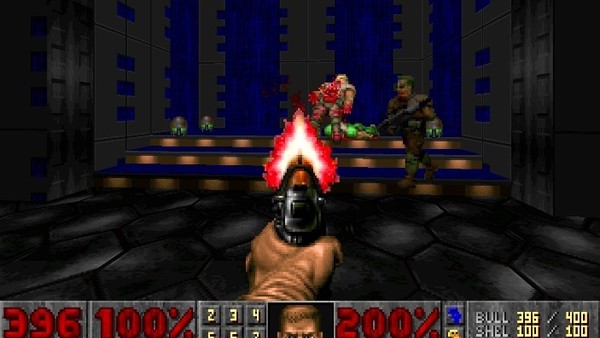
The original Doom wasn't the first FPS title to hit the market, but it exploded the genre into the mainstream and was a lightning rod for controversy from day one.
Planting gamers directly into the boots of a killer didn't go down well in some circles, which were only too happy to overlook the fact that this killer was Earth's last line of defence against the forces of hell.
Doom wasn't just slammed for its depiction of graphic violence, church groups took issue with its satanic imagery and the game was banned in Germany in 1994.
The peak of its notoriety came in 1999 when it emerged that the perpetrators of the Columbine High School Massacre were avid Doom fans and this thrust the topic of video game violence back under the spotlight.
Now having spawned a dozen sequels, Doom continues to incur wrath with its free-flowing gore and gunplay, but Bethesda head Pete Hines gave Polygon the perfect answer when quizzed on the uproar: "If you're not into violent, bloody games... Doom's probably not a game for you".
1. Hatred

Hatred is another mass murder simulator that graduated from the same school of gun-packing psychopaths as Postal 2.
This isometric shooter sent players on a 'genocide crusade', which is basically a fancy way of saying 'kill everyone in the world, not matter how helpless they are'.
Many of the game's features were designed only to offend. Health was regenerated through the execution of incapacitated civilians and the camera switches to a cinematic viewpoint when the coup de grace is delivered, for maximum shock value.
Hatred was based on the Unreal 4 engine and Epic Games, the creators of the tech, demanded their logo be removed from its title screens after learning of its premise.
Valve Corporation also pulled it from the Steam platform, only to later bring it back with an apology. It's still region-locked in Australian and Germany, though.