10 Quick-Time Events That Ruined Great Video Game Moments
Epic final boss battle? Just push one button and you're done. Wait, what?!

Almost universally hated, quick-time events (QTE's) have been one of the most persistent mechanics to plague video games, despite the constant uproar in regard to their use. In theory, the can give the play a degree of interactivity and immersion in cutscenes, or even spice up animations with some added player engagement. However, they tend to come off as lazy and poor attempts at 'gameplay'.
Indeed, most implementations of infamous QTEs lack the nuance that the likes of God of War or Until Dawn employ. More often than not, they are used as an excuse in lieu of creative and imaginative gameplay - or to simply get a character from point A to point B with as little difficulty as possible. And sometimes, they can go so far as to knock great video games down a notch, stopping them from reaching perfection.
From singular instances that managed to be so appalling in their use that they soured the entire experience to games that stumbled at the final hurdle due to crowbarred in 'gameplay segments', here are just ten examples of QTEs ruining otherwise great video games.
10. Fighting Le Paradox - Sly Cooper: Thieves In Time

Whilst Sly Cooper's games have flown under the radar for the extent of their run time, Thieves in Time turned out to be genuinely fun. It combined the traditional gameplay of the series with fun platforming that hasn't been seen since the PS2 era. And as the game was rounding off, it felt like it was going to do a stellar job in all regards, before it went and committed the cardinal sin of centring the final boss around quick time events.
Thieves in Time employed costumes for the titular character that imposed special abilities focussed on the time era the gang were currently in. And for the most part, the final boss of each area was built around each costume's ability, suggesting that the logical progression was for the final boss to be an amalgamation of all the costumes abilities, each one used to best him.
But no. They took the cheap way, souring Sly's final moments and robbing the fans of what could have been an excellent boss fight.
9. Paying Respects - Call of Duty: Advanced Warfare

When someones says Call of Duty: Advanced Warfare, what comes to mind? Is it how it's a relatively decent shooter that was good by COD standards? Or maybe the fact that it didn't stray so far into the future to detach itself from the franchise, making it the best recent Call of Duty game out there?
Of course not - all you remember are the ludicrously funny memes centred around 'pressing F to pay respects'.
It's an unfortunate circumstance, but any good that people remember about Advanced Warfare is replaced by the fact that the QTE in which you press F to pay your respects was so funny. Even people who praised the game on its release would say the most notable thing to come out of it was that QTE.
Now, the game was completely destroyed by the fact that they included this bizarre choice of interactivity, but it's a testament to how the public view your game when the most notable thing is a QTE that bore no meaning for the overall story.
Maybe the game would be remembered differently and far more positively if they hadn't included. So, join us in remembering a decent FPS tarnish by a QTE and collectively press F to pay our respects.
8. The Final Boss Fight - Mercenaries 2

Mercenaries 2 was pure cathartic fun. In no other games could you complete a mission for a faction, be paid a couple million, buy a nuke and proceed to nuke that faction's headquarters simply because you could. It was like Just Cause but with everything being destructible. And whilst the game was a little rough around the edges, it stood by one of the core tenants of video game development and made it a fun game. Which makes the end boss fight painful to play.
The game was bombastic up until this point and whilst it hadn't really focussed on boss fights, it allowed the player options. But the final boss fight was just a poorly executed quick time event. One that was unnecessarily difficult and just boring. The game even had you flying to the boss fight in a helicopter whilst The Ride of The Valkyries played.
It was epic, yet fell flat at the last hurdle.
A common and frankly far too popular option developers continue to take, unless your game has been built around QTEs, the final boss should NEVER be based on them. A final boss is the test of a player's skill in using the mechanics of the game, not how quick they can press a button.
It ruins the flow of the game, does less and less for immersion and simply ruins what could be a good, satisfying climax.
7. Far Too Often - Tomb Raider

Tomb Raider as a franchise has employed the use of quick time events more and more as the series progressed. The first major use was in Tomb Raider legend in which is was more fun to fail the QTE and watch Lara get clotheslined by a low-hanging roof. While they were fun to fail, they added nothing and detracted from the actual game by just being... meh.
However, the point in which the series truly began to overuse and misuse them was in Tomb Raider, the reboot. Having to mash buttons to scramble up a wall or press a bunch of buttons to stop men from beating Lara is both frustrating, and completely removes any dramatic tension these moments should've had.
There are some scenes that don't require interaction and can play out on their own. Forcing the player to take control of meaningless and dull animations just ruins any requisite weight. It's almost insulting that developers don't trust players to have the same emotional reaction to a traumatic scene if they don't have some arbitrary interaction with it.
6. Ropeburn Fight - Mirror's Edge

Mirror's Edge employed a singular use of a quick time mechanic throughout it's entire run time but somehow managed to make it such an egregious example that it finds itself on its list. You might be wondering how a game would create such an abominable QTE, and the answer is by having a QTE but not cluing the player into the fact that it's a QTE.
At the end of the mission Ropeburn, you face off against the titular Ropeburn in a fight. He comes at you with a lead pipe, and you are expected to press the triangle/Y button to disarm him. Whilst you might argue the fact that it glows red (the same colour employed to signal the ability to disarm regular enemies) frankly, it doesn't hold much weight.
The game expects the player to react with the incredible timing to a completely optional mechanic that can clunky to operate at the best of times and all without any prompt beyond a red glow. It's a QTE that doesn't want to call itself a QTE making it exceptionally frustrating.
5. Fighting The Didact - Halo 4

This is the fourth game on this list to have fallen to the QTE final boss plague and it really stands as a testament to the how damaging such a mechanic can be if implemented wrong. One of the more annoying uses of the final boss QTE is in Halo 4, however, when you face down the Didact having watched Cortana sacrifice herself, simply pressing a button to end it all.
There isn't much to say after four entries in regards to how annoying this can be. However, Halo 4 took a step further in the sense that the final fight was buggy to no end, meaning that even if you wanted to experience the lacklustre and lazy duel, you couldn't.
It's hard to imagine how 343 thought this was better than just putting you in an arena to shoot at each other. Sure, both of them would be underwhelming, but at least it feels like some effort was put in to maintain gameplay consistency.
4. "Jason!" (And Other Pointless Things) - Heavy Rain

This game took the idea of a quick time event and ran it into the ground. For every gut-wrenching moment of character drama, there was an unnecessary door-opening QTE. It was excessive in its use and made the game a chore to play.
Indeed, for a game like Heavy Rain (something comprised of quick-time events) to land itself on this list is quite damning, and in all fairness, the game has quite a few exceptional uses of the mechanic. Forcing the player to cut their character's finger off through a series of complex QTE's was inspiringly horrific. But we're not talking about those examples, we're talking about 'Press X to Jason'.
However, having to contort your hands just to rock a baby to sleep took away from the pacing, especially when some of the simplest movements required a severe degree of finger flexibility. It watered down the good moments and made the game incredibly dull and repetitive.
Getting to those excellent scenes required hand gymnastics that were just needlessly frustrating.
3. The Navarro Fight - Uncharted

Uncharted garners some leniency considering the fact that it has a somewhat decent shootout before the actual final boss, but still, it isn't great. The game used light fighting mechanics when battling foes up-close anyway, so the sudden change to an interactive cutscene is baffling. It would have been better, not to mention easier, to just have a regular fist fight.
The series had its foray into quick time events further along the line too, but managed to seamlessly integrate them into the brawling part of gameplay. They may have been clunky to begin with, but as the games progressed, the fighting became fluid, despite being based on a QTE here.
2. The Showdown With Sauron - Middle Earth: Shadow Of Mordor

Yet another - and final - victim of the lazy end boss pandemic. Shadow of Mordor didn't exactly have an inspiring and game-changing story, but the gameplay made up for it in spades. So, when we came to the final boss, it was key this final bout played up to the strengths of everything that went before.
Hacking, slashing, brutal impactful finishers, all with responsive controls? Nope, Monolith just threw out a quick time event that ended Sauron in seconds.
It was a massive shame considering how the game had done an excellent job of setting the scene. You had stormed the enemy fortress with an army of orcs, bested the second in command and rode a Caragor to the Black Gate. The stage was perfectly set for an epic final duel, yet Shadow of Mordor totally whiffed on the last beat.
1. Opening Doors, Chests, Ventilation Shafts - Everything
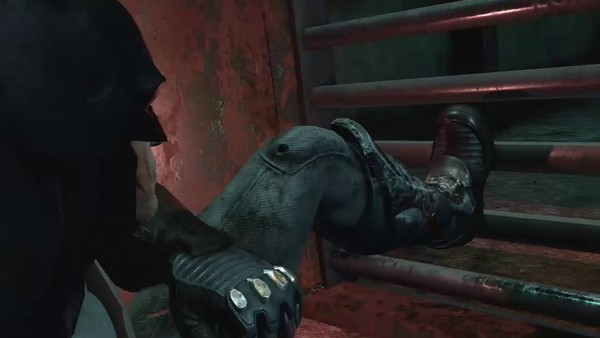
Now, whilst every entry on this list has been attributed to a singular title, the top spot, however, is taken by a specific use of the QTE across multiple games. Whilst games like Heavy Rain fill the space with QTE's and force the player to do mundane tasks, more and more games feel the need to inject player interactivity into unarguably trite and boring scenarios.
Why video game developers think that players need to mash buttons to open doors and chests is beyond belief. It's honestly meaningless. No one sits there playing a game, complaining about the lack of interactivity during the three-second animation of someone like Batman opening a vent cover.
Even games that use QTE's excellently fall prey to this. When playing God of War, the misuse is even more apparent. One minute you can be mashing buttons to rip out a titan's eyes, and the next you'll be doing the same to open a chest.
It's pointless, trite and ultimately assumes the player has the attention span of a gnat. How this sort of thing made the leap to the current generation is beyond me.
--
Any other quick time events that soured brilliant games for you? Let us know in the comments down below!