10 Recent Video Games That Were Too Big To Fail (That Did Anyway)
Rockstar did the unthinkable - released a terrible Grand Theft Auto game.

"Too big to fail" is a term generally reserved for large financial institutions the failure of which would result in catastrophic economic strife, and so they're continually bailed out by the government to prevent wider systemic collapse.
In the world of video games it's thankfully not quite so dire, though there is nevertheless a clear feeling of hubris among some game publishers, that their releases are such commercial juggernauts that nothing they do could possibly derail the gravy train.
Yet in a time where gamers are more empowered than ever, keenly raking publishers over the coals for their poor conduct, it's safe to say that even the safest bet is no longer completely safe.
While these 10 video games all seemed like absolute slam dunk projects, each also flamed out as critical and consumer goodwill ran dry, leaving them with dented Metacritic scores and, worst of all, ill-stocked coffers.
Though each of these games seemed like critical and commercial smash hits on paper, and that they were simply too big to fail, each ended up falling flat in one way or another (if not both)...
10. Battlefield 2042

Why It Was "Too Big"
The Battlefield franchise is one of the premiere first-person shooter behemoths - it's been around for two decades and, despite its ups and downs, has endured as a huge-scale alternative to the crowned king of the FPS, Call of Duty (which we'll be discussing later).
The prospect of any Battlefield game being bad enough to turn off players en masse just seemed inconceivable, especially with every new release now available as part of the EA Play Pro subscription service for a much lower entry fee.
Why It Failed Anyway
Compounding the rocky launches of the last few Battlefield games, last year's Battlefield 2042 released in a state which players and critics alike agreed was unfinished.
Between the depressing lack of expected features and embarrassing overabundance of bugs, the general feeling was that EA rushed the game out to meet a deadline, confident that it would still sell well enough regardless.
The Damage
2042's release has dealt possibly irreparable damage to the Battlefield brand, with the game receiving over 30,000 negative reviews on Steam within two days of its release, while a petition for refunds has been signed by more than 230,000 people.
But the real impact is reflected commercially: sales were so disappointing out of the gate that EA refused to disclose them, and less than five months after its release the concurrent player count has already dipped below 1,000.
Though EA and DICE are continuing to patch the game into slightly better shape, it's clear that many fans feel burned enough by the franchise that they may not return for the next installment.
9. Marvel's Avengers

Why It Was "Too Big"
The Marvel Cinematic Universe is one of the most lucrative entertainment franchises on the planet, and so the prospect of an Avengers-themed action RPG developed by Crystal Dynamics (Tomb Raider) and published by Square Enix seemed like an absolute slam dunk.
Why It Failed Anyway
There was admittedly a healthy amount of pre-release skepticism about the Avengers' underwhelming character designs and the possibility that it was ultimately going to be a low-effort "live service" game exploiting the Marvel brand for easy microtransaction-driven profits.
And ultimately those fears were largely realised, as Marvel's Avengers turned out to be a generic, grindy brawler filled with unimaginative action-adventure gameplay and tired progression systems.
More than anything, though, many complained about the lack of content, which for a live service title is basically the kiss of death.
The Damage
Within two months of Avengers' release, the player count on Steam had dropped by 96%, while sales also quickly fell off a cliff after a strong start, causing a stonking $63 million in losses for Square Enix.
Though the subsequent story expansions were broadly well-received, the publisher was raked over the coals late last year when they implemented pay-to-win mechanics and a progression-slowing patch, the former of which was removed following sustained player vitriol.
Though Square Enix insists they're continuing to support the game, it's really just a matter of time before they quietly put their failed cash cow out to pasture.
8. Godfall

Why It Was "Too Big"
Godfall was heavily hyped up pre-release as one of the PS5's first major AAA console exclusives - a glossy multiplayer "looter slasher" published yet crucially not developed by Borderlands' Gearbox Software.
It certainly looked slick and entertaining from the trailers, even if they failed to give much of an impression of the story or more involved gameplay elements.
Why It Failed Anyway
Godfall was extremely polarising upon release, in large part due to the shocking lack of launch content, simplistic combat, and generally repetitive gameplay.
Perhaps its most unforgivable misstep, though, was launching without multiplayer matchmaking, meaning that anyone hoping to team up with randoms was totally out of luck.
For a game that launched for a full-whack RRP of £60/$70, it was an embarrassingly lackluster package, and plainly clear that Gearbox shoved it out the front door in the hope of snagging some easy new-gen sales.
The Damage
The fact that sales data for Godfall is incredibly scarce really says it all - once word got out about the mediocre gameplay and piecemeal amount of content for the asking price, it divebombed at retail and never recovered.
The game ended up being quickly discounted, and even the recent release of an updated Ultimate Edition hasn't managed to breathe much life into a fundamentally failed enterprise.
7. Tom Clancy's Rainbow Six Extraction

Why It Was "Too Big"
The Tom Clancy brand has been one of the gaming industry's indefatigable pillars for almost 25 years, and though not every single game has been a commercial smash, outright flops have been few and far between.
More to the point, when Ubisoft announced Rainbow Six Extraction, a sci-fi spin-off from their massively successful Rainbow Six Siege, it seemed like it simply couldn't be anything less than a modest hit.
Siege has enjoyed such unexpected longevity since its 2015 launch that the studio seemed to have the formula for success nailed down pat, so why wouldn't it work for Extraction?
Why It Failed Anyway
While the reviews certainly weren't damning, they weren't massively enthusiastic either, with most critics broadly praising the general mechanics but finding little inspiration in its generic multiplayer survival gameplay.
The general consensus is that it was a relatively bland attempt to do something different with the Siege formula, and so why would anyone play it instead of Siege?
The Damage
Extraction enjoyed strong player engagement out of the gate due to releasing simultaneously on Xbox Game Pass, though the community quickly thinned out due to the lack of available content and scarcity of updates.
While Siege continues to regularly tout 50,000+ concurrent players on Steam alone, Extraction conversely feels like it's already on life support, and is destined to be forgotten entirely by casual players before year's end.
6. Cyberpunk 2077

Why It Was "Too Big"
CD Projekt Red is one of the few marquee video game developers whose name alone will shift millions of copies of whatever they're making. After the success of The Witcher, players have a lot of faith in their ability to deliver quality AAA experiences.
And Cyberpunk 2077 certainly looked like a sure-fire smash hit, what with its gorgeous art style and expansive, appealing open world. How could the people who made The Witcher 3 possibly screw this up?
Why It Failed Anyway
Cyberpunk's launch was one of the most dispiritingly bungled of recent years. Performance issues were rife across platforms, with console versions in a compromised enough state as to be considered borderline unplayable.
Given that CD Projekt Red clearly attempted to conceal the non-quality of the console versions, millions of players were irate, while even those who were able to play it questioned whether the end result justified all those years of hype and development.
The Damage
Now, in commercial terms Cyberpunk is undeniably a success - it's sold more than 18 million copies to date, but the ding CD Projekt Red's reputation took over its release is massively costly.
The studio ended up paying a $1.85 million settlement to pissed off investors, which while a drop in the ocean given the game's huge sales, was really just the tip of the PR iceberg.
The PS4 version of the game was enough of a mess that Sony voluntarily delisted it from PSN for more than six months, and refunds were offered by both Sony and Microsoft.
The ultimate failure of Cyberpunk, though, is that very few people are still talking about its story or gameplay, but they are still talking about how horribly botched its launch was.
Needless to say, CD Projekt Red's reputation has been permanently dirtied as a result, and their next release is sure to be met with a healthy side order of pre-release scepticism.
5. Crucible
Why It Was "Too Big"
By the end of last year, Amazon was worth $438 billion. That is the definition of "too big to fail," and so it'd certainly be a relief for any video game developer to be partnering with such a financially flush publisher.
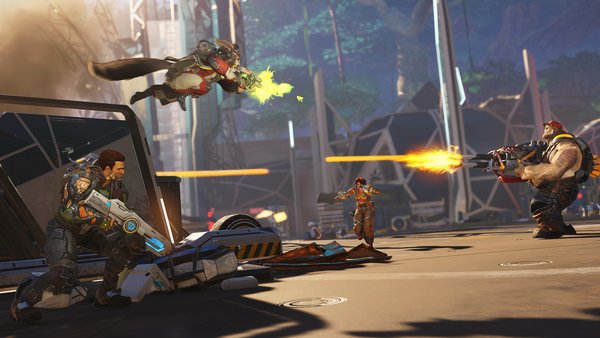
2020's free-to-play third-person shooter Crucible was developed by Relentless Studios under the Amazon Game Studios publishing label, and was the commercial goliath's first big swing at making a Fortnite-level global gaming phenomenon.
Given that Amazon owns Twitch, it truly seemed like they had a perfectly fertile environment to make Crucible a mammoth success.
Why It Failed Anyway
After six years in development, Crucible launched in open beta in May 2020 and was immediately dogpiled by critics and players alike for its lack of launch content, generic hero shooter gameplay, poor matchmaking, frustrating design decisions, and excess of glitches.
In a multiplayer space that's notoriously difficult to crack, this just wasn't going to cut it.
The Damage
Crucible went back into closed beta barely a month after launch, and within days its concurrent player count dipped below 200 from which it never recovered.
In October 2020, less than five months after its original release, Relentless Studios announced that Crucible would be imminently shutting down, with Amazon pulling the plug on the costly endeavour.
Let Crucible's death be an important lesson - you can be backed by more money than God and still not make a game that people actually want to play.
4. Call Of Duty: Vanguard

Why It Was "Too Big"
The Call of Duty franchise is more-or-less commercially bulletproof - the series to date has sold more than 400 million units, delivering tried-and-tested FPS thrills where a baseline level of polished entertainment is guaranteed every single time.
Why would the most recent entry, Call of Duty: Vanguard, be any different, especially with it being the franchise's first entry on new-gen consoles?
Why It Failed Anyway
Vanguard received the series' most mixed reviews since 2013's Ghosts - ironically itself the first Call of Duty for PS4/Xbox One - with many complaining about the short, over-familiar campaign, frustrating multiplayer time-to-kill, and perhaps most of all the utterly lackluster Zombies mode.
While Call of Duty doesn't fail in the way that most video game franchises do, Vanguard still received considerably more sustained vitriol from the fanbase than even more initially divisive entries like 2016's Infinite Warfare.
This prompted many to speculate that the game's development had been severely hampered by the pandemic.
The Damage
Though Call of Duty's sales have been consistently strong even with fluctuations, Vanguard suffered a brutal 40% drop from predecessor Cold War's launch. Worse still, this gave it the lowest launch sales for the series since 2007's Call of Duty 4: Modern Warfare.
Analysts pointed to a crowded marketplace with both Battlefield 2042 and Halo: Infinite releasing around the same time, but simply, the interest among all but the most devout fans just wasn't there.
Why bother shelling out top dollar for a new Call of Duty when you can just... keep playing the free-to-play Warzone instead?
The wider impact of Vanguard's under-performance is that Activision recently confirmed there won't be a Call of Duty game released in 2023, marking the first time in 18 years that the series won't release an annual title. Insiders even directly cited Vanguard's poor sales as the reason.
At least with Microsoft recently acquiring Activision, sales will become less of a concern as each new title presumably releases day-and-date on Xbox Game Pass.
3. Madden NFL 21

Why It Was "Too Big"
EA's Madden NFL is quite literally the American football video game franchise, given the lack of competing AAA games for fans of American football.
Yet to be fair, Madden NFL has been a supremely consistent series over the last decade-or-so, with the majority of the releases landing 80+ Metascores. And so, it seemed that the franchise's singular dominance of American football games was absolutely well-deserved.
Why It Failed Anyway
But the wheels finally came off with NFL 21, which broke the series' long-standing critical winning streak with a Metascore of just 63.
Criticism was largely levelled against the bug-filled gameplay and EA's refusal to provide long-requested updates to Franchise mode, enough that "#FixMaddenFranchise" and "#NFLdropEA" began trending shortly following the game's release.
Many felt that they were simply paying money for a roster update and little else, given how few worthwhile changes NFL 21 made to the prior entry.
The Damage
The PR hit was significant, with the various hashtags trending enough to receive mainstream media coverage, all while fans continued to campaign for the NFL to take their license to another publisher.
The game sold well regardless, yet EA did at least appear to listen to the vocal criticism, as last year's NFL 22 received more broadly positive reviews, with many noting its massively improved Franchise mode.
This is a rare example of a failed game actually bringing about meaningful change, even if there's still much more work to be done.
2. Grand Theft Auto: The Trilogy - The Definitive Edition

Why It Was "Too Big"
Rockstar's achievements in the mega-budget AAA gaming sphere are basically unparalleled - they've never put out a blockbuster dud, so how could they possibly screw up a remaster trilogy of GTA III, Vice City, and San Andreas?
Taking three of the most beloved games of all time and slapping a new coat of paint on them, possibly with a few quality-of-life fixes, should've been the easiest money and acclaim they ever got.
Why It Failed Anyway
Somehow, they screwed up the unscrewupable.
Rockstar's big mistake was outsourcing the project to the evidently ill-equipped outfit Grove Street Games, who simply weren't a caliber developer to take on a project of this scale, or remaster games this beloved.
After a suspiciously quiet marketing push, the games were released to an utterly baffled fanbase, perplexed that the remasters were evidently rushed, thrown together messes full of technical jank and questionable stylistic choices.
The Damage
Despite Rockstar initially stating that the trilogy sold above expectations, stock analysts insist it underperformed, but worse than that it dealt quite the blow to Rockstar's own reputation.
In many respects this was Rockstar's first high-profile dud release, and a firm reminder that even the hallowed titans of the industry aren't beyond a colossal screw-up.
While it's not exactly getting many people less hype for GTA VI, it did prove that Rockstar isn't above shovelling s**t out the door in pursuit of an easy, nostalgia-fuelled payday.
1. Far Cry 6

Why It Was "Too Big"
By the time a video game franchise makes it to six mainline installments, it's reasonable to assume they've found the secret sauce that keeps players coming back for more.
And that certainly seemed true of Far Cry, what with 2018's fifth game becoming the fastest-selling entry in the series, grossing a stonking $310 million in a single week.
Why expect anything different for Far Cry 6, then?
Why It Failed Anyway
Every franchise has its fatigue point, and with its sixth main game Far Cry finally got there.
It didn't help of course that Far Cry 6 was a totally pedestrian entry into the series, failing to offer much in the way of creative innovation and largely just rehashing the same prevailing formula yet again.
With a forgettable story to boot that totally wasted the great Giancarlo Esposito as antagonist Antón Castillo, this was the franchise at its most wheel-spinningly uninspired.
The Damage
Far Cry 6 launched to just 50% of its predecessor's digital sales in the UK, and the game's general commercial under-performance caused Ubisoft's stock price to drop to its lowest point in over four years.
Though it's incredibly unlikely that Far Cry 7 won't be released within the next few years, hopefully Ubisoft might take a little time to regroup and consider a new direction for the series.