10 Secret Ways Video Games Play YOU
All those desperation moments are perfectly controlled.

Even the most basic video game is infinitely more complex than it might at first seem, because even the simplest sequence in the most well-trod genre requires a skilled, committed team of designers and coders to convincingly put it all together.
At their best, video games can make us forget about all the 1s and 0s that go into developing them, focusing instead on the thrill, the spectacle, and the sheer fun of it all.
It goes without saying that game developers have a slew of sneaky tricks up their sleeves in order to enhance the experience, many of which gamers wouldn't ever bother to consider.
The result are games that as much react to you as you do to it, changing things on-the-fly to curate the most entertaining and intense experience that's just difficult enough, yet crucially not infuriating.
These 10 games all incorporated subtly brilliant programming sleights of hand to manipulate player behaviour and also give them a secret helping hand when they needed it most.
Basically, the main lesson to take away from this is that video games are a lot less random than you probably think.
Most of those "lucky" escapes aren't so lucky, as for the most part they've been meticulously designed by extremely talented people to, well, play you like a damn fiddle...
10. Crash Bandicoot 2 Slows Obstacles & Gives Extra Health To Struggling Players

The first Crash Bandicoot is a notoriously difficult platformer, and one which caused game director Jason Rubin to take a long, hard look at what could be done to mitigate player frustration for the sequel, Cortex Strikes Back.
For the follow-up, Rubin implemented some cutting-edge difficulty-shifting mechanics, known internally as "Dynamic Difficulty Adjustment" (DDA), which would not only award struggling players an Aku Aku mask upon respawning - allowing them to take a free hit without damage - but also slow the speed of boulders if players were killed repeatedly by them.
Better still, fruit crates would even be transformed into checkpoint boxes if a player died near them enough.
In Rubin's own words, the goal was to "help weaker players without changing the game for the better players." And though some of these adjustments are quite obvious, namely the Aku Aku mask, slowing an obstacle incrementally each time it kills a player is brilliantly subtle enough that just about nobody ever noticed.
The result is probably the best-balanced of all the Crash games, given that the first is too punishing and the third, Warped, is just hilariously easy.
Mercifully, when Vicarious Visions released their N. Sane Trilogy remaster back in 2017, they retroactively inserted the DDA mechanics into the original Crash, even if the remaster's new collision boxes arguably still make the platforming harder than in the original.
9. Gears Of War Multiplayer Gives First-Time Players Health & Damage Boosts

It's probably reasonable to expect behind-the-scenes tinkering to be kept to a relative minimum where multiplayer games are concerned, if only to ensure there's a consistent, level playing field between players.
Except, that's not really the case at all, at least if the Gears of War franchise is any indication.
In an unfortunately now-deleted tweet, former Lead Designer on the series Lee Perry said, "In Gears, found out 90% of first time players don't play a second multiplayer match if they don't get a kill. That first game's important."
He then followed up with, "So we started you off with some major advantages (like additional damage bonuses) that tapered off with your first few kills."
While some might be exasperated that other players are running around with buffs, at least it's only for a few kills, and let's be honest, when you're starting out, that's probably fair enough.
And as a way to combat the basic psychology of losers quitting by dangling the carrot of victory in front of new players' faces, it's actually really freaking smart. Not great for competitive play, though.
8. Mario Kart Items Are Distributed According To A Player's Race Position

It's no secret that most popular racing games employ rubber-banding mechanics to ensure a consistent sense of competition between players both human and A.I., granting racers near the end of the pack an opportunity to catch up with first place, placing greater pressure on those leading the race.
But the Mario Kart franchise dares to take this much further, and uses a similar mechanic to calculate the distribution of the various pickup items scattered around the map.
These items include bombs, bananas which other players can slip on, boosts and so on, allowing players to get a leg-up on their rivals. But as it turns out, those lower down the pecking order are given a higher probability of receiving a high-value item, such as a massive speed boost or the much-loathed blue shell.
Conversely, those in higher positions will rarely receive such items, and largely be stuck with the more boring ones such as a coin or a Blooper.
At least with Mario Kart's blue shell being the grand, infuriating equaliser that it is, nobody's really playing Mario Kart expecting a purely "fair" experience anyway.
7. Countless AAA Games Give More HP To Your Final Chunk Of Health

There are few more satisfying moments in action games than scraping through an intense shootout or fisticuffs with just the scantest morsel of health remaining.
And while this might simply seem like a wonderful coincidence while you're playing, these moments are actually precisely engineered by developers, making use of what's frequently called "magic HP."
Basically, many action games disproportionately allocate health points across your energy bar, such that the last chunk or segment of health actually contains more HP than the rest.
As a result, you'll feel the nervous tension of being low on health, even though you've actually got more HP in the bank than you think, and you'll feel a tremendous amount of relief when you make it through the next sequence miraculously in tact.
It's been confirmed that both Assassin's Creed and Doom use this feature, and Call of Duty has a similar "death shield" system, where players with low health can't be "one-shotted" by enemies.
It's quite ingenious, really, and a remarkable example of creative number-crunching which draws out a significant emotional response in the player.
6. The Uncharted Series Changes The Animation Speed Of Collapsing Objects Based On Player Ability

It's relatively well known that Uncharted, like many similar action-adventure games, deliberately has enemies miss their first few shots at the player, giving them an extra moment or two to get their bearings and launch an assault.
But a more niche nugget of game dev brilliance? According to franchise Lead Designer Kurt Margenau, if players are on one of Uncharted's many collapsing platforms or walkways, the animation of the collapse will subtly slow down or speed up depending on the player's own progress.
If you're lagging, the animation will ramp down to give you a few precious nanoseconds to catch up, and likewise if you're well ahead of the "ideal" timing, it'll speed up to make things feel a little more urgent.
It's insanely smart, really, and while it's fair to say that Uncharted as a series probably dines out on the desperation climbing moments a little too eagerly, the sense of palm-sweating anxiety felt when a platform begins to give way speaks for itself.
It's probably no coincidence that this isn't entirely dissimilar to "coyote time", a common technique in more traditional platforming games that gives players a little extra lee-way when jumping between platforms.
Of course, Naughty Dog cut their teeth on the Crash Bandicoot franchise before striking it big with Uncharted, and that likely had an influence on the latter series' mechanics.
5. Hellblade: Senua's Sacrifice "Lies" To The Player About Permadeath

Hellblade: Senua's Sacrifice is an incredible game, and opens with a haunting warning for the player - "The dark rot will grow each time you fail. If the rot reaches Senua’s head, her quest is over and all progress will be lost."
The obvious implication from this message is that Senua has a limited number of lives, and after dying so many times, she will be permanently dead, requiring players to start the game all over again from the beginning.
As it turns out, however, developers Ninja Theory were actually just toying with players, and the game doesn't in fact have any permadeath features whatsoever.
Put so eloquently by Ninja Theory's Chief Creative Director Tameem Antoniades, "The wording for the permadeath message was chosen quite carefully because we didn’t want to lie to the player...It’s actually your interpretation of the message that is what threw people off."
While the opening warning doesn't precisely detail the consequences of dying in the game, it doesn't take much reading between the lines to assume the inference.
Whether you consider it a lie or not, it certainly did a fantastic job of enhancing the game's already palpable sense of urgency and emotion.
4. Bioshock Slows Down Big Daddies' Running Speed If You're Facing Away

It's an extremely common trick for developers to hide a lot of the crucial calculations just out of the player's sight, typically behind the camera where the player has no chance of seeing quite how the sausage is being made.
Memorably, the 2013 Devil May Cry reboot DmC had off-screen enemies move slower in order to balance the player's combat load, and similarly, Bioshock nerfed the speed of the intimidating Big Daddies if you were facing away from them.
Bioshock 2 designer Jordan Thomas claims this was to ensure that players didn't "die confused," though at least given Bioshock's healthy abundance of life-restoring Vita Chambers, frustration was generally kept pretty low regardless.
3. Middle-Earth: Shadow Of Mordor Adds Health To Duelling Uruks To Prolong Fights

Middle-earth: Shadow of Mordor is of course best known for its innovative Nemesis hierarchy system, but there's another neat flourish working under the hood to make even the most insignfiicant combat engagements seem dynamic and exciting.
As confirmed by the game's Quest Designer/Scripter Rick Lesley, when the player engaged in duels with Uruks, the Uruks receive a slight health boost in order to prolong the back-and-forth battle for the sake of "spectacle."
While this minor health buff rarely means the difference between life and death for players, it is nevertheless a subtly brilliant attempt to make fights seem more dynamic and epic, rather than all Uruks effortlessly falling by your sword the exact same way in the same amount of time.
2. Counter Windows Are More Generous Than You Think To Boost Player Self-Esteem
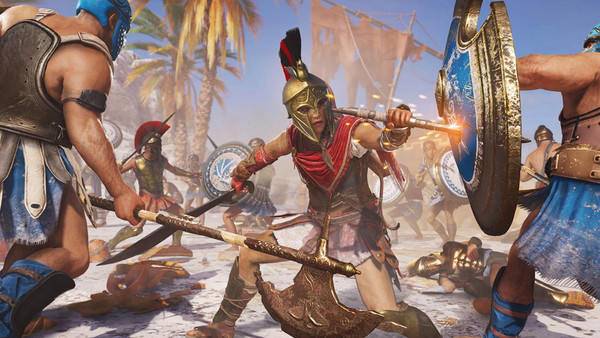
It's pretty much a staple of third-person action-adventure games these days, like Assassin's Creed and Batman: Arkham, that players will be given a small window of time to perform stunning counter attacks against enemies.
And while the entire conceit of counter attacks requires players to react quickly and marvel in the satisfying attack that follows, the time windows for these counters are actually a good deal more generous than the games themselves tend to indicate.
Even if you hit a few split seconds outside of the stated window, the counter will typically still register in most games from the genre, with the idea being that it helps players feel as though they're a total badass.
It's basically the coding equivalent of patting the player on the back and allowing the inherent power fantasy of video games to be as potent as possible.
1. System Shock Makes Your Last Bullet Deal Double Damage
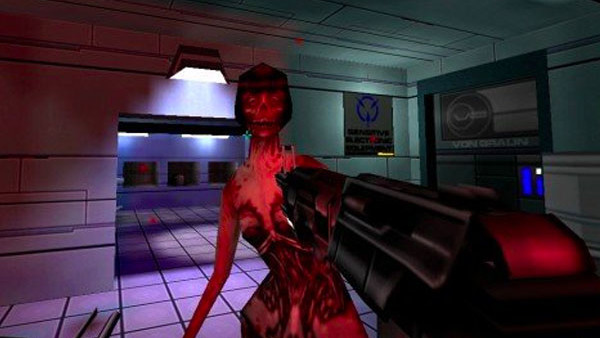
While we've already explained that some games will make the player's last chunk of health count for a lot more than the player thinks, the cult classic System Shock series had its own ingenious way to keep players alive that little bit longer.
As confirmed by developer Rob Fermier, who worked on the first two System Shock games, whenever a player is down to just a single unit of ammo, it is programmed to deal double damage.
The idea of course is that this would heighten the possibility of players being able to scarcely dispatch an enemy before running dry of ammo, playing-up the desperation to survive by the skin of one's teeth. It's quite incredible, really.