10 Stupidly Obvious Video Game Plot Holes You Just Had To Ignore
You can't catch tuberculosis. Who knew?

Video games are such enormously complex projects with an almost unthinkable number of moving parts that it's little surprise things don't always come together with total coherence.
This is true enough for gameplay, but also plot, because when you've got literally hundreds of people working on story, character, visuals, gameplay, and every other facet of game design, it's no surprise that continuity and basic character logic can slip through the cracks in the testing phase.
While all of these games are entertaining enough that these blatant plot holes can be ignored easily enough, it doesn't mean they haven't tormented committed fans ever since release.
From plot-invalidating inconsistencies you can't not think about, to bizarre characterisation that makes no sense, fans had to simply grit their teeth and try to forget - or at least, ignore - these obvious lapses in storytelling integrity.
If you want to preserve your untarnished memories of some classic video game stories and moments, this is your last chance to turn back...
10. Snake Didn't Need To Crawl Through The Microwave Corridor - Metal Gear Solid 4: Guns Of The Patriots

One of Metal Gear Solid 4's most iconic moments occurs in the game's climax, where Old Snake drags himself through a microwave corridor in order to reach the GW server room.
And while it's a tremendously powerful and overwhelmingly epic moment at the time, it doesn't really stand up to much narrative or logical scrutiny when you consider that Metal Gear Mk. III ends up doing almost all of the work to shut GW down.
Snake puts himself through a gruelling experience while Mk. III seems to deal with the microwaves just fine.
The strained argument for the scene among fans is that Snake needed to hold off the Scarabs from attacking Mk. III while it uploaded the worm to disrupt GW, but that's pretty flimsy.
It's far more probable that Hideo Kojima concocted the incredible visual of the scene and then wrote the story around it...which is rarely a recipe for a coherent, meaningful narrative.
9. Why Wasn't Scott Arrested For The Mansion Killing Spree? - Heavy Rain

Heavy Rain is, in fairness, a game with its fair share of eyebrow-raising narrative inconsistencies, what with one of the game's playable characters, private investigator Scott Shelby, turning out to be the Origami Killer himself in a continuity-derailing plot twist.
But even accepting that Shelby is presented as an unreliable narrator, there's one bothersome scene near the end of the game that just beggars belief.
Shelby heads to Charles Kramer's mansion and shoots several of Kramer's bodyguards dead, while the player is given the option of letting Kramer die of a heart attack or saving his life.
Yet even if the player saves Kramer, Shelby's violent slaughter is immediately disregarded and, despite Kramer's ability to finger Shelby to the cops, he's seemingly never reported to the police.
If you get the ending where Shelby escapes scot-free, it seems even more absurd, especially in a game so intently focused on the consequences of one's actions.
8. Aidan Is Retconned To Be King Leoric's Son - Diablo III
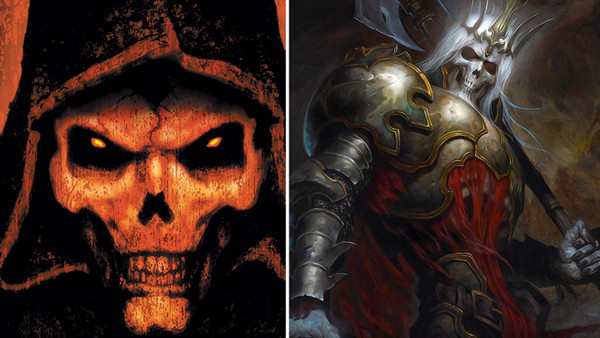
The protagonist of the first two Diablo games is simply known as the "Dark Wanderer," until Diablo III came along and forced a heap of contrived retconning upon a fanbase already displeased by the game's always-online DRM and auction house debacle.
Despite the first two games firmly establishing that King Leoric had just one son, Albrecht, Diablo III re-jigs the facts to reveal that not only does Leoric have a second son, but this new child is none other than the series' original protagonist, the Dark Wanderer himself.
In a further feat of unnecessary demystification, it turns out his real name is...Aidan.
Not only is Diablo III's story almost totally unaffected by the reveal - therefore rendering it pointless - but it actively forces the player to reconsider the series' established lore in awkward ways. Namely, what the hell was Aidan doing when his dad went mad prior to the events of the first game?
Given that not a single character recognises the Dark Wanderer as Leoric's son in the first two games, it retroactively makes the original Diablo in particular seem totally ridiculous.
7. How Did Claire & Leon Enter The Quarantined Raccoon City? - Resident Evil 2

One of the most nagging plot holes in the Resident Evil franchise regards the ease with which Leon S. Kennedy and Claire Redfield are both able to enter Raccoon City in the second game.
This is in spite of the fact that Resident Evil 3, which partially takes place roughly 24 hours before the second game, reveals the city has been quarantined and blockaded by the military to prevent people from entering (or leaving).
After years of fan hand-wringing, Resident Evil 3 scenario writer Yasuhisa Kawamura rustled up his own excuse in 2012, claiming the heroes were able to slip through the blockade when the military retreated, following a zombie attack.
That's a pretty lousy excuse, and while the plot hole is hardly franchise-derailing, it does signify a major logical contradiction between the second and third games.
6. How Does Haytham Know Connor Is His Son? - Assassin's Creed III

The twisty lore of the Assassin's Creed franchise has always been rather on the "eccentric" side, though the third game left fans especially bemused with its treatment of protagonist Connor and his father Haytham Kenway.
One of the game's most memorable scenes occurs in Sequence 9, when father and son meet up in an old church, and curiously, Haytham seems to magically know that Connor is his son despite this never being indicated prior.
The game's Animus database even flat-out states that Connor's mother Ziio kept Connor's existence a secret from him, so when he shows up to the scene armed with this knowledge, it's incredibly jarring.
There's no real excuse for this, yet it's also not much of a secret that AC3's development was extremely troubled, and so it's pretty impressive the end result (mostly) turned out as well as it did.
5. Why Didn't The Clock Tower Accident Alert Anyone? - Uncharted 4: A Thief's End

One of the more memorable set-pieces in Naughty Dog's brilliant Uncharted 4: A Thief's End is Chapter 11's epic clock tower sequence, where Nate needs to climb to the top of the tower and ring a gigantic bell at the top in order to proceed.
This results in a predictable ton of property damage, of course, ending with the gigantic gears breaking apart and the bell itself crashing to the ground, only barely avoiding Nate himself.
The scene makes it abundantly clear that this calamity was noisy as hell, and given that the exterior Madagascar streets were shown to be extremely busy mere minutes earlier, it's completely impossible to believe that nobody would investigate the building following this thunderous commotion.
Instead, Nate and Sully are freely able to proceed through the building and complete a puzzle for the next 20-or-so minutes without encountering even a single person.
And if you want to take it further, the insane loudness probably should've made both men deaf for life.
4. How Did A Single Necromorph Slaughter The USM Valor? - Dead Space
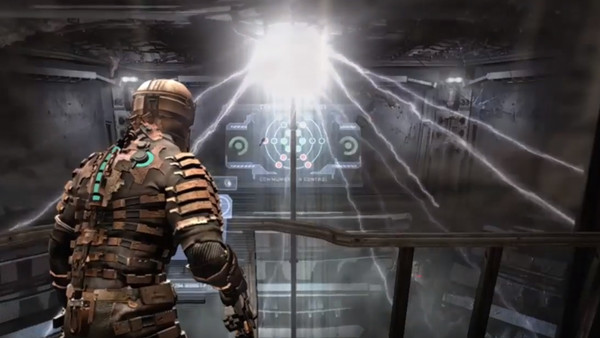
The original Dead Space is a masterpiece of claustrophobic tension, and one of its more distinctive moments sees protagonist Isaac Clark learning that an incoming rescue vessel, the USM Valor, has picked up an escape pod containing a Necromorph and become overrun.
Except, anyone who's played a Dead Space game will scarcely be able to believe that a single Slasher-type Necromorph would be able to run riot in a Destroyer-class vessel and annihilate all 67 of its crew members.
Even accepting the element of surprise the Necromorph may have had, it's highly implausible that a single Slasher could dismantle everyone onboard before they could destroy it, especially as without an Infector Necromorph onboard, there was no known way to quickly spread the contagion throughout the ship.
Fans have long debated how the Valor was able to fall so easily, but ultimately, it's easier to just spare your sanity (and your time) and pawn it off as because plot.
3. Why Didn't Cloud Revive Aerith? - Final Fantasy VII

Perhaps the most famous plot hole in video game history is one compounded by its sheer emotional impact.
Aerith's unexpected death in Final Fantasy VII left players shook to the core, but once they wiped the tears away and took a few deep breaths, many began to question why Cloud couldn't just...use a Phoenix Down to revive her.
Now, even if you accept that Phoenix Downs are only able to rouse someone from unconsciousness rather than actual death, the Revive materia is perfectly capable of cancelling death states, a fact that's curiously glossed over for the sake of some emotionally shattering drama.
Granted, the Final Fantasy franchise's grasp on its own internal logic - especially as it pertains to both magic and life/death - is loose at best, but even so, it's easy to understand why an urban legend persisted for years that there was a way to bring Aerith back to life.
It'll be interesting to see whether or not Square Enix bows to fan demand and allows Aerith to be resurrected in the upcoming remake.
2. Why Didn't Anyone Catch Tuberculosis From Arthur? - Red Dead Redemption 2
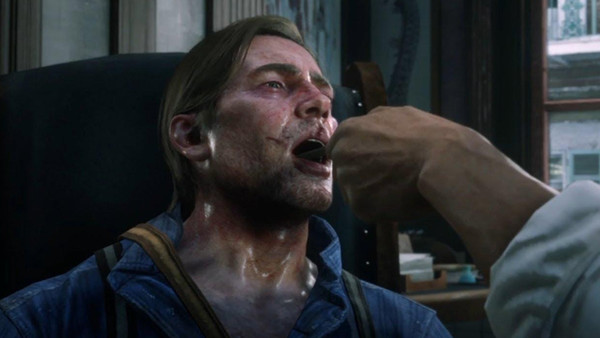
Later on in Red Dead Redemption 2, steely protagonist Arthur Morgan learns that he's contracted tuberculosis and has a limited time left to live, eventually leading to his death at the end of the game.
But what's baffling about this is that, despite the highly contagious nature of tuberculosis, Arthur doesn't appear to infect anybody else, even while continuing to live, eat, drink, sleep and use the bathroom at a crowded camp.
Given that TB killed 1.7 million people worldwide in 2017, the notion that Arthur didn't spread his illness to his pals well over 100 years prior is just absurd. It doesn't ruin it a masterful game, but it is a peculiar oversight in an otherwise detail-rich work of art.
Even just a few brief glimpses of campers coughing and sputtering occasionally would've sewn this hole up nicely.
1. The Space Pirate Logs - Metroid Prime

There's no understating the brilliance of the iconic Metroid Prime, but the game's original GameCube release shipped with a plot hole nagging enough that it was actually removed from subsequent releases.
At the very end of the game, Samus finally encounters the titular monster, a gigantic spider-like creature equipped with mechanical weaponry, which in-game logs in the original NTSC release suggest were assimilated from the Space Pirates.
Except this directly contradicts logs elsewhere in the game, which claim that the Space Pirates were unable to pass the Impact Crater's forcefield and reach Metroid Prime. So, if Samus was the first person to breach the Crater, what the hell is going on?
Thankfully Retro Studios kinda-fixed this issue for both the PAL release a few months later and 2009's Metroid Prime Trilogy re-release, wiping any mention of the final boss from the Space Pirates' logs. That still doesn't explain where Metroid Prime received its mechanical weaponry from, though.
Thankfully the game is incredible enough that most fans were happy to let it go, logic be-damned.