10 Terrible Video Game Sequels Fanboys Conveniently Forget About
'The Arkham Trilogy'... and that other one.
Whenever a developer stumbles onto a winning formula with a new IP, the temptation to spin it into a continuous series always exists. While few will preserve the sanctity of such a positive outcome, most developers will instead opt for what they see as a potential money-spinner and thus, a franchise is born.
It can be very difficult to get this kind of thing right and continue that initial success, but the rare few pull it off, resulting in a huge number of reliable series' that get new, occasionally annual instalments. This decade has been no different, and you need only look to any October - December release schedule to see it in motion.
However, even the most reliable examples aren't without flaw. Some sequels are so laughably bad, tarnishing their otherwise solid legacies to the degree where fans simply choose not to acknowledge their existence whatsoever.
So let's dredge them up and hang them out to dry, shall we?
10. Star Wars: Knights Of The Old Republic II: The Sith Lords

Star Wars: Knights of the Old Republic is, without doubt, one of my favourite games of all time. The way it invited players to become so engrossed in - and ultimately vital to - such a well-realised Star Wars story, was quite simply an absolute joy.
And when people talk about great Star Wars games, Knights of the Old Republic is always on that list. But this is done, however, without much of a mention for the sequel. Knights of the Old Republic II did manage to carry a few of the strong themes and mechanics over from the first game, but ultimately its reception fell very flat thanks to some shaky stories and weak characters.
It just couldn't hold a candle to its predecessor, with the developers trying to shoehorn the shocking reveal of KOTOR's main plot into the sequel wherever they could. The result was a mishmash of predictable betrayal and an incoherent narrative structure. Nothing solid was ever able to build, and in the pursuit of severing plot ties for the sake of 'unpredictability', it became entirely the opposite.
If you hear someone professing their love for KOTOR, chances are they're only referring to the first game.
9. Splinter Cell: Conviction

For quite some time, the Splinter Cell series was held as the modern standard for what a great stealth-based game should be able to do. Sam Fisher is an exciting protagonist, and the world that Ubisoft built around him did a wonderful job justifying his existence as both necessary and believable.
Understandably, the series has a great many loyal fans, but even they would struggle to argue that Conviction is a title worthy of the rest of the series. Ditching the measured, tactical approach for gun-toting action and even a stage featuring a three minute chase that makes Benny Hill look serious, Splinter Cell: Conviction just never truly felt like a Splinter Cell game.
While the events of the story may necessitate Fisher's brasher approach, there's no way that justifies him essentially altering his style altogether and introducing 'torture segments' to garner information from targets. When talking about Splinter Cell as a remarkable stealth series, simply skip this instalment and go straight to Blacklist.
8. FIFA 14
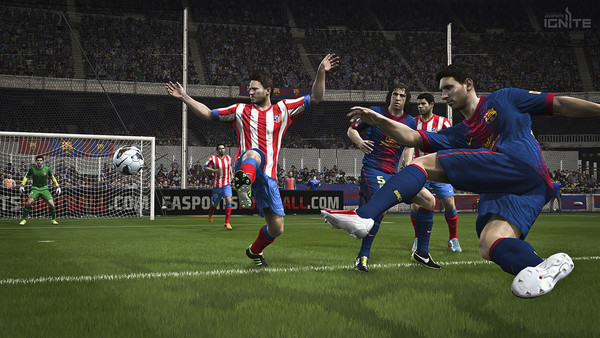
Since the turn of the decade, EA Sports' FIFA series has managed to arrest the majority of the football game market back from the previously superior Pro Evolution Soccer franchise. At a time when PES seemed to be moving backwards, the FIFA games were making meaningful additions and genuine gameplay innovations.
That is, up to a point. In 2013, EA prepared to launch their new season's title for an old and new generation of consoles. One can only assume, then, that it was the increased demand of this duality that led them to basically improve on nothing, compared to such solid momentum established beforehand.
Fans will talk for hours about how the FIFA series justifies its yearly release with notable improvements, rather than just updated teams and statistics, but you can bet that nothing will be mentioned about the stagnation that was FIFA 14.
After all, this was the version that touted its 'dynamic stadium atmospheres' only to dress 70,000 static fans in one of three t-shirt designs.
7. Star Wars: The Force Unleashed II

When Star Wars: The Force Unleashed arrived in 2008, it presented players with an experience that allowed them to truly feel like they were harnessing the raw powers of a powerful young Jedi. It was a great game, and is still considered to be just that in hindsight.
It's a big shame the sequel couldn't live up to that; The Force Unleashed 2 was lambasted for broken features and unfulfilled promises. Suddenly, a protagonist who was built up to be so powerful and promising in the first game was knocked back to basic levels to suit the structure of the game again. Think of it as being like how Ash's Pikachu should probably be level 100,000 by now, yet he always loses to newbies at the start of each new series of Pokémon.
That's right; Starkiller becomes that much of a wimp when the sequel begins, all in favour of allowing the game to follow a basic, lazy structure. TFU 2 fell quickly into the shadow of its superior predecessor and faded from memory even faster.
6. Ninja Gaiden 3

The brutal action of the Ninja Gaiden series has enchanted many a gamer over the years. Debuting in 2004, the original of the series sped along on the strength of some dazzling combat and a gameplay mechanics that were a challenge - but ultimately a joy - to master.
Those early instalments were not perfect, but there was enough padding around the flaws to help them be more easily overlooked. For Ninja Gaiden 3, however, this was no longer the case and any problems were more readily on show.
An attempt to hone the combat systems in the game became buried under a mess of faulty mechanics and a dreadful story involving an infected arm; the end result just barely managing to attach itself to the saga, failing to live up to its own name.
Let's just get it out there - if it were released under a new IP, this game would've been universally panned from day one.
5. Super Mario Bros. 2

Attaching the tropes and signatures of this the Super Mario world to any new game is essentially a licence to print money, with fans sure to add the latest addition or spin-off to their collections.
All of those fans will have a Mario game that they're admittedly not as fond of, however, and for the majority you'll find it's Super Mario Bros 2. While the game reviewed well and does feature on many critically acclaimed lists, it doesn't enjoy the same love that many others do.
Criticisms include an attempt to depart too far from the popular features of its predecessor and a sub-par villain that just doesn't capture the imagination at all. Wart is - for all intents and purposes - the Luigi to Bowser's Mario. They share some similarities with their superior counterparts, but we all know who the favourite is when people are forced to choose.
Granted Super Mario Bros 2 is not a bad game, but it's certainly a small fish in a big pond, especially where Mario is concerned.
4. Dead Space 3

By the time Dead Space 3 released, the winning formula of the series had unfortunately become a simple, by-the-numbers affair that came nowhere near close to capturing the magic of the original. The horror elements were so bland and the action so predictable that there was virtually no excitement in it.
Things took a turn for the even worse as the game wore on and you ended up on the surface of a randomicy planet, a contrastingly barren place that dissipated anytensioninto the atmosphere above. The worst was still yet to come, however -a final boss battle that had you actually fighting off the 'inner-mouth' of a carnivorous moon.
You actually fought an angry moon.One of the greatest WTF moments in recent gaming history, wouldn't you agree?
Dead Space and the immediate sequel will live in the memory as the makings of a consistently great series of horror games. Dead Space 3 has already been written off by many of the same commenters.
3. Halo: Reach

Before dividing opinion and sending the gaming community into rapturous debate with Destiny, you may remember that Bungie was previously responsible for bringing us the impressive and influential Halo series.
The releases in the main thread of the Halo story were masterful, and the idea of a prequel to set the scene of the conflict sounded like a fantastic idea. When Halo: Reach stepped up to become that scene-setter, a fantastic idea was left unfulfilled.
Halo: Reach is essentially a good example of a Halo game, and it carries across many of the strong mechanics from the rest of the franchise. What it doesn't do, however, is capture the same impressive tone of its relatives. It's all brash action and a plot devoid of nuance, and it's what some fans have referred to as Bungie's attempt to channel Call of Duty in their own flagship series. Not a clever move...
2. Batman: Arkham Origins

Whenever anyone talks about how they want to see their favourite comic book hero given their own successful series of video games, they'll point to Batman's Arkham franchise as the yardstick for how that can be achieved.
And rightly so, of course; the Arkham series features some truly exciting super hero action. What won't be included in this talk, however, is the series' third instalment: Batman: Arkham Origins. Arkham Origins was the only title in the franchise not developed by Rocksteady, and that was evident in the lack of innovation and polish that the game had compared to the others.
This third instalment took the series' combat - its trump card from day one - and just decided to cram more of it into the game without any willing consideration for narrative. The story was awful, and using Batman to beat the snot out petty thugs is only fun when necessitated by a meaningful motivation.
Arkham Origins is, understandably, overlooked by many fans of the series.
1. Dragon Age 2

Dragon Age: Origins is considered to be one of the greatest Western RPGs of all time, and so the news of a sequel was met by excitement. Dragon Age 2 fell flat on release, however, as it was deemed to have deviated too far from the winning formula of the first title.
This reaction has taken it to the point of some not even considering it to be a Dragon Age title, with some gamer reviews suggesting it attempted to cater more to fans of hack and slash games than it did for fans of the first. It became more action orientated than its predecessor, and this was not a popular move.
Fortunately Dragon Age: Inquisition managed to recapture a lot of what was missing from Dragon Age 2 within the latest release, sending the sophomore entry even further into the shadows of the series as a whole.
What gaming sequels have you had to strike from your memory in recent times? Let us know what entries you think aren't worth a place under their series' banner in the comments below!