10 TERRIBLE Video Games (That Revolutionised The Industry)
Sometimes awful games move the needle too.

The overwhelming majority of bad video games are simply released, get pilloried by players and press alike, and then quietly fade into the ether of irrelevance, destined to be forgotten.
Yet just because a game isn’t very good, that doesn’t mean it can’t make an impact.
And as these 10 video games all prove, it’s entirely possible for downright terrible pieces of interactive entertainment to shape the industry.
These video games all received mixed-at-best reviews from critics and many didn’t make much of a dent with gamers either, and yet the ripples of their influence are still felt today, years or even decades later. Who’da thunk it?
Perhaps their failure ushered in a major new market trend, other developers capitalised on the game’s One Good Idea, or it served as a cautionary tale to the rest of the industry.
Whatever the means, these games all had a lasting impact on video games as we know them that extends far beyond their sales figures and Metacritic scores.
For as much as they might be laughing stocks where moment-to-moment gameplay is concerned, these games all changed the industry one way or another, for better or - as is sadly often the case - worse…
10. The Order: 1886 Killed Off Smaller AAA Games

The Order: 1886 is one of Sony's rare AAA blockbuster misses in recent years - a visually stunning yet mechanically clunky and, dare one say, aggressively generic third-person action game that didn't move the needle an inch and quickly evaporated into the pop-culture ether.
One of the primary complaints about The Order was its short play-time of around 5-6 hours, which for a game selling for the typical AAA retail price simply seemed like an atrocious value proposition any way you slice it.
Yet The Order's critical and commercial failure had a slyly tectonic impact on the industry as a whole, effectively hammering the final nail in the coffin of smaller, more linear AAA tentpole games.
The focus became greater than ever on ensuring that AAA blockbusters gave players their "money's worth," which often equated to bloating the critical path out with tedious busy-work. Looking at you, Final Fantasy VII Remake.
Mega-budget games with short play-times were effectively phased out, in turn teeing up the rise of the "AA" game - that is, ambitious lower-budget titles that look AAA, like Hellblade: Senua's Sacrifice and, more recently, Fort Solis.
The Order's failure fundamentally changed both the industry and consumers' expectations of AAA games, while also birthing a revolution of glossy AA fare punching well above its weight.
9. Night Trap Helped Birth The ESRB

Though there's a sure charm to the FMV games of yore, let's be honest - the vast majority of them were absolute rubbish, and the bewilderingly legendary Night Trap is no exception.
If the concept, of rescuing a slumber party of scantily-clad ladies from a fleet of vampires, sounds like a ton of fun, the shockingly tedious execution quickly makes Night Trap more of a chore than anything.
The programmatic gameplay, where success relies mostly on rote memorisation of enemy routes, quickly wears out its welcome, and so the game endures today mostly as a campy curio - albeit enough to receive a 25th Anniversary Edition re-release in 2017.
Yet the tendrils of Night Trap's legacy reach much further than that - along with Doom and Mortal Kombat, it was at the forefront of the 1993 United States Senate hearings on video games, which in turn led to the creation of the monolithic Entertainment Software Rating Board (ESRB).
Beyond regulating which games could be sold to who, the ESRB was instrumental in distinguishing video games from toys in the public sphere, all while debates raged about the potential for "objectionable" content to have undue influence on children's growing brains.
Were it not for Night Trap, Doom, and Mortal Kombat stirring the pot, it's safe to say that the public, non-gamer perception of the medium - as a mere kids' play-thing - would've been woefully ignorant for considerably longer.
8. I, Robot Was A Groundbreaking 3D Shooter

No, this isn't a licensed video game based on that 2004 Will Smith-starring sci-fi movie, but rather an arcade shooter released by Atari 20 years prior.
I, Robot was released exclusively for arcades in 1984 and tasked players with shooting shield blocks before attacking the blinking eye of the malevolent entity known as Big Brother.
Pretty standard stuff, right? Except, in 1984, I, Robot's 3D version were positively mind-melting. It was the first game in history to feature 3D polygons running in real time, basically an entire decade before the tech was popularised by the PlayStation.
Yet outside of its innovations, I, Robot received predominantly mixed-to-negative reviews from gaming press of the era, who found its gameplay unremarkable despite the jaw-dropping visuals.
This, combined with the the game's arcade hardware proving unreliable, the arcade market being massively weakened by 1984, and Atari producing only around 1000 game cabinets, caused I, Robot to quickly slip from lips of the gaming masses, no matter that it proved what could be done in 3D years before it fully caught on.
7. Destiny Popularised "Live Service" Content Delivery

When Bungie's massively hyped online shooter Destiny launched in 2014, the collective disappointment from gamers was thunderous.
For as good as the game looked and as tight as its gunplay was, the storyline was utter nonsense, the gameplay was extremely grind-reliant, and it was painfully clear that there simply wasn't enough content to sustain a player-base long-term - at least at launch.
But in the months and years that followed, Bungie fleshed Destiny out with DLC expansions which prevented them from haemorrhaging players and brought the game closer to its initial promise.
Yet right from its inception, Destiny's commercial success proved massively influential for AAA games as a whole.
It not only crystallised the popularity of loot-driven gameplay loops, but also the perceived "acceptability" - at least on the publisher's side - of releasing games half-finished and then drip-feeding expansive updates.
Basically, Destiny pioneered the now-pervasive "live service" model, no matter that the game first released on September 9, 2014 was a shockingly lackluster proposition for a AAA asking price.
6. Bubsy 3D Was An (Awful) 3D Landmark

Where influential 3D games are concerned, it's important not to ignore the infamous disaster-piece that is Bubsy 3D. Alongside Super Mario 64 and Crash Bandicoot - both also released in 1996 - it is one of the three prongs in the early 3D platformer movement.
Sure, it's the rustiest prong that'd probably give you a nasty infection if the end touched you, but it's still a prong nonetheless.
Though Bubsy 3D is no way a good game, certainly in comparison to the wildly superior aforementioned titles, that it featured fully explorable 3D environments was still a major achievement at the time.
Furthermore, it helped contribute to the wider success and adoption of 3D games, and given that it was produced by a team of just eight people, it sent a message loud and clear to the rest of the industry: yes, you can do this too.
It's still not very good, but given that Bubsy 3D will be ceaselessly compared to two of the greatest games of its era until the end of time, it never stood much of a chance either. It deserves to get its flowers all the same, though.
5. Zhengtu Online Is To Blame For Loot Boxes
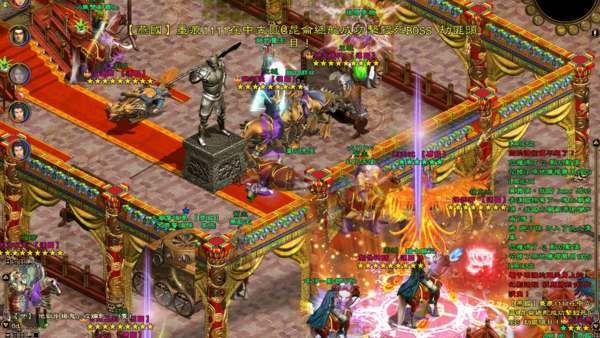
If the above image of MMORPG Zhengtu Online is enough to give you a decently debilitating migraine, just imagine what actually playing the bloody thing feels like.
Jokes aside, Zhengtu Online (also known as ZT Online) is perhaps the most influential awful game you've possibly never heard of. Active between 2007 and 2018, the Chinese MMORPG shamelessly popularised one of the grossest trends in contemporary gaming - loot box monetisation.
Despite the game's utterly unremarkable, Diablo-esque gameplay loop, it became popular in China due to being free-to-play, albeit with the gargantuan caveat that gear was largely obtained from loot boxes.
And lo and behold, the boxes could only be opened with keys bought with real-world money, granting players the mere chance to gain some sweet, sweet loot.
ZT Online quickly started making money hand over fist, employing increasingly predatory practises to further entice players to part with their hard-earned dollar.
And though you probably didn't know it, ZT opened the floodgates for loot boxes to infest video games at large, with Team Fortress 2's addition of creates in 2010 effectively popularising the practise in the West.
And as we all know in 2023, loot boxes are a bell that can't be un-rung, and their destructive impact on gaming as a whole can be traced directly back to ZT bloody Online.
4. Trespasser Pioneered The Modern FPS

DreamWorks' 1998 Jurassic Park-themed FPS Trespasser is the textbook definition of an ambitious failure - a game that tried to do a whole hell of a lot, but buried its more impressive innovations under frustrating, boring, bug-filled gameplay.
Trespasser was a rushed-to-market production that nevertheless deserves its due for breaking so much ground, by featuring large, open outdoor environments, smart dinosaur AI, continually rendering the world and objects as players move around the map, and being the first game in history to feature full ragdoll physics.
Despite being clunky-as-hell and running poorly on all but the most high-spec PCs of the time, Trespasser's landmark technicals made it popular among developers, with Valve's Gabe Newell even citing it as influencing Half-Life 2's own physics-based gameplay.
Furthermore, the minds behind Halo: Combat Evolved and Far Cry have also nodded to its impact.
Trespasser may not be particularly fun to play, but its role in the genesis of the modern FPS should be unmistakable.
3. No Man's Sky Became The Poster Child For "Redeemed" Video Games

No Man's Sky has had one of the most fascinating journeys of any video game released over the past decade.
Hello Games' procedurally generated action-adventure game was hugely hyped prior to release, only for players and press alike to express disappointment with the launch day product, which fell far short of the developer's many lofty pre-release claims.
Beyond many promised features - like multiplayer - being absent, it quickly became clear that No Man's Sky was another "wider as an ocean, deep as a puddle" open-world game, where most fun and intrigue was quickly exhausted.
Yet to Hello Games' credit, after a frustrating period of radio silence, they returned with some serious updates to the game which massively improved the user experience, and some seven years later, they're still making the damn thing better.
The likes of base building, vehicles, VR support, multiplayer, a third-person camera, and much, much more were added to the game in the years that followed, ensuring that No Man's Sky's reputation was rescued from the ashes of mediocrity.
But more than that, it proved that even lackluster games produced by small teams can be fixed over time, in turn throwing the gauntlet down to AAA developers who simply released unfinished games and promptly moved onto the next big thing.
Without No Man's Sky being the poster child for "redeemed" video games, it's safe to say that many of the biggest video game turnarounds may not have happened.
In an important way, it changed the culture around releasing inferior products and just calling it a day. And thank God it did.
2. E.T. The Extra-Terrestrial Almost Killed (And Then Saved) The Industry

If you thought ZT Online's influence on the industry was bad, at least it didn't almost straight-up kill video games as we knew them.
E.T. the Extra-Terrestrial is one of the most infamously terrible video games ever made, even for the subterranean standards of licensed games based on hit movies.
E.T. was rushed to market after just five weeks of development, and boy, it sure shows.
But rather than the game simply making some quick, easy bank and disappearing into the void of ephemera, it ended up flopping horribly at retail, enough that it had a major impact on publisher Atari's financials.
More to the point, it further impacted the already-volatile state of the gaming 'biz in 1983, leading to a devastating industry recession which caused revenues to shrink by an eye-watering 97% by 1985.
Yet the business began to recover in 1985 when Nintendo decided to break into the home console market with the NES, which proved successful enough that, by 1988, revenues were close to pre-recession levels, with Nintendo holding a gigantic 70% market share.
Causally speaking, E.T.'s failure basically led to the modern Nintendo we all know and love. Without this flaming trash-fire of a game wounding an already injured industry, would we even have the Nintendo Switch today? Makes you think.
1. Aliens: Colonial Marines Ruined Bulls**t Marketing For Publishers

Aliens: Colonial Marines is one of the most disappointingly shambolic video games of the last decade - a potential-filled FPS that ultimately fell short in every way which an Alien-themed video game could.
The underwhelming graphics, generic gameplay, atrocious AI, and wonky engagement with the series' lore all led it to be widely ridiculed upon release, but more than that, it ignited a debate about the responsibility of publishers to accurately market their games.
Even accepting that games are fluid products which often change substantially during development, many players felt that Sega has falsely advertised the game's quality and level of polish, in turn grossly misleading them.
A few months after Colonial Marines' release, Sega even flatly admitted that the game's trailers were deceptive, following the publisher having discussions with the UK's Advertising Standards Agency (ASA).
With that, Sega were compelled to add disclaimers to the game's marketing materials, making it clear to players that the more impressive trailer footage was from a work-in-progress version of Colonial Marines.
Yet the game ultimately sparked a wider discussion about the responsibility of publishers to market their titles accurately and in good faith.
With a company as huge as the ASA getting on the case and making Sega revise their marketing, the overall degree of high-level scrutiny placed on video game advertising increased massively.
And with that in mind, there was considerably less incentive for publishers to use "bullshots" and footage that wasn't honestly indicative of the end-product.
This isn't to say that deceptive marketing has been wiped out completely in the decade since, but it's certainly far less prominent than it was back in 2013.
And so, with Colonial Marines inadvertently shepherding in a new era of more honest video game marketing, its ultimate legacy might actually be a net-positive. Imagine that.