10 Worst Bosses In Great Fighting Games
 Fighting game bosses are typically meant to be understood as the most difficult enemy of any fighter. Traditionally they were unselectable characters and the very last or second to last opponent in the game before you get to the ending sequence, or in the case of 3D fighter coin-ops, just the game credits. The experience of bringing the arcade fighter home significantly lowered the frustration of losing to an incredibly unfair boss fight, it doesn't change that most bosses were designed to be intimidating and and just downright cheap. Now to the very well seasoned veteran of any fighting game defeating the final boss is a matter of understanding the game mechanics and AI behavior, but any casual player with no previous knowledge of a fighting game's strategy will be mercilessly manhandled.
10. Dural (Virtua Fighter Series)
 The Virtua Fighter series is notoriously unforgiving with precision. Oftentimes landing the best combos meant that you were extremely proficient at timing button presses at precise frames of the animation on screen. The precision wasn't as defined when Virtua Fighter 2 came out, but it didn't make it any easier to master the game. When it came to the final boss Dural, a character whose characteristics predates Metal Mario of Smash Bros. or the metal box power-up in Smash Bros. Melee. The idea was that you would fight this metal woman with the physics of a ship anchor in her underwater stage of Atlantis. Fighting underwater, as ridiculous as that may sound, meant that the entire match was in slo-mo. She was the only character in the game that was given an underwater stage. Couple augmented physics with fighter that has an already steep learning curve, Dural is one tough boss to beat. Luckily though, she is an optional boss, meaning that losing to her still meant that you completed the game. However, in later games they would give her stealth skin making it hard to see her character model and plan your defense.
9. Metal Mario (Super Smash Bros.)
 The whole idea of Smash Bros is a beat-em-up party game. There are people, though, that have taken it very competitively. The whole premise of beating people is scoring kills, not like your traditional fighting game where you simply deplete a life bar. Instead, your life is a measure of resistance to being viciously flung off the screen, wherein you will lose a life or the entire match completely depending on the settings. The closer to 0% your life bar is, the harder it is to be knocked far away by a hit. However the higher it is to 300% or more, you could be more likely knocked away from very weak smashes. That is, unless you're fighting Metal Mario. He is very difficult to smash off the screen, and his life meter doesn't affect him as much as it does any other character. The only advantage is that when you do manage to get his damage count very high, he has a hard time making it back to the stage due to his weighted condition.
8. Kintaro (Mortal Kombat 2)
 When Kintaro was first introduced as the successor to Goro, he was a brutally strong boss. While there were some versions of the arcade out there that screwed up the AI to make him completely impotent, the most complete versions of MK2 brought him out in full force, if you chose not to beat him by exploiting the primitive programming. If you jumped in and he blocked your kick, YOU could actually be stunned and punished with his uppercut. His teleport move was unblockable and difficult to avoid if you reacted too slow. If you stood around and blocked too much he'd walk up to you and toss you like a rag doll. Not that blocking was particularly effective against bosses in Mortal Kombat, because of block damage.
7. Gill (Street Fighter 3: Third Strike)
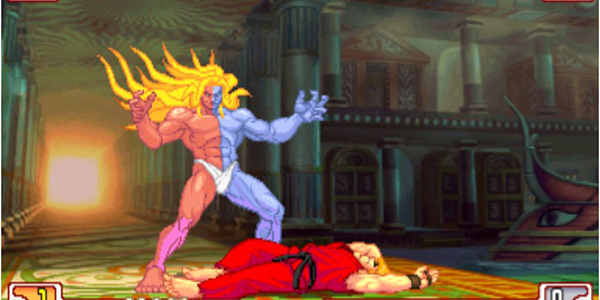 It's so difficult to claim anything from Third Strike to be a worst gaming boss because ever since Daigo's legendary parry, everyone claims expertise in everything Street Fighter. For those who don't play Street Fighter casually though, making it past Gill was a bit of a challenge. His normal attacks caused block damage and when he stunned you, it lasted much longer than normal. The AI would land combos and hit really hard. His super arts were particularly broken. His lesser evil was Meteor Strike, that rained down fire and ice balls that could hit you low if you were blocking high, and if it landed fully could take up a massive chunk of your life bar. The most devastating would be his Seraphic Wing, that covered the entire length of the screen and caused obscene amounts of damage, and chipped off a lot when blocked -- which is the only defense against it. On top of that, his final super art would recover his full life bar if he was defeated while his super meter was full, so if you struggled to whittle his health down at great cost of your own, you had to do it again.
6. Seth (Street Fighter 4) Street Fighter 4's final boss was Seth, an amalgamation of all the best moves in the game. Teleportation, Sonic Boom, a Shoryuken, a dive kick, and the Spinning Pile Driver. Your basic approach of attack is stopped if you even attempt to jump in to close the distance when he's ready for you. If you jump in and he doesn't immediately punish you with a 3 hit Shoryuken, he will block your jumping attack and hit you with the Spinning Pile Driver. He hits with the combo ability of Gill with no loss in comparison of strength. His super and ultra arts are particularly frustrating because if he lands it, as a matter of insult to injury, you have to sit and watch the very long animation. The initial attack covers the length of the screen with no actual projectile that needs to connect for it to land.
5. Abyss (Marvel Vs. Capcom 2) Marvel vs. Capcom made popular the tag team fighting gameplay. The final boss of that game, Onslaught, was beatable mostly by super moves. It had two forms and it was pretty much a simple task to beat it. When Marvel vs. Capcom 2 was released, the final boss now had three forms. The first was a big armor that attacked slow, but attacked through normal attacks much like Juggernaut and the Hulk. The second form was much more mobile, quicker and had short distance projectiles that juggled you in the air, and again, your attacks would not stop his attack animations. The third form was something that is unique to Marvel vs. Capcom games, essentially forcing you to fight an aerial battle against the background. So if you weren't proficient in stringing together combos in MVC you would have a hard time fighting Abyss. His form was very fluid, disappearing frequently into the ground and constantly changing your direction on the screen with attacks emanating from the ground.
4. Galactus (Marvel Vs. Capcom 3) Another player vs. background fight involves the final boss of Marvel vs. Capcom 3. Following the trend of having an unconventional boss, this one was similar to Abyss in that he also had multiple stages to beat. The first form would be a team up against a mimic of Dr. Doom, Wesker, Akuma, or Dormammu. During this phase, the AI will summon another on this list to come help out. The second phase Galactus himself comes out and you have to start fighting his hands and head. After draining a significant amount of his health bar he starts throwing out the really unfair moves -- moves that deal an incredible amount of chip damage when blocked, and will almost if not kill you when landed. Those moves also cover at least 50% of the screen.
3. Night Terror (Soul Calibur 3) Not technically a boss in a sense that you can regularly get to this fight in normal arcade play. Night Terror is found in the Tales of Souls gameplay mode. His character at its most basic level is Nightmare and Siegfried, but much much bigger. His attacks have huge reach and are deceptively fast. Night Terror is always constantly attacking as well, so beating him is a matter of being really cheap and spamming moves that the AI simply doesn't like to block. Beating him by normal means is an uphill battle. To make matters worse, he's actually resistant to a ring out. Pushing him towards the edge is a slow process as he seemingly has a gravitation to the center of the ring. Even if you do manage to ring him out, the jerk just flies back onto the ring.
2. Akuma (Super Street Fighter 2 Turbo)
 Akuma is probably one of the most recognized bosses in fighting game history. His introduction in SSF2T was mysterious and left an impact that carried into Street Fighter history. At first glance he was another Ryu/Ken copy, but with the ground-breaking introduction of super moves, Akuma was given the coolest super ever; the Raging Demon. Essentially a command grapple, he would rush up to his opponent, the screen would black out for a few seconds and when you reappeared his enemy would be lying on the floor beaten. It couldn't be blocked and there was a wake-up trap for people who actually knew how to use it against the less seasoned players. If it killed you his Kanji character would appear in his sunburst flashy finish. For balancing issues Akuma is usually given a paper thin defense since his introduction, making him a glass cannon. Give him to the AI though and you'd have quite a fight on your hands.
1. Azazel (Tekken 6)
 Ah, this bastard. Quite possibly the worst character ever to have to been placed at the end of a fighting game. This monster fills up an entire half of the screen and, despite his size, is very difficult to land hits on as he has auto-block properties. That means while he's standing there he's blocking, but this also includes being able to block most attacks while he himself is attacking. Also, due to his size has insanely long reach. Several of his attacks cause block stun, allowing him to land free hits. Has projectiles in a virtually projectile-less fighting game that come from the air and from the ground that will juggle you helplessly in the air and bouncing around. Understanding the game mechanics mean almost nothing when it comes to fighting Azazel particularly when he has his advantage in defense, his moves are fairly difficult to sidestep, and can counter-attack through his own blocking. Really, he is one of the biggest reasons as to why playing Tekken on a home console is better than playing it on a coin-op machine.