11 Best 3D Platformer Video Games Of The 2000s

Possibly the most straight-up fun genre of all time.

Some video-game genres - such as first-person shooters - manage to pretty much remain consistently popular throughout the ages. Others, however, are subject to the ebb-and-flow of video game trends, rising in popularity in one generation, only to disappear in the next, then resurfacing years later. One such genre is the 3D platformer, whose heyday was widely agreed to be the late 90s. This could be down to the mass hysteria surrounding the rise of 3D games at the time. Polygons were the future made real, analog sticks replaced D-pads, and 3D worlds immersed gamers like nothing before; it was, like, virtual reality, but on a flat screen, and you could see all the way into the game world (as far as dodgy draw distances of the time would allow, anyway). Baffling, magical, flawed - everyone fell completely in love with it. Plenty of excellent 3D platformers were then released during the 2000s, but most of them suffered from poor sales due to a shift in what gamers wanted (or foolishly thought they wanted). They were shunned as somehow being 'childish' or 'unrealistic' next to the wave of violent action/-heavy titles that flooded the market. Now though, many of the noughties platformers have made comebacks in one form or another - re-released as HD upgrades or revived as digital downloads. So now's a better time than ever to tip our hats to the greatest 3D platformers of that turbulent decade, and dip back into their innocent, colourful and beautifully-designed worlds that prove games never needed guns or explosions to achieve greatness.

11. Spyro: Year Of The Dragon - PSX - 2000

Insomniac's last game starring the amiable purple dragon before they began working on Ratchet & Clank was a fitting send-off for 3D platformers on the original PlayStation. Sure, it came right at the start of the decade and was technically inferior to every other game on this list, but it also squeezed the very most out of the PlayStation's hardware capabilities. The missions were appropriately wacky, and aside from toasting everything in his path, Spyro also got to play Ice Hockey with pink cats, skateboard (with tricks and a Tony Hawk's-lite point-scoring system), and take on some exhilarating bosses - anyone remember the airborne battle against the Twin Dragons? it was bright, silly, and immensely playable - everything a 3D platformer should be. While the core gameplay changed little from past Spyro excursions, the extra side-missions and new playable characters made it worth returning to. You could buy caged animals from the series' resident, avaricious a-hole Moneybags (I don't know why Spyro doesn't just torch the guy), and spent around half the game playing as Spyro's strange allies; including a kangaroo, a bomb-throwing penguin, a yeti, a dragonfly and a laser-wielding monkey - all of which diversified the gameplay to arguably make Year Of The Dragon the quirkiest, greatest PSX platformer yet.

10. Tomb Raider: Anniversary - PSX - 2007

The evolution (or some would say devolution) of Lara Croft's adventures throughout the 2000s reflected the industry's move away from puzzle-solving and platforming towards gunplay. This pretty much banished the series into the wilderness until its kind-of revival with 'Tomb Raider' in 2013. Ironically, the best Tomb Raider game to come out of the 2000s was Anniversary, a faithful remastering of the original game, but with more moves, more puzzles, and more rounded breasts for the iconic heroine. Mercifully, the gameplay in Anniversary was refined so that Lara no longer moved with the grace of a triangular-wheeled Reliant Robin. It was a great nostalgic platformer that played as you will have remembered the original game playing back in the late 90s, rather than how the original actually played by 2000s standards (i.e. awfully). The platforming elements and puzzles continue to be challenging, and don't succumb to the simplistic auto-placement that we see in later series like Uncharted and Tomb Raider (2013) - both of which I think of as action-adventures due to their pseudo-platforming and focus on gunplay.

9. Banjo-Tooie - N64 - 2001

One of the first 3D platformers released in the 2000s was also one of the last great games released on the elderly N64. Rather than settling on giving gamers more of the same, Rare were more ambitious with Banjo-Tooie making the levels vaster, the puzzles more complex, and the draw distances farther. But ambition doesn't always yield the best results, and there were plenty of people who complained that Tooie felt stark and directionless in comparison to its more condensed predecessor. Many of the areas felt like great sparse plains rather than multi-layered platform worlds, and the N64 didn't quite have the firepower to make these look impressive. Tooie's flaws, however, are offset by the wealth of new gameplay mechanics, with 45 moves to make, a whole bunch of new mini-games to play, and the ability to turn into awesome creatures like a T-Rex and, erm, a washing machine. The use of goofy noises instead of voices is charming to this day, and discovering sneaky shortcuts between levels brings up similar levels of satisfaction as gamers would experience years later with Dark Souls.

8. Mirror's Edge - 2009

Yes, yes. Many readers will be itching to point out that this is a first-person game and doesn't fit the traditional '3D platformer' mould. But Mirror's Edge is a 3D game, is it not? And it entail a copious amount of platforming, correct? Well then, it's a 3D platformer - case closed and moving on. Mirror's Edge was loved by some, hated by others, but universally praised for trying to do something truly different to herald in the seventh console generation. You control a parkour-savvy courier called Faith, and spend much of the game jumping between rooftops, wall-running, and besting enemies through avoidance and agility rather than gunfire. The game was genuinely adrenaline-inducing, and you'd hold your breath in suspense whenever you made a death-defying, long-range jump between skyscrapers while being chased by gunmen. No games quite dared follow in its footsteps for years, but the franchise is now being revived, with Mirror's Edge Catalyst due to come out next year.

7. Conker's Bad Fur Day - N64 - 2001

The N64 is widely regarded as a distinctly 90s console, maybe because it feels far too archaic to share the same decade as consoles like the PlayStation 3 and Xbox 360. But, believe it or not, Rare's foul-mouthed rodent made his long-overdue N64 debut in 2001. Despite appearing in the dying days of the N64, Bad Fur Day went on to become a cult hit thanks to a combination of excellent platforming and a dark, twisted sense of humour that appealed to an older demographic of gamers. The gameplay in Bad Fur Day is made up of pretty conventional jumping, slingshots and smacking enemies with frying pans. But the game was rife with context-specific scenarios in which you could use machine guns to take down bayonet-armed teddy bears, toilet paper to get rid of the Great Mighty Poo boss, and bees to 'tickle' a particularly promiscuous sunflower. In true Rare style, it was wacky, but without previous Rare platformers' child-friendly filters. With its unapologetically adult humour, Conker's Bad Fur Day is a real one-of-a-kind, and has recently been remade in HD for the Xbox One.

6. Ratchet & Clank Future: A Crack In Time - PS3 - 2009

With so many games released in the Ratchet & Clank saga throughout the 2000s, I was on the border of a nervous breakdown deciding which of these games would represent the series in this list. Tools of Destruction - with its glossy graphics, colourful villains, and imaginative level design - was up there, as was Up Your Arsenal - the pinnacle of the series on the PS2. But in the end, A Crack In Time felt like the mechanical duo had reached their finest point. The game bravely separates the two titular heroes throughout most of the game, as Ratchet goes in search of Clank in the Polaris Galaxy. This lets both of the characters come into their own in terms of both narrative and gameplay. Exploring the Polaris Galaxy as a free-roaming environment imbues Crack In Time with an immense sense of scale and adventure, and each planet you can explore has a unique character that had you giddily anticipated what awaited you as you encountered each new one. Crack In Time didn't do much to evolve R&C series, and feels like it owes a lot to the masterful Super Mario Galaxy, but it perfected one of the best 3D platformer formulas on Sony consoles.

5. Super Mario Sunshine - GameCube - 2002

Probably the most divisive 3D adventure of the instantly-recognisable plumber, Sunshine deserves praise for trying things to do Mario a little differently. While there was the usual panoply of platforming and jumping around that you'd expect from a Mario game, Sunshine also armed the plumber with a water gun, which he used to wash away the slime covering the game's eponymous island. It's up for dispute whether the water-gun mechanic was ideally suited to a Mario game, but pretty much everyone agreed that using it as a jetpack was a blast. Many of the puzzles revolved around using the gun or Yoshi (rideable in 3D for the first time) to get obstacles out of the way, and it was probably the most fun game to ever depict a large-scale clean-up job. The reason Sunshine doesn't appear higher on this list is because it wasn't as ambitious as other platformers that appeared in the late 2000s. Mario Sunshine for the most part stuck to what people wanted and expected from the Mario formula, but its main gameplay variation sometimes was just a tad tedious to me. The Mario magic was still there, but it would be a few years yet before the man in red would make the big breakthrough that fans had long been waiting for.

4. Prince Of Persia: The Sands Of Time

Picking out the best game of the 2000s Prince of Persia trilogy was a no-brainer. While the follow-ups were decent games that stayed faithful to the mechanics of the original, their darker tone felt contrived in its attempts to appeal to... who? Adults? Moody teenagers? Whatever the intentions, the sequels lost that 'Arabian Nights' magic of the Sands of Time. The first Prince of Persia game of the new millennium was one of the most innovative platform-adventures ever made, thanks to awesome time-bending mechanics that let you rewind and freeze time to aid you in your quest. The rewind mechanic meant that you could retry tough challenges in a matter of seconds, which you would do a lot because this game didn't hold back on pushing your platforming dexterity and puzzle-solving skills to the limit. It was a great way of keeping the player immersed, and the game was filled with witty quips; a personal favourite of mine was like the Prince/narrator quipping upon your death that "No, that didn't happen", before you rewound the game to try-try again. The art design was gorgeous, with each area having its own sense of history and purpose, rather than just being a death-trap for the Prince to traverse. The spectacular combat, which entailed plenty of flips and time-freezing, never grew old, nor did the wall-running and charming story, all of which combined to make one of the finest 3D platformers ever.

3. Jak & Daxter/Jak II/Jak 3 - 2001-2004 - PS2/PS3

Naughty Dog has proven to be excellent at knowing when to drop one franchise and move onto another. Leaving Crash Bandicoot to be more or less desecrated by lesser developers, the company created the Jak and Daxter trilogy for the PS2 - charting the adventures and coming-of-age of elf-alike humanoid Jak and his furry 'ottsel' sidekick Daxter. What's unique about the Jak games is the way the main trilogy seamlessly melds together into one awesome narrative. Unlike many platformers, the Jak games don't feel like three distinct products simply throwing familiar characters into new situations, but a continuum in which we see the characters grow, mature and evolve. The worlds of the three games are vast, open, and diverse, taking you from the comfort of Sandover Village to the arid, hostile deserts of Jak 3. While Jak and Daxter was very platform-oriented, the sequels expand to more open worlds, integrating vehicles and weapons into the games - fitting as we see the characters mature into adults. The Jak trilogy achieves something few platformers manage by feeling truly epic - a sprawling sci-fi adventure that taps into every 3D platforming trope out there, as well as adding plenty of ideas of its own.

2. Psychonauts - Xbox, PS2, PC - 2005

Much-loved but massively undersold, Psychonauts is one of the unsung heroes of noughties 3D platformers. The game was written and designed by Tim Schafer's Double Fine Productions - which was behind legendary 90s point-and-clicks like Grim Fandango and the Monkey Island series. Psychonauts was a wonderfully original platformer that followed young psychic Raz as he enters the weird minds and twisted psyches of people living at the 'Psycadet' camp, trying to uncover a malicious plot brewing in the camp. The gameplay is a combination of conventional platforming, and use of psychic powers such as telekinesis and invisibility. But what really makes Psychonauts a gem is the rich ensemble of quirky, witty characters, and the beautiful, surreal settings where the game takes you. With the game comically revolving around dreams and the subconscious, the its environments are a vibrant fusion of Crash Bandicoot, Salvador Dali and Tim Schafer's unique art design. Making a new 3D platformer IP in the 2000s was never going to be easy. But after a slow start, Psychonauts eventually gathered a cult following once the digital game downloads boom took off. It's one of the most inventive and most 3D platformers ever made, and a must-play for fans of the genre.

1. Super Mario Galaxy - Wii - 2007

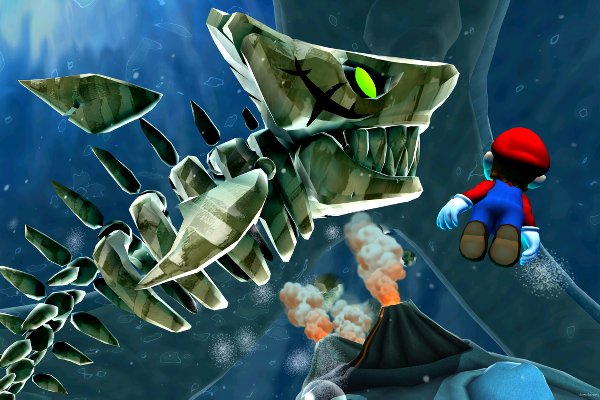
Super Mario Sunshine demonstrated Nintendo's intention to take the legendary plumber's adventures in a new direction. But for this writer, turning Mario into a hose-wielding slime-disposal expert (fitting job though that may be for a plumber) wasn't a tenable long-term strategy. Going interstellar, on the other hand, was completely, ingeniously bonkers; if farmer Matthew McConaughey could be sent into space, why shouldn't Mario? The gameplay harked back to the Mario 64 days and the 2D Mario days, eschewing weird weapons and sludge for beautiful worlds and a focus on good old-fashioned jumping and platforming. But a pure throwback to the olden days wouldn't have landed Galaxy in the number one spot. The space travel is utterly breathtaking, and you'll be euphorically clenching your teeth as you're cannonballed between the disparate planets of the game. The spherical dimension to many of the levels allows you to jump off a planet and have gravity pull you back towards it on the other side, making for a beautiful, mind-bending, and confusing-in-a-good-way experience. Galaxy proved that the WiiMote was more than just a gimmick, using it sparingly but brilliantly as you flew between planets and rode strange creatures within them. The game also reassured us, at the end of a decade defined by video-game realism, that there would always be a place for the 3D platformer is alive, well, and here to stay. What's your favourite platformer of the 2000s? Let us know in the comments!

Contributor
Contributor

Gamer, Researcher of strange things. I'm a writer-editor hybrid whose writings on video games, technology and movies can be found across the internet. I've even ventured into the realm of current affairs on occasion but, unable to face reality, have retreated into expatiating on things on screens instead.