5 Ways Origins Can Save Assassin's Creed
Completely different combat and no more climbing towers, for a start.

Originally released in 2007, it's easy to see how Assassin's Creed revolutionised the industry with an intriguing premise and story; as well as stunning visuals and gameplay.
Assassin's Creed 2 introduced the now-legendary character of Ezio as he cut a bloody path through his enemies, seeking revenge for the death of his family. This spawned two subsequent instalments with Ezio as Ubisoft were understandably unwilling to see such a well-received character go to waste.
Sadly, those halcyon days are long gone, as many longstanding issues finally came to a head in the form of Assassin's Creed Unity; a broken mess of a game that caused serious damage to the franchise.
To date, there have been nine main games released, with a tenth planned this Autumn. Including the mobile games and standalone DLC packages, and it goes up to nineteen (Origins included).
Assassin's Creed Origins was unveiled at E3 2017, and caused waves when the demo revealed just how different the game had become. With revamped gameplay and a new focus on the beginnings of the Templar-Assassin rivalry, Origins could be exactly what Ubisoft needs to get the series back on track, earning the trust of their player base along the way.
5. No Eagle Vision Or Towers

Although it has been a staple of the franchise, Eagle Vision has been overused from the start, and seriously detracts from the stealth aspect of the game.
Stealth games should be about tension, and when you can see where your enemies are standing at any point, all that tension is removed. Part of the issue is that Assassin's Creed is a third-person game - it therefore won't be quite as intense as something like Alien: Isolation, but that only means there needs to be fewer things to make it easier for players.
By actively showing where enemies are, Assassin's Creed is making its stealth element far easier than it needs to be. This reduces tension and immersion to a total crawl, and overall, effects the quality of the game.
Ubisoft has apparently realised this, as Eagle Vision has been replaced with... a literal eagle. However, unlike Eagle Vision this will have a cooldown period attached, ensuring players cannot overuse it. This will help to amp up tension in stealth sections if players use it at the wrong moment, and can't determine what's ahead of them. Enemies are tagged, showing outlines, allowing the player to follow their routes and determine exactly how they want to get to their targets.
The eagle is also used to point out areas of interest, replacing the need to climb towers with actual exploration of the surrounding area, which is another welcome change.
4. Giving The Franchise Time To Breathe

Since the release of Assassin's Creed 2 in 2009, the franchise has released at least one game on an annual basis, and that's not accounting for the mobile spin-offs and DLC packages.
Although, reviews started to shift downwards around the time of Assassin's Creed 3. This method of releasing sequels year-after-year eventually resulted in Assassin's Creed Unity, which was so completely broken that it ruined sales for Assassin's Creed Syndicate, in spite of the fact that Syndicate was - by all accounts - an excellent game.
Unity really damaged the selling power of the Assassin's Creed name, and Ubisoft have clearly recognised that fact in pushing back the release of Assassin's Creed Origins until November 2017. Although this is a step in the right direction, it will take time for Ubisoft to regain the trust of the player base it lost due to Unity.
A successful release of Origins could harm the franchise if it manages to convince Ubisoft that they have managed to steady the ship, and they return to an annual release format. However, it may also convince them to continue to take their time between sequels.
3. New Combat

The combat in Assassin's Creed has always been something of a joke. There are YouTube videos aplenty showing players racking up enormous kill counts, because every single protagonist of the series has been capable of murdering an entire army on their own.
They're supposed to be assassins, not people that could wipe out an entire city.
Syndicate made some attempts at this by having weapons that didn't instantly kill people, but the main issue is that the combat needs to have some level of difficulty.
Gameplay footage from Origins indicates a massive overhaul for combat, with exactly this problem in mind. Standing still and attempting to counter like in previous games will only result in untimely death. Instead, Origins goes for a Dark Souls style of combat.
Dodging, blocking, and parrying will be the main methods of not getting a sword in the face. Archers will do massive damage to the player if they're not taken out immediately, which points towards more strategic gameplay. Players can also now choose between a faster, light attack to mostly offset enemies, or a slower, heavier attack that will deal some real damage.
Enemies will now think tactically as well. They won't queue up neatly to have their heads taken off, instead players will be rushed, and will need to think quickly if trying to fight off numerous opponents is a good idea, or whether retreating is the better option.
2. The New Weapon System
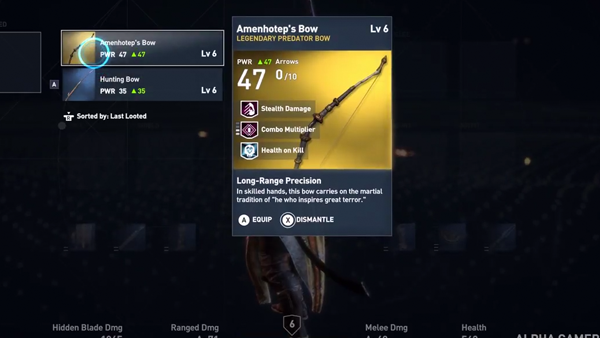
In previous releases, although there were initial pointers that the weapons were different, the only thing that really changed were the animations when you inevitably countered every attack sent your way.
The series has attempted to mix things up by having players buy better weapons, but when your main source of death-dealing comes from standing still and countering anything that comes your way, it doesn't matter how much your shiny sword costs.
The new weapons unveiled in the Assassin's Creed Origins demo change everything about the way players fight. In the same way the combat requires strategy and thought, so too do the weapons. Heavier weapons will break down enemy shields, while longer spears will keep multiple opponents at bay, whilst heavier axes are more effective against armour.
Ranged weaponry gets a facelift as well, with a plethora of bow types that can be easily switched to mid-combat. These can be used to break down shields, knock enemies to the ground, or send out five arrows like a shotgun spread.
The method of acquiring weapons has also changed. Unlike in previous games where player-held weapons were bought, and enemy weapons could only be used temporarily, defeating enemies and looting their weapons will be the main method of acquisition.
This allows the player to build up a veritable arsenal, each with its own specific use.
1. A Skill Tree & Crafting

Skill trees are dime-a-dozen in video games, but it's not something that Assassin's Creed has ever bought into. Instead, the player simply got better with time.
They unlocked new abilities after each story mission or whenever they acquired a new piece of gear, but it never felt like were involved in the character's growth. This was most obviously an issue in the downturn of the series with Assassin's Creed 3, where players were simply given all of the new skills after Connor became an Assassin.
Assassin's Creed Origins turns all of this on its head. Players start with relatively few abilities, then gradually unlock them as they play through the game and invest points into the three skill trees:
Hunter focuses on stealth and ranged combat. Warrior will have the player gain new combat abilities like parrying. Seer leans towards Assassin tools, buying and selling, and, more interestingly, the ability to tame animals, Far Cry Primal-style.
Weapons and armour will require upgrading through crafting, meaning that players will need to actively improve their gear if they want to stand a chance in combat as the game progresses. This new system will increase micromanaging, with players having to choose which weapons they want to progress with, but that's not always a bad thing.
It will feel more like the player's character, and will see more investment put into the new protagonist, Bayek.