8 FPS Games With Plots That Actually Didn’t Suck

The genre can be so much more than just mindless slaughter.

First-person shooters have a pretty shoddy reputation when it comes to storytelling, and you can understand why. The genre began life - for all intents and purposes - in the early 90s with the release of Wolfenstein 3D and then Doom - which were so groundbreaking and novel at the time that people were perfectly content to blast their way through the games' hallowed corridors without noticing that the plot was essentially just 'kill, kill, kill'. Fast forward to today, and the FPS genre is defined by pretty much the same premise, thanks to the prevalence of online-focused, impersonal shooters in the Call of Duty and Battlefield series - both of which have about as much plot as an army recruitment ad. But amidst these genre-defining shooters are plenty of releases that tell some of the greatest stories in video games, albeit interspersed with sequences of mass killing. Some of them are unforgettable classics, while others got undeservedly drowned out by the domineering big-name releases. Then there's the big question: what exactly is a first-person shooter? While there are plenty of first-person games that entail shooting, for this writer an FPS is defined by the act of shooting to progress through the game. Stealth, player choice, branching dialogues and in-depth skill trees can all play second fiddle to the action, while the story is usually fixed, with few (though there are some) opportunities for the player to alter its course. So that means no Deus Ex, no Fallout 3 and no Thief for you. Now, when your outrage subsides, click on through.

8. BioShock Infinite

What better way to start than with one of the most ambitious FPS plots of all time? BioShock Infinite casts you as Booker DeWitt, a detective who gets tasked with saving 'the girl', Elizabeth, from the floating airborne utopia of Columbia. When up there, Booker gets caught up in the middle of an all-out class and race war in the city, touching on themes rarely explored in video games. The environmental storytelling in Infinite is fantastic, as you get little hints of the city's warped politics through little bits of character dialogue, audio journals, and those brilliant Dimwit & Duke mechanised puppet theatres. In terms of plot, Booker's relationship with Elizabeth is among the best, most heartfelt dynamics in any video game; you care for both characters deeply, and you desperately want things to work out for them as everything begins spiralling towards time-bending chaos. Elizabeth's 'gift' means that her and Booker bounce around between different dimensions and alternative histories of events. By the end, you feel exhausted and mind-blown by the plot which - despite sometimes getting tangled up in itself - took video game storytelling to places it never went before.

7. The Darkness

This unique shooter is one of the most underrated games of the last console generation, in large part thanks to a dark, gripping story that sheds light on the satisfying, brutal gameplay. You control mafia hitman Jackie Estacado, who is possessed by a malevolent power called the Darkness. This power has its perks, sprouting monstrous demonic tentacles from Jackie that tear up his enemies and feed on their hearts, but it also leads to his girlfriend being killed, which sends him on a hate-driven quest to get revenge. The Darkness contains a fascinating double-conflict, because while Jackie wants to rid himself of his nefarious power (to do so, he must confront in the hellish Otherworld), he needs its help to avenge his girlfriend. The closer Jackie gets to completing his quest, the more he gets consumed by the Darkness, and this intriguing plot is done justice through excellent writing and voice acting.

6. Perfect Dark

Perfect Dark's sci-fi plot is veritably insane. Set in 2023, you control Joanna 'Perfect' Dark, a spy for the mysterious Carrington Institute. Her employers are allied to an alien race called the Maians, who are embroiled in an interstellar conflict with the warmongering Skedar - a race capable of disguising themselves as oddly Aryan-looking humans. It's the kind of plot that conspiracy hacks would hail as holding the key to the truth about our governments, the president and spy agencies ('like, all those institutions you think you can trust, they're just puppets, man. The truth runs waaaay deeper than you can imagine'). But what wearers of tin-foil hats wouldn't realise about Perfect Dark is that it's brilliantly self-aware, and treats its wacky plot devices lightly. Perfect Dark knows it's crazy, and charges full warp-speed ahead with it in a completely unrestrained, unapologetic way. It takes you from futuristic skyscrapers to alien spacecraft - complete with classic little grey aliens - and constantly has you eagerly anticipating the next crazy turn it will take.

5. The Resistance Trilogy

The Resistance holds the unceremonious accolade of being that 'other' sci-fi shooter on the PS3 - you know, the one that wasn't Killzone... But Resistance holds a few definite advantages over its more illustrious rival. While its large-scale multiplayer mode was far more anarchic than Killzone's, the Resistance trilogy had a fantastic plot set during an alternative post-war history (which is starting to become a recurrent theme in this list), in which a violent alien race called the Chimera have taken over the world. The trilogy storyline gels together brilliantly, really picking up momentum in the second and third games. It's a series that's relentless in capturing humanity on its knees, and shows little sentimentality when it comes to killing off important characters. Inevitably, the aliens aren't the only enemy you'll face, as cannibals and militant survivalists roam the game's ruined environments - which are all beautifully characteristic of the 1950s. By the time you begin the third game, the plot gets condensed into a personal and intimate story that's a refreshing change from the macho approach taken by other games pitting humanity against aliens.

4. Wolfenstein: The New Order

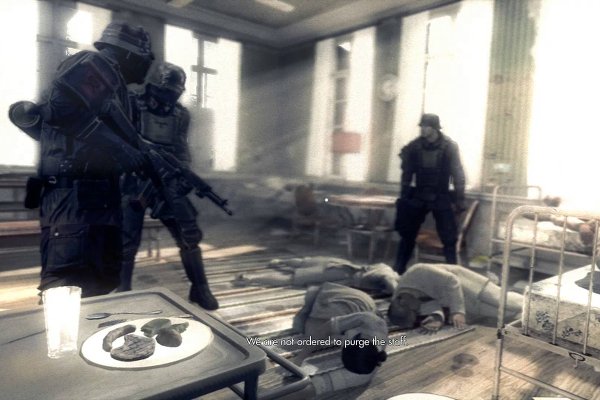
Wolfenstein (most enjoyably pronounced as 'Volf-en-Schtein') is one of the games originally responsible for giving first-person shooters a bad name for storytelling. Pretty much every Wolfenstein game had a schlocky plot involving zombies and nazis, and no one was expecting much of it when The New Order was released. But The New Order surprised the world with a fantastic story set in an alternative-history 1960s Europe in which the Nazis won the war. Reprising the role of B.J. Blazkowicz, you awaken from a coma and head into a fascinating dystopian vision of Nazi Germany. Blazkowicz is developed as a character like he never was before, and his love interest in Polish psychiatric nurse Anya Oliwa is actually convincing, as you root for the pair to get it on with each other... and kick the crap out of nazis, of course. The game mixes up scenes of extreme - almost comical - violence with some emotionally heavy moments, and this unlikely combination works surprisingly well. The New Order also gives players a unique degree of choice, where early in the game you have to choose which one of two characters lives and dies, impacting on the story throughout the rest of the game; a perfect indicator of The New Order's experimental approach to narrative.

3. Metro 2033 & Last Light

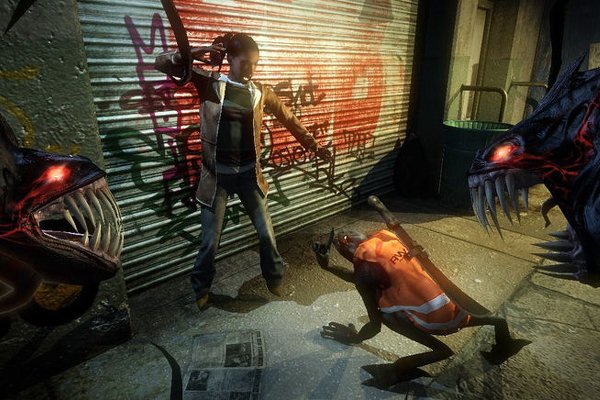
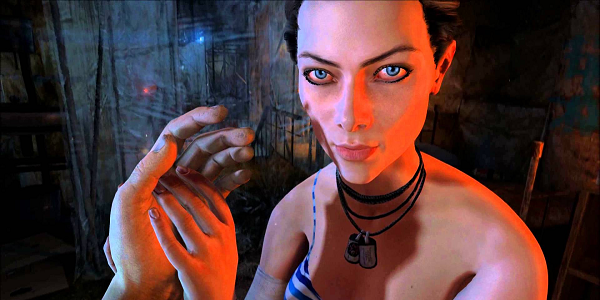
Some would say it's cheating to include a game based on a novel, but wrapping a great story around a video game is no easy task, as attested to by the scarcity of book-to-game adaptations out there. The Metro games are set in post-apocalyptic Moscow, where everyone is living in subway tunnels beneath the city because the surface is radioactive and populated by mutated monsters. You control Artyom, a young man who must leave his underground home for the first time in his life to venture through the subways and even surface of Moscow to get help for his home station of Exhibition, which is being overrun by mutants. The Metro games are layered with haunting elements of the supernatural (such as the shadowy ghosts of people who have died in the Metro), and convincingly depict a moribund society struggling to survive in torrid conditions. In Metro, we see humanity at its best and worst extremes; ugly ideological conflicts between communists and nazis plague the subways, but you also encounter selfless people who lay down their lives to protect others. A powerful and intimate story, all amidst the relentless din of gunfire reverberating through Moscow's subway tunnels. Who'd have thought it?

2. The Half-Life Series

In a way, it's little wonder that Half-life 3 is yet to be announced and may not happen until the technology's there for it to be truly groundbreaking (VR?). The first two games in the series proved to the world that a great story could be told in a first-person shooter, so the third game has its work cut out in making a similarly colossal impact on the medium. Sure, the adventures of the mute Gordon Freeman may not pack the emotional gravitas of far more recent games, but they essentially introduced the idea that first-person shooters didn't have to involve persistent shooting, that you could slow the game down at times to take in your surroundings, or just absorb events happening around you. Wasn't that introductory tram ride in the original Half-life one of the most immersive, engaging video game experiences ever? Half-life 2 built upon its predecessor's story in every way, expanding it out to the totalitarian dystopia of City 17. The expressive faces of the characters, the eclectic, dilapidated environments, and Gordon's stoic silence through it all worked together to make Half-life 2 a landmark of distinctly 'video game' storytelling.

1. BioShock

The sequel may have given us parallel dimensions, and Half-life may have laid the foundations for FPS storytelling, but in the end it's this dark, mesmerising ocean-floor adventure that wins the top accolade. BioShock took its narrative blueprints not from films or other games, but straight out of philosophy books. The fallen deep-sea utopia of Rapture is an embodiment of the objectivist, individualistic philosophies of Ayn Rand and a commentary on what they lead to - warning us that relentless pursuit of self-interests and individual 'greatness' is the road to hell. As you pick up audio logs around Rapture, the story of how the city came to collapse slowly comes together. This method of storytelling, which lets you dig as little or as much as you like, works fantastically with the player just wandering around the stunning, Deco-inspired architecture of the Rapture. It's a type of immersive storytelling that only a game can do. Beyond the lofty philosophical themes, BioShock's plot cleverly explores the idea of choice in video games. The game toys with your own sense of control over events, but concludes with one of two alternate endings, which poignantly show that ultimately show that your decisions do matter. BioShock contains not only the best FPS plot in video games, but quite possibly the best of any game every created. It came out at a time when gaming hardware was powerful enough to give developers free rein when it came to visual storytelling, making it a timeless masterpiece that's yet to be supplanted. What's your favourite first-person shooter with a killer story? Let us know in the comments!

Contributor
Contributor

Gamer, Researcher of strange things. I'm a writer-editor hybrid whose writings on video games, technology and movies can be found across the internet. I've even ventured into the realm of current affairs on occasion but, unable to face reality, have retreated into expatiating on things on screens instead.