8 Video Games That Faced Development Hell (And Turned Out AMAZING)
Not every troubled game turns out like Duke Nukem Forever.

Unlike movies, when a game enters development hell, there's a good chance it will eventually release in some form. Whether it takes five years or ten, even the most plagued projects from throughout the industry have made it to shelves after a bit of tinkering, often overcoming massive changes in technology and trends in the process.
That doesn't mean they end up being any good though. For the most part, these storied titles (like Duke Nukem Forever), which suffered through more "will they/won't they?" drama than a 90s sitcom, limped onto shelves with black eyes and broken bones, feeling immediately dated and nowhere near up to competing with the most recent releases.
Occasionally though, developers have been able to pull off the impossible, and drag a game out of development hell to critical acclaim and financial success, like a phoenix rising from the ashes.
8. L.A. Noire

L.A. Noire is Rockstar's most underrated game, but for the longest time it wasn't even a Rockstar game at all. The project started with a team of just six people all the way back in 2003, then set to release on a "next-generation Sony platform". Somewhere along the way, though, that deal must have fallen through, and in 2006 Rockstar came in to publish the ambitious detective thriller instead, taking the title multi-platform in the process.
The reasons for the shakeups were primarily down to the then-revolutionary motion-capture technology developers Team Bondi were after, with the end product living or dying on how well players would be able to analyse the subtle gestures and facial tics of interrogated suspects. However, even when that was nailed down, Rockstar and Bondi proceeded to clash over pretty much everything during development, with the latter getting annoyed at the former for taking too much creative control.
The game did eventually come out in 2011 to damn good reviews and strong sales, but by then the relationship between the developer and publisher had deteriorated. At one point Bondi were poised be become the next big Rockstar studio, but after L.A. Noire came out, the partnership ended with the developers going out on their own to their eventual demise.
7. Alan Wake

Remedy's Alan Wake was supposed to be the next big property for the Xbox 360; the new franchise that would eclipse anything the competition had to offer and completely revitalise third-person shooters. While it was an admittedly great game though, it in no way lived up to the hype that its long development would have had you believe.
The studio's next franchise after finishing Max Payne 2, the title was originally set to take that title's solid core gunplay and transfer it into an open world environment. The idea was that you'd control the titular writer and use him to explore the horror of Bright Falls, driving from one creepy area to the next. Essentially, it would have mixed survival horror with sandbox gameplay, long, long before The Evil Within 2 would attempt to do the same thing.
Unfortunately, the devs couldn't quite get the two to mesh while still being able to deliver their TV-inspired, episodic narrative. Officially announced in 2005, the project was internally rebooted to fit the more linear design, eventually releasing exclusively for the Xbox 360 in 2010.
6. The Last Guardian

Beginning production immediately after development on Shadow of the Colossus, Team ICO's next game was set to be their most ambitious yet. Leaked via a target render in 2008 under the working title "Project Trico", the project was officially unveiled to the public as The Last Guardian in 2009. The reveal quickly made waves with fans, drawn in by the lush art style and promise of great adventure gameplay between the player and their feathered, beastly friend.
Unfortunately, that reveal would be the last players would see of the game for the whole generation. From here, Sony's higher-ups would begin to call development on the title "slow" (an understatement), as the project missed one E3 after another. Sony never officially said the game was cancelled, but with the lack of any updates, Team Ico's closure in 2011 and the introduction of the PS4, the chances of the game coming out looked slim.
Then E3 2015 happened, and the game was officially re-revealed on Sony's stage. While the original studio had closed, the project was still being worked on by the same creative leads, with the length of development partly being down to the limitations of the PS3, and the title having to be rebuilt for Sony's new console.
The end result definitely felt a little bit dated, but for Team Ico fans, it was a dream come true.
5. Overwatch
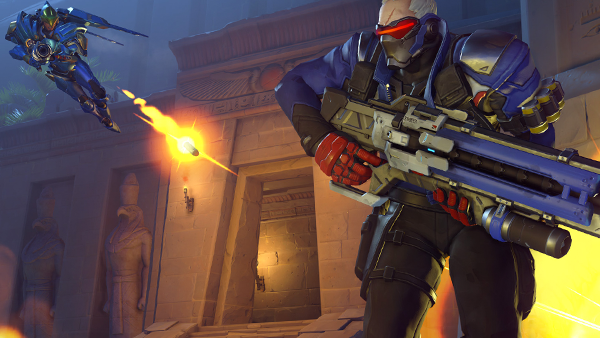
While it's become a genuine global phenomenon, Blizzard struggled for years to get a team-based multiplayer shooter off the ground. Their first attempt was Titan, which entered production in 2007.
Though it was worked on mostly in secret, it was essentially going to be a class-based shooter which would play out a little bit like Destiny, only on a much larger scale. Like the developer's other titles, Titan was planned as being an MMO, only one which would attempt to ape the gameplay style of a regular AAA action blockbuster.
After failing to find a proper focus between these two warring genres, the title was internally rebooted in 2013 and cancelled outright the year after, partly because the MMO market was becoming too crowded. The decision didn't come lightly, as it was reported that Blizzard had already sunk $50million (which, for reference, was the entire budget of L.A. Noire) into the failed project.
From there the team began to conceptualise Overwatch, with the aim being to revolutionise a genre they all loved. They decided to reign their ambitions in a bit, focusing on key core mechanics and systems rather than trying to cram every idea idea into the project like on Titan. With the class-based shooting ideas giving way to individual heroes, Tracer was created, and the Overwatch everyone loves quickly fell into place.
4. Final Fantasy XV

Final Fantasy XV was a game over 10 years in the making.
One of three FF titles announced all the way back in 2006, Final Fantasy Versus XIII was going to take the franchise into a radical new direction, aiming for a darker, more serious tone and completing moving away from the staple gameplay mechanics of the mainline series.
Even as this spin-off though, the project encountered one set-back after another, but everyone at Square Enix believed in the project, so much so that as early as 2007 the publisher considered transforming it into a mainline, numbered sequel. That didn't officially happen until around 2012 though, when the team began looking towards their next-generation offerings. At this point the game was overhauled completely, swapping engines and even the creative lead.
Being rebranded as Final Fantasy XV only brought about more complications though, as the scale of the production ballooned. From here, every idea was thrown at the wall, including potentially turning the game into a musical. Thankfully, by the time it was officially re-announced in 2013, what XV was going to be had finally taken shape, and it released three years later.
3. DOOM (2016)
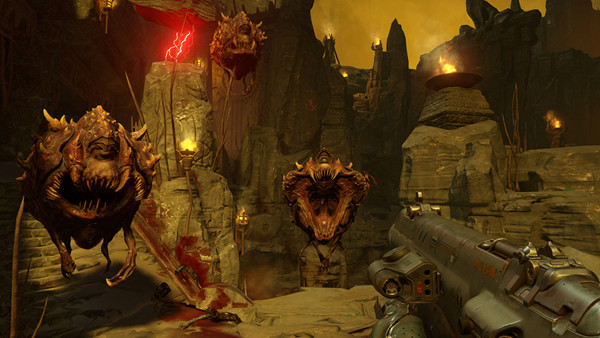
One of the best games of the generation so far, the simple, back-to-basics approach of 2016's DOOM was a breath of fresh air for first-person shooter fans. By looking to the past and reviving old-school mechanics, the reboot of the iconic franchise ironically managed to feel fresh, stripping away the baggage that had crippled other shooters at the time and putting the focus purely on buttery-smooth demon killing.
While that approach seems like a no-brainer now, it only came about after years of Id Software trying to keep the franchise relevant. After Doom 3 brought the series more inline with other serious military shooters, the fourth game (officially announced in 2008) was set to take that one step further. Taking the action to Earth, the sequel was being built with Call of Duty in mind, swapping out open levels for linear shooting galleries, a grey-and-brown colour palette and a narrative that would team you up with a bunch of other A.I. mercs.
It didn't look all that bad, but it certainly wasn't Doom. It was labelled a "mess" by people who worked on it, and eventually had to be rebooted entirely in 2011. From there, the developers had to rediscover the series' identity, dropping the Earth setting entirely, putting the focus back on fast combat with projectile-based weapons, and stripping out the majority of the scripted storytelling in favour of an unrelenting power trip.
2. Prey
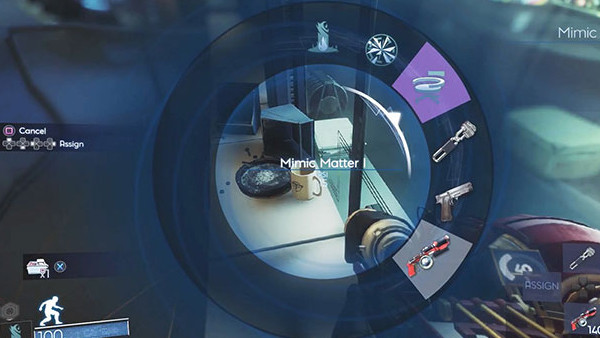
Another Bethesda property that took the publisher years to properly get a handle on, Prey (or Prey 2, as it was known at the time), went through multiple different facelifts and developers before eventually releasing as a total, name-only reboot in 2017.
Announced as soon as the original game came out back in 2006, the sequel entered active development in 2009 and was set to take the series entirely into space, chronicling the story of an intergalactic bounty hunter living across seedy space stations.
This version debuted at E3 2011 and immediately became one of the show's most anticipated titles, however a few months later development on the project was stopped, with Bethesda admitting the title wasn't up to the standard they wanted. Production was altered internally, but when the studio failed to hit its 2012 release date, the project was cancelled outright, with Arkane taking over dev duties.
The reason for the canning was apparently just as much about politics as it was quality, though, with many fans lamenting the decision. Sadly, salt was poured into the wounds years later when more about the cancelled game was revealed, including one cool twist that would have revealed that the protagonist was a clone, and every in-game death was real.
1. Fallout 3

Fallout fans can be divided between those who love Bethesda's first-person shooter take on the series, and those who pine for a return to the classic, isometric structure of Black Isle Studios' original releases. For a time, Fallout 3 (or as it was known back then, Van Buren) was going to build upon the great second RPG (after a couple of failed spin-offs like Tactics threatened a radical identity crisis), but the original team was laid off in 2003 when Interplay Entertainment went bankrupt.
The game had been quite far along in development, but the license for the franchise was sold off to Bethesda for little over $1million. Intending to put their own spin on the series and bring it more in line with their own gameplay ethos, a new team got to work on revamping the IP in 2004. Of course, during that time much of the studio's focus was on shipping The Elder Scrolls IV: Oblivion, which would eventually propel Bethesda into the mainstream.
Their rebooted version of the sequel eventually came out in 2008 to more fanfare than the studio no doubt ever expected, changing what Fallout was in the process. While Van Bruen was all but discarded, in a great twist of fate the publisher would actually go on to hire Obsidian Entertainment (home to many former Black Isle employees), to craft New Vegas and realise some ideas from the original version of the third game.