8 Video Games With Mind-Blowing Details You Didn't Notice
 It's often said that if you give a million monkeys a million typewriters and lock them in a room for an eternity, one of them will eventually knock out Hamlet. It's a cool saying, and I happen to believe it. However, I equally believe in another, similar true-ism if you lock game developers in a room with nothing but time and money, they'll start screwing around with their game. When I say screw around, I don't mean intentionally ruin they're much cleverer people than that. What I'm saying is that they're an inventive sort, and if given the time, they'll stuff their game with tons of clever references. They're only human, and the impulse to dick about and be a smartarse is an overpowering one. So if a game's development isn't too fraught and turbulent (L.A Noire, I'm looking at you) you'll often find that your favourite games are jam-packed with incidental details that you may not have noticed. Whether these details foreshadow the main plot, offer up Easter eggs or reference something from outside the source material is immaterial they exist, and when we find them, we're justifiably thrilled. After all, a game doesn't simply arrive fully-formed a lot of thought and programming went into the enterprise, so it's only right that the developers may want to cite anything and everything that may have influenced them. With that in mind, I've taken the time to catalogue what I believe are some of the cleverest hidden details in games. They often hide in plain sight, but when you notice them, you can't help but tip your cap and acknowledge the inventiveness. Be aware, there's a SPOILER WARNING in effect.
8. Arkham City The Twist Is Foreshadowed Throughout
 Throughout Arkham City, we were confused at how the hell the Joker managed to shake off his terminal case of Titan infection and appear renewed and replenished. Of course, we eventually saw that it wasn't really the Joker at all it was Clayface, and the Joker was still knocking on death's door. It's a well-done twist, and it came out of nowhere. Or did it? Well, if you look closely throughout, there are loads of clues that foreshadow the event. For example, when you fight the 'Joker', turn on detective vision. If you do this, you'll notice that unlike regular assailants, Joker doesn't have any bones. Furthermore, Joker takes an unholy amount of punishment from Batman, far more than you'd ever expect from a man who, despite being proficient in hand-to-hand combat, is just as breakable as a regular human. Obviously, this leads to only one conclusion he's not a regular human. The only thing that can withstand that amount of punishment without bones is Clayface, so it's easily possible to put two and two together before the big reveal. On top of that , when you rock up at the Monarch Theatre for the finale, you'll hear Joker heckling you with an odd amount of movie references, subtly cluing you in that he's actually Basil Karlo, Clayface's actor alter-ego. Combine this with the fact the movie boards are advertising a film called The Terror and you've hit the hint home run before the finale The Terror was the name of Karlo's most famous film.
7. Mirror's Edge The Game Knows How Risky It Is
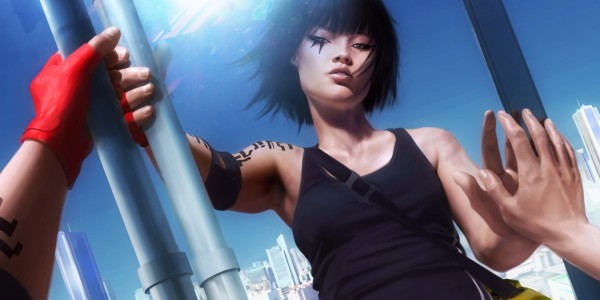 You remember Mirror's Edge, that noble misfire that was technically a pretty good game underneath some of the bugs? To be fair, it was nothing if not unique, offering you the intriguing scenario a first-person parkour simulator set in a dystopia where you operate as a message runner. Your protagonist was called Faith, which became an even more apt name when you saw what she was doing. Namely, she ran through hordes of armed goons, leaping between buildings and other death-defying drops. Obviously, it didn't take long for many people to jump (pardon the pun) onto the 'leap of faith' reference, because again, that's precisely what she's doing. Yet the other reason she's called 'Faith' is much more based in the real world. As you might remember from the heady days of 2008, Mirror's Edge was seen as a hell of a risk, even for a juggernaut like Electronic Arts. They'd poured a lot of money into this brand new intellectual property, and they really had no idea how it was going to be received. Unlike your FIFAs, Maddens and Battlefields, It had no brand security behind it they were literally going in blind. So really, the name of Faith is as much a reference to the studio as it is to the character. Much like the girl herself, EA were taking something of a leap of faith in trying to get this off the ground. Unfortunately, it didn't do as well as they'd hoped, but on the bright side a sequel was announced at E3 2013, so happy days.
6. Metal Gear Solid 3D The Loss Of Depth Perception
 It's a good thing that more consoles are getting to see the brand of madness that is Metal Gear Solid. Playstation users have been putting up with its incoherent ramblings for nigh-on a decade and a half now, so it's only right that Xbox and Nintendo fans should help us take turns babysitting the insanity that is Hideo Kojima's opus. Of course, just because the bloke's mad, it doesn't mean he's unable to indulge in a bit of genius now and then, and giving him access to the 3DS for Metal Gear Solid 3D gave him the platform to pull off a masterstroke of hardware detail unseen since Psycho Mantis moved your dualshock across the room. Metal Gear Solid 3DS is a direct port of Snake Eater, and as befitting its status as a port, the plot runs exactly the same, including when Naked Snake loses his eye after a barney with Ocelot. What Kojima Productions does next could only be done on the 3DS if you notice, after this event the 3D effect doesn't work in first person aim. Now, I'm willing to bet that a great many of you thought this was lazy programming, or something lost in translation during the port process. Well, I'm here to tell you it's not it's actually a moment of design genius. The reason the 3D isn't working is because unlike before, you're aiming with just one eye, courtesy of one being shot out. Those of you who know their biology will know that when you're only using one of your peepers, you no longer have any depth perception a situation in which Naked Snake now finds himself in. So really, the loss of the 3D effect was representative of Big Boss's new challenge as a semi-blinded man, and the studio were actually attempting to give you an insight (pardon the pun) into his new, damaged biology in a way only the 3DS could.
5. GTA IV It's Only Depressing Because You're Seeing It As Niko
 It's safe to say that Niko Belic isn't the happiest of chaps. Between being constantly troubled, occasionally mournful and possessing more moral shades of gray than your average colour wheel, his is not a nice life, despite all the trappings homicide seems to have brought him. He's dogged by his old war record and what his life-of-crime is doing to him in the present day, so he barely cracks a smile. In fact, I'd go so far as to argue he's probably the most depressing protagonist modern GTA has ever had even more so than Claude, and that guy's a mute. As such, he's given a more depressing playground to wonder around, and this was many people's primary grievance with GTA IV when you compared it to the wonderful technicolour fun-scape of San Andreas, everything was just a bit drab and sad. Well really, there's a point to that the world you see is informed by what Niko sees. He sees the world as a depressing place, so lo and behold, the Liberty City is shaped in that image. This theory is given credence by the later DLC. If you remember playing them, you'll remember that they were just a whole lot more fun, especially in the Ballad of Gay Tony, which painted Liberty City with a much brighter colour brush, mirroring Luis Lopez's sunnier outlook on life. Liberty City just seemed a more fun place to be, with drinking and dancing minigames, as well as underground fights and driving ranges. Really, the only reason you weren't doing that as Niko was that as a shell-shocked veteran who may have committed horrible crimes, he wasn't exactly in the mood to go dancing.
4. Portal 2 It's Stuffed With Greek Myths
 As is often the way in Portal, it's all foreshadowed by the turrets. When you're going through the turret-building factory lines, you'll come across the place where they're throwing away broken turrets. As everyone knows by now, there's a turret yelling that he's different, and if you pull him off the line he'll tell you the story of Prometheus, who gave man the fire of the gods and was punished by being pecked by crows. It's all a very clever analogy GLaDOS is Prometheus, and her giving the portal gun to Chell (ok, she doesn't actually give it, but she did leave it out) results in a downfall when she ends up as a potato being pecked by crows. This analogy is rammed home by there being references to Aeschylus the writer behind Prometheus Unbound in Cave Johnson's painting. However, that's the least subtle of the Greek myths in Portal 2, which also operates as a re-telling of Pandora's Box. Basically, one can see Chell as Pandora, and Wheatley as Pandora's partner-in-myth, Epimitheus. In the myth, Pandora bestowed upon Epimitheus great power, which he used to destroy the world. It's not too hard a jump to see the comparison in Portal 2 Chell gives Wheatley unlimited power (access to GLaDOS's body and mainframe) and he proceeds to screw everything up, as is his purpose in life. Finally, there's also versions of Tartarus (Greek hell) and Elysium (Greek heaven) in the game. Zeus threw the titan Cronos into the pit of Tartarus to banish him, which finds a direct comparison on Portal 2 when Wheatley inadvertently throws you into a pit instead of killing you after he goes bonkers. On the other side of the coin, Elysium was depicted as a field of plenty, which finds its in-game reference in the field you get banished to after GLaDOS banishes you from the Apeture compound. The heavenly themes are made even more obvious by the fact that you ascend up there using a lift.
3. Far Cry 3 Alice In Wonderland
 Far Cry 3 is an excellent game that much is plain. They took the faults of Far Cry 2 (weak characterisation, slightly faulty mechanics) and built upon them, buffing up the island setting and plot to an almost mirror shine. The characters were good, the storyline was good really, it was just a 9/10 game all over. But beneath the surface, there was something very clever going on. You might notice that around half-way through the game, when Jason really starts to enjoy slaughtering people, that loading screens begin to include quotes from Alice In Wonderland. Specifically, it brings up the debates between the Mad Hatter and Alice about whether she's mad. The analogy there is faintly obvious the Hatter's admission that 'we're all mad here' equally applies to Jason Brody, who goes from scared college student to Rakyat Messiah as the game develops. But there's also a number of details that speak directly to player. First, much like Alice going down the rabbit hole you go from North to South on the map, giving your descent into madness a geographical twist. Also, Vaas makes it clear to the player that Jason's not the only one indulging in madness. His 'definition of madness' rants can equally apply to you you're playing through the game, knowing full well you'll bump into him an inordinate amount of times, but you put up with it because it's a computer game. Also, once you finish the game, you might start it up and play again on another difficulty. Either way up, Vaas is asking whether you're any better than Jason (who keeps throwing himself into the these positions) or himself (who keeps giving the same lecture). After all, no-one's forcing you to repeat yourself. You do it anyway, because we're all mad here.
2. Spec Ops: The Line Walker Was Mad The Whole Time
 If you've played Spec Ops: The Line, you'll know how special it is. It expertly skewed the modern shooter in the most effective way possible by making it clear that the power-fantasies you indulge when you pick up a run-and-gun shooter are utterly pathetic. It does this by showing you the increasing madness of Captain Walker when confronted with an incredibly dark situation which Call of Duty might play for thrills. But if you were paying attention, you could've noticed that Walker's madness is foreshadowed throughout. First of all, lots of subtle details change for Walker depending on whether you look at them. For example, we know by the end that Konrad is just a figment of Walker's fractured consciousness he's an imaginary construct of an obsessive mind, and the game gives you many clues to this throughout. If you look closely, you'll see that the fake Konrad actually resembles Walker, and Konrad remarks they're a lot alike, hinting at the fact they actually are. This revelation also gives a new spin on Walker's madness there are images of Konrad looking down on him throughout chapter one, implying that Walker's already insane before everything goes FUBAR. You also get another hint in chapter 5, when a billboard changes from Konrad's face to what it really was, further showcasing the obsession Walker has with his old C.O. A final, less specific augur of madness comes just after that scene when Walker passes a tree at first glance it's completely normal, but when you pass it, it withers and dies off-screen. If you look back, it's a burnt husk. Combine all these with the fact you spend the game physically and mentally descending, and you've got a brilliant metaphor on your hands. Really, if you saw the signs, you could've turned the game off before Walker went truly mad. No-one's forcing you to drive him crazy, but as the game loves to tell you, this is all your fault.
1. Bioshock: Infinite The Luteces
If you were to compare Bioshock Infinite's dimensions twist to it's predecessor's Would You Kindly rug-pull, I'm willing to argue that the former might be even more ingenious than its illustrious predecessor, especially when you look back at how the game unfolded. Basically, the whole thing is about free will and determinism. Booker is living a life that's railroaded to what the Luteces, who exist across all dimensions, want from him namely, bringing them the girl and wiping away the debt. They see all the choices he could make across all dimensions, and as the game points out, some of these are fixed points, regardless of what Booker chooses to do with his (and your) illusory free will. This is played out several times throughout the game, if you look hard enough he always ends up flipping heads in the carnival, he never actually gets to throw a baseball (regardless of target) and the bird or cage pendant choice, your only choice as a free agent, is completely irrelevant as it won't change your fate. What makes it even weirder is that you know the Luteces, in their dimension-hopping ways, have seen you make these choices over and over again. After all, where do you think all the other coin-flips on Robert's board came from? You're fixed in what's going to happen across all dimensions, and the game keeps reminding you of this throughout. The best example of this comes from the game's prologue, after you've played it through once. As you'll know once you've completed the game, it's the Luteces that row you to the lighthouse. You'll note that Robert tells Rosalind that he (Booker) doesn't row. She asks whether he doesn't row, referring to the act of rowing in general, but through emphasising doesn't instead of row within the sentence, Robert's actually making it clear that in no reality, at any point, did you row to the lighthouse he always did it for you. Again, he's speaking about a fixed point, not whether you like to row as a hobby. It gets even cooler when you realise that Lutece is Latin for Paris, meaning that throughout the game, you always were going to take Elizabeth to Paris, even if in this case it's not a city, but a pair of British dimension-hoppers. So that's your lot. What do you think? As always, comment below!