9 Little-Known Science Facts That Make Fallout Even Cooler
War never changes, but science can make it better.

Everybody loves a good apocalypse, and the wild popularity of the Fallout series is testament to just how much.
Fallout embraces science with the unbridled enthusiasm and of a drunk auntie at a wedding, simultaneously grasping it with both hands to the point of near asphyxiation, and stumbling slightly in its eagerness, and that's what makes it great. There's a sense that everything is rooted in the gritty world of real science, making it all the more threatening, but with a dash of over-the-top science fiction bombastic-ness to keep things exciting. You could say that it's the perfect blend of science and imagination.
Although a little exaggerated, there's plenty in the Fallout universe for the science enthusiasts amongst us to get their teeth into. Such nerds might get a tingle of excitement as they come across the synths, the FEV and even the Ghouls and the knowing little nods from the creators to the real-world science.
Sometimes, getting into the nitty gritty details behind sci-fi can ruin the experience, but in the case of Fallout, the more you know about the science, the more you get out of it. The breathtaking attention to detail from the creators is something that can only enhance the playing experience.
Plus, you know, it means that you could one day have your very own Power Armour.
9. Power Armour Suits - Exoskeletons

You can't talk about Fallout without talking about the Power Armour.
This stuff is essentially a one-man tank and even afford protection against the ever-irritating fall damage. They're arguably one of the most iconic features of the Fallout universe and you can see why, who wouldn't want a badass cross between Iron Man and a juggernaut?
The real question is, could you have one in, you know, *whispers* real life?
Yes and no.
Organisations such as DARPA are already working on powered exoskeletons for the armed forces. Whilst this won't allow you to stomp about the place with impunity like in Fallout, they would enable troops to carry immensely heavy loads and lift great weights. Granted, the reality is that sealing yourself into a suit and falling from a great height/taking some heavy fire is probably more likely to turn you into a can of Spam rather than a war machine, but technologically enhanced troops are on their way, make no mistake.
8. Synths - Robot Rights

As we get ever closer to it, the debate as to whether it is possible or even ethical to create an artificial consciousness creeps from the world of science fiction into science fact.
In terms of Fallout analogues, our current levels of artificial intelligence technology would probably already enable us to create Gen 1 and perhaps even Gen 2 synths. Much of our current AI would probably do a fairly good job of mimicking human behaviour, even if they weren't as utterly convincing at the Gen 3 synths.
The problem with Gen 3 synths, is that the process of creating an artificial living mind is as much an ethical problem as it is a technological one. Just as the Gen 3 synths in Fallout 4 insist that they should be afforded the same rights as humans, real life robotics experts are having the same debates - what rights would an artificial consciousness have? We have already created an emotional robot whose emotional status affords her the right to be protected from abuse and sexual exploitation (no, really).
Synths might seem like works of sci-fi, but they could become a reality much sooner than you might think.
7. MAD - Fallout Was Nearly Our Reality

The whole situation in Fallout is essentially an alternative reality in which the tactics of the appropriately named MAD (Mutual Assured Destruction) doctrine failed to work as a deterrent and backfired spectacularly.
Okay, as a quick recap, MAD works as a nuclear deterrent in the same way that cutting off your hands prevents you from breaking a nail. World powers work to stockpile as many nuclear weapons as possible to ensure that any country that would choose to launch their nukes would receive return fire in hellish abundance. During the cold war, stockpiles of nuclear weapons probably reached a peak of around 66,000 at points. That's a lot of nukes, and a number that will become significant later.
This is all fine and dandy until one country goes postal and decides to hit the big red button anyway (or even that we just think they did, but it turns out to be a false alarm).
In the real world we narrowly (and I mean narrowly) avoided this eventuality, but in Fallout the balance is tipped the other way and, although part of an alternative timeline, is probably alarmingly close to the reality we could have been living through has someone flicked the switch.
6. Radroaches - Megafauna
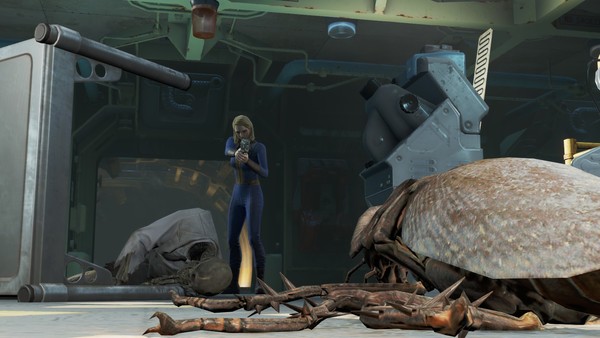
One major feature (read: total ballache) of the Fallout landscape are the giant bugs that plague your progress, but how did they get that way?
Sure, perhaps the radiation caused the "grow like crazy" gene to flicker on but there could be another factor at play, because the Earth has seen gigantic insects before. Meganeura is a genus of insects that were doing their thing around 300 million years ago. Around the same time, the oxygen levels in the earth's atmosphere was at a record high and scientists have long thought that the two were related.
Theories abound as to how high levels of oxygen could result in f*ck-off big insects - from the effects of a tracheal breathing system to an evolutionary arms race - but if the two are related, then what does that mean for Fallout's megabugs?
In a post apocalyptic world, there's not much in the way of booming global industry. There are fewer fossil fuels being burnt and deforestation grinds to a halt; the major centres of urbanisation have been targeted and, over all, the global oxygen levels may go on a hike.
5. Ghouls - Radiation Sickness

Radiation is sort of like the science fiction version of fairy magic when it comes to creating mutants, whether they have special powers or horrible disfigurements. Whilst the idea of nuclear fallout creating a shambling race of immortal mutants is unlikely, the reality is that radiation does cause genetic mutation, so the idea is not completely off the table.
Aging and death in normal humans is generally brought about by the shortening of a part of your chromosomes called telomeres. Perhaps it's possible that the mutations brought about by the nuclear fallout of the Great War would prevent the telomeres from shortening, meaning that cells that are replicated can be replicated indefinitely.
It might also explain why cells that don't reproduce, or at least not as prolifically, would slowly die off. Do you know what kinds of cells do this? Brain cells. This could well serve as an explanation as to why Ghouls' brains seem to slowly rot away.
Immortality comes at a cost, however, as the Ghouls aren't exactly going to win any beauty pageants.
As well as maybe-possibly-hypothetically damaging chromosomes in a specific immortality-causing way, it also causes damage that would cause the hair to fall out and the skin to blister and ulcerate. We call this radiation sickness, they call them Ghouls.
4. FEV - CRISPRs
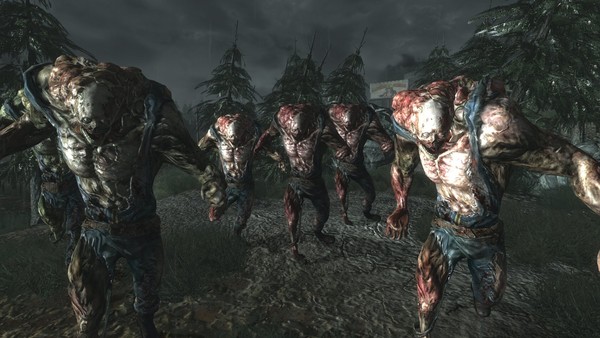
The Forced Evolutionary Virus is one of the major reasons why the Fallout landscape is crawling with things that look like they're been dragged out of a drain. It is a kind of viral gene editing that can alter an organism's DNA so dramatically that they become unrecognisable.
Slightly worryingly, there's a real-world analogue and it's even better. You've probably heard of them, they're called CRISPRS.
The FEV is based on a retrovirus, with its ability to insert foreign DNA into an existing genome. This is all fine and dandy but it can lead to the adverse effects such as sterilisation, as the FEV views haploid gametes (the sex cells) as incomplete (because they only contain half the chromosomes of diploid cells) and "corrects" the error.
CRISPRs are a genome editing tools. They're actually the naturally occurring defence mechanism of a wide variety of bacteria against the threat of viruses, but when we harness thier power in the lab, we can do an unprecedented amount of genetic "tinkering" (not to get too technical or anything). What's more, they can be delivered by viruses.
With CRISPRs, you could create a genetically perfect human/supersoldier/whatever - and one that can breed to boot - with none of the unpleasant side effects associated with the FEV. We don't currently do this thanks to those pesky ethical codes, but in the advent of a nuclear apocalypse ... who knows?
3. Energy Weapons - More Powerful Than Lightning

When you've got a Radscorpion charging towards you, it's helpful to have a weapon to hand that will reduce it to an angry pile of ash, but how much energy does it take to vapourise an adversary?
The peeps over at Nerdist did the sums, and it turns out that the answer is "a metric sh*t-tonne" or, more precisely, 2.8×10^9 kJ.
In order to vapourise anything, you essentially have to eliminate the water in their body, and you do this by breaking the molecular bonds that hold the oxygen and hydrogen atoms together. It's not as complicated as all that, you do it every day when you boil water for your morning coffee, but as humans are around 70% water, you'll need a lot of energy to turn it all into a gas.
This is about the same amount of energy as is contained in two lightning bolts, all contained in your modest little energy weapon.
Just remember to keep the safety on.
2. Why Is There Still Food? - Food Irradiation

So you can wander around the irradiated wasteland of post-apocalyptic society and simply pick up food like it's a frigging farmers' market? What, we're supposed to just accept that it's still recognisable, let alone edible, after lying around an abandoned hellscape for over 200 years?
Well, it's a long shot, but there could well be some real science in this that would make it all work.
Whilst it's true that most processed American food would probably survive a nuclear holocaust, but the following centuries might well see it decomposing into a mush - that is, if it weren't for all that lovely radiation.
Ionising radiation, as you may well be aware, is not super-great for living organisms, and this includes the bacteria and fungi that might cause your food to rot. If the irradiated landscape was sufficiently deadly enough, perhaps the land was rendered so sterile that the food simple stayed in suspended animation because there was nothing here to eat it.
We already know this works, because we're already doing it. One method used for food preservation is exactly that: Exposing it to radiation until all the bugs are dead.
Don't worry, you can safely eat irradiated food without sprouting limbs from your abdomen. Just steer clear of nuka cola.
1. Let's Talk About Nukes

The Fallout future is frightening, but could it actually happen? Exactly how many nukes would it take to blow us all back to the dark ages?
Thankfully, someone has run the numbers on this.
In the Fallout scenario, the nukes are a generally modest 200-750 kilotons (compared to the Tsar Bomba at a whopping 50 megatons). This massively reduces their blast radius, meaning that there is a smaller area in which you run the risk of being blown into your own shadow, but it does mean that, rather than the radioactive material being thrown up into the stratosphere, it spreads through the lower atmosphere before their relatively short half-lives render them harmless, treating everybody within a 25 miles radius to a deadly dose of radiation.
Anyway, using these figures to calculate how many you would need to wipe out both China and the United States, an area of nearly 10 million square miles, you would need about 422,000 nukes to flatten it. As we learnt earlier, even at the height of the Cold War, there were only 66,000 nukes on the planet, but if we take into account that the Cold War never ended in Fallout and factor in continued production, we get 218,556 nuclear weapons.
Still not enough.
But hold up. The 422,000 figure assumes that the population is spread out evenly across the land mass, which is just not how humans distribute themselves, we tend to densely populate certain areas. This makes popping to the shops easier, but also makes us sitting ducks for weapons of mass destruction.
Given the population distribution of both countries, our new figure come out at just 15.8% of our original estimate ... or 66,676. For those of you playing along at home, that is the number of nukes that actually existed at one point.
So, with this massively reduced figure, the number of nuclear weapons that existed in the Fallout universe would have been enough to wipe out not just the American and Chinese populations, but the rest of the world too.
Turn out it's not so far fetched after all. Better get digging that bunker.
You could write for WhatCulture Science! Click here to find out how you could get paid to write about what you love.
If science gives you the warm fuzzies, like us on Facebook or follow us on Twitter to stay up to date.