9 Terrible Video Games With AWESOME Stories
Video games recommended for everything other than gameplay.

Right off the bat, we need to make one clarification:
We're using "bad video game" to literally mean "bad gameplay", or where actually interacting with the product was the worst part about the experience.
There's a whole can o' worms extrapolation as to what defines a "video game" in an age where the industry is borrowing more from Hollywood than ever, so let's just nail that definition down right here, right now.
Any game where playing is what you slog through to reach the next cutscene or drip-fed piece of exposition - that's what we're focusing on. Cool? Cool.
Now we've got that out the way, it's pretty fascinating how the very importance of a game story has waxed and waned over the years. Coming into vogue at the close of the 90s, the 2000s saw a boom in cinematic flair - your Uncharteds, Metal Gear Solids and Call of Dutys twinning cinematic spectacle with tight control schemes and player-driven responses to whatever was happening on screen.
Often it's enough to make you forget you're only pushing A or forward on the analogue stick to save the day, and it's that sensibility that lets some absolute stinkers slink by.
The following titles might be terrible video games, but at least you still had plenty to talk about when the credits rolled.
9. Deadly Premonition

Deadly Premonition owes everything to an incredible cast of characters, a forever-appealing murder mystery setup where you solve the case one day at a time, and a protagonist who's just as likely to go into a Sherlockian monologue, as he is delving into the psychology of Tom & Jerry.
It's this hybridised approach of ridiculousness and laser-focused intent that lets creative director SWERY65 take you on a journey that ONLY works, because you don't know what's coming next.
To this day, Deadly Premonition's gameplay doesn't run smoothly on consoles. The 2019 Switch port still turns into a flip book if you drive at speed, and gunplay feels like a beta for what Resident Evil 4 nailed five years prior.
Don't get me wrong though, I love Deadly Premonition, but did I cringe while playing with its driving physics, wince while trying to line up a headshot?
Every single time.
8. Alpha Protocol

Speaking of Switch ports, God I wish Alpha Protocol would get another day in the sun.
The product of Obsidian applying spy thriller tropes to a Mass Effect structure (yes, it really is as awesome as that sounds... sometimes), the final product was littered with bugs, animation glitches and gunplay that put actually hitting your target down to a dice roll.
Everything outside of going on missions, though? Pretty damn exemplary.
You've got Nolan North playing a twisted version of Nathan Drake in Steven Heck, a dialogue system that results in multiple characters living or dying, plus different endings depending on which kind of spy you want to be. Jason Bourne brutality, James Bond suave? A total shadow-clinging Sam Fisher or a hybrid of all three? The choice was yours.
Hidden compounds, going undercover, romancing anyone in your way or blagging yourself into a high-rolling casino - name something from a spy film you wish you could do, and it's all here.
You just have to slog through the gameplay, to get to the good stuff.
7. Hellblade: Senua's Sacrifice

Gorgeous visuals and arguably the best lead performance of the generation it may have, but interacting with Hellblade is a slog, plain and simple.
Coming from the fact that developers Ninja Theory wanted to create a 'triple-A game on an indie budget', all that money went into motion capture tech and research as to how Senua deals with her psychosis, rather than the game itself.
Sadly, gameplay boils down to two strands. Either you're engaging in super simplistic, repetitive combat where the same combos get trotted out again and again, or you're searching lovingly-rendered environments, looking for a number of hidden runes to progress.
Nothing more, nothing less.
Again, Hellblade shines so brightly as a brave exploration of mental health struggles and as an educative light shone on the rituals of certain ancient Nordic tribes. Maybe repetitive gameplay accentuates the former, but here's hoping the sequel fleshes everything out way more purposefully.
6. Mafia 3

Repetition, thy name is Mafia 3.
Now, I really loved how much Hangar 13 were channeling their inner Rockstar for this game. The period-appropriate soundtrack, gorgeous sun-kissed vistas and map variation in general was very early 2000s Rockstar, but gameplay? That got the short end of the stick.
Many videos have been made as to how Mafia 1 and 2's hyper approach to detail was ditched, and Mafia 3 is easily one of the most repetitive titles of the entire generation.
Thankfully, its story is arguably the best of the bunch. Opening with supreme confidence, the tale of Lincoln Clay getting his revenge is The Punisher 101, but it's done with excellent acting, cinematography and payoff.
What few game mechanics there are - namely third-person cover shooting and Assassin's Creed-style stealth - get to shine when you actually care about who you're gunning down.
It may have stumbled considerably at launch thanks to a high price tag illuminating all those shortcomings, but as a budget open-world game with a solid reliable story? You could do far worse.
5. Uncharted: Drake's Fortune

Uncharted really seems to divide people.
Either you got used to Naughty Dog's spin on the Gears of War formula; adding platforming and ambushing the A.I. into more standard cover shooter fare... or you kinda hate its floatier feel.
Over the years, Naughty Dog got better at encouraging this sense of "vertical play" into each scenario, but the first game? It's really only worth going back to for the cutscenes.
Nolan North's medium-defining turn as Nathan Drake is still one of the finest pieces of video game cinema, and he's joined by the equally capable Emily Rose as Elena, and Richard McGonagle as Victor "Goddamn" Sullivan.
Outside of this though, the negatives come thick and fast. Releasing just one year after the disastrously received PS3, Uncharted was one of the few titles forced to accommodate the SixAxis motion controller for grenade tossing and balancing Nate as he traversed the environment.
Add to all this that Naughty Dog had never done a cover shooter before, and there's a reason we tend to take the characters and tone from Uncharted, whilst citing 2 and beyond as to why you should care about the IP overall.
4. Legacy Of Kain: Defiance

Did you realise it's been almost two decades since The Legacy of Kain series was active?
A staple part of any PlayStation owner's diet, what started as a top-down RPG morphed into an action adventure, and bizarrely ended on attempting to ape Devil May Cry.
Great in theory, terrible in execution.
Whilst it was still a blast to hear Michael Bell and Simon Templeman one last time as Raziel and Kain respectively, all this had going for it was pre-investment and payoff.
Defiance is TOTALLY worth it to see the conclusion of 7 years' worth of character-building. Wrapping both the Soul Reaver and Blood Omen series, Raziel and Kain face-off in a pretty damn epic time-bending tale that has one of the finest scripts in the saga.
Seriously, just listen to this pair trade off, and you'll "get" why Legacy of Kain was such a massive deal in the first place.
Gameplay-wise you had everything from frame rate woes to camera-dictated movement killing you whenever the enemies didn't, but Defiance was everything fans wanted from a climax to this fiction - even if it still ended on a "to be continued" final shot.
To this day, not one Legacy of Kain HD collection exists on consoles. Not one.
3. The Witcher
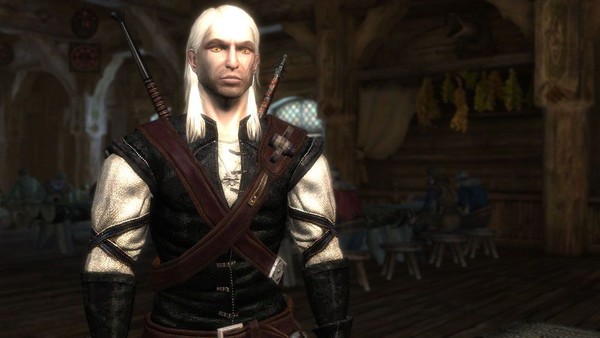
Of all the glow-ups in gaming history, Geralt and the Witcher series in general might have the most impressive.
Literally, going from a smaller-scale title brought about from a licensing deal with creator Andrzej Sapkowski, CDPR would work themselves half to death bulking out the experience into a semi-open world RPG for The Witcher 2, then one of the finest RPGs of all time in The Witcher 3: Wild Hunt.
It all had to start somewhere though, and the original Witcher's gameplay is a slog from front to back. Yes, there's depth to potion making and sword combat, but this is for hardcore fans only, as the real positive is storytelling.
Witcher 1 is where series' veteran Doug Cockle began flexing his pipes as Geralt, and from moment one, you can tell he was born to play the role.
All of the Witcher games follow a timeline post-book, but the original features a ton of references and recreations of iconic arcs from the source material. It's this stuff, interacting with the Continent through an amnesiac Geralt and meeting everyone from Triss to Vesemir for the first time, that is the only reason you should ever play today.
2. Brutal Legend

Possibly the most disappointed I've ever been by a game, ever, Brutal Legend was advertised as God of War by way of 70s and 80s metal album covers. However the result was a wretched real-time strategy, done through an over-shoulder camera with terrible controls.
Unique, innovative and still finding its audience with those who could look past such deceptive advertising, the vast majority of us were put off altogether.
And that's a shame, because everything outside of playing these large-scale battles is exemplary. Ozzy Osbourne, Lemmy Kilmister and Rob Halford all play prominent roles, with Ozzy hanging out underneath the world itself, offering upgrades to your Druid Blow hotrod while swearing and insulting Jack Black's Eddie Riggs.
From every second of cutscene to each spoken word, the narrative of a modern day roadie being thrust into a world where all his favourite heavy metal tropes are real is beyond perfect for anyone into metal itself.
Going back today - which you can do on Xbox One through backwards compatibility - Brutal Legend does shine phenomenally bright in its opening hour or so, then takes a nosedive into one giant risk that ultimately didn't pay off.
Every single Lemmy scene though? Bliss.
1. Every Telltale Game After The Walking Dead Season 1

As we'd later find out from the studio shuttering after years of increasingly disastrous sales, 2012's first season of The Walking Dead was something of a fluke.
Not taking anything away from the incredible story, sense of causality and tension throughout, but in terms of mainstream appeal or even why Telltale are a household name, it came from a game releasing right when its TV counterpart was at the height of popularity.
Everything after Walking Dead season 1 got demonstrably worse sales-wise, but it's here where you can throw in the ramifications of a developer and publisher accepting as many projects as possible.
Game of Thrones, Batman, The Wolf Among Us, Tales from the Borderlands - all brilliant stories (especially Batman and Borderlands), but gameplay was some of the most tedious around.
Besides a reused engine that was already straining in 2012, we had arbitrary quick-time events, slowly placing icons over in-motion scenes to trigger actions, and a level of animation quality that felt decidedly locked in the last generation.
It got so bad with Game of Thrones that the entire score and dialogue could drop out at any moment, leaving you with sound effects set against a completely silent backdrop.
Telltale will ultimately remain recommendable, but they're also a testament to the adage of "too much, too fast".
Watch Next
How Well Do You Remember The Xbox 360?
