9 Video Game Sequels That Took Away Your Favourite Character
Shining that spotlight somewhere else.

When was the last time your expectations for a game sequel were completely wrong? Like just, 100% absolutely ridiculously off-base, and what you ended up with was nothing like the version you had in mind?
It doesn't happen that often, right? Mainly because the closer you get to manipulating an entire marketing campaign, the closer you are to false advertising and fan backlash. Also, people like to know what they're getting into.
Case in point: Characters.
Most of the time with any sequel in gaming, you're signing up to embody a certain character one more time. Maybe the devs are going to expand on a moveset, fill out their backstory, put them in some perilous, morally grey scenario and have you steer them through it.
More than any other medium, we get attached to our characters over time, because we're literally attached to them through the controller.
To mess with that is to play with fire, but for better or worse, the following titles struck that match anyway.
9. Star Wars Jedi Knight: Jedi Academy - Kyle Katarn
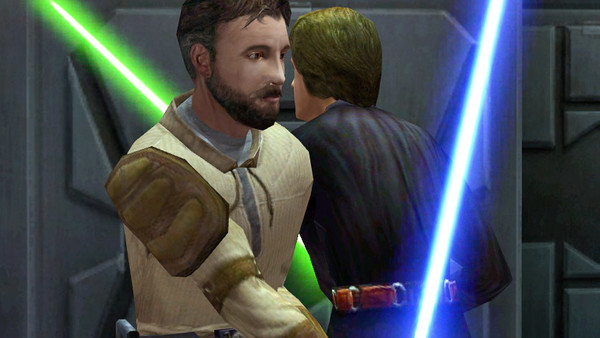
For many, the exemplary Jedi Academy (now on PS4 and Switch with online multiplayer, no less) is the best Star Wars game of all time. It's also another chapter in the Dark Forces series, which started almost a decade prior, with one rebel Kyle Katarn as its protagonist.
Katarn is still known as the best character in Star Wars that never got the big screen treatment, but come Jedi Academy and him teaming up with Luke Skywalker to help teach a new generation how to defend the galaxy, control shifted to an all-new, customisable Jedi instead.
Sufficed to say, some who'd stuck by Katarn for years were a bit deflated that the spotlight was shifting away, right when his character was achieving greatness.
Did It Work?
Hell yes.
Jedi Academy is easily one of the most inviting titles in the franchise, and its various interpersonal student relationships are only bolstered by Katarn accompanying you on missions as a Jedi Master.
There are multiple endings based on if you've specced towards light or dark side powers, and you can even fight Kyle if you went down the latter route, burying him under a pile of stones for Luke Skywalker to rescue.
Katarn fans would only get their all-blasting, all-lightsaber swinging Jedi Master followup in Jedi Academy II: Jedi Outcast.
8. Gears Of War 4 - Marcus Fenix

By the end of the Gears of War trilogy - where fans had banked close to 100 hours across three campaigns and TONS of 3am-reaching Horde sessions - Marcus Fenix took off his iconic do-rag, and Gears was done.
Original developers Epic moved on; lead creative Cliff Bleszinski the same, and if anything, we certainly didn't want another Gears of War Judgment, where it felt like Microsoft were trying to cash in on the rise of Nathan Drake archetypes by front-loading something with Damon Baird.
For the next generation of Gears, it would require the next generation. Step forward, Marcus Fenix's son, JD Fenix.
Did It Work?
Not even for a moment.
JD was harmless enough, centring the story and his character motivation around how he's not Marcus Fenix, but this should've been a way to make him loveable. Instead, it just made you yearn to play as the original crew.
It didn't help that every time Marcus was on screen he stole the show, leaving JD to feel like Gears of War doing an Uncharted impression.
Gears 5 finally found its footing with fellow newcomer Kat chasing her own lineage and role in the creation of the Locust. JD, though? He was redesigned to tragically be a clone of his father.
You could even choose to let him die near the end, and I have to imagine The Coalition are totting up player data to see which choice will be canon in Gears 6.
7. Dino Crisis 3 - Regina

Of all the Capcom franchises in the world, Dino Crisis routinely gets held up with millions of us screaming for a sequel.
The idea of Resident Evil-style gameplay mixed with terrifying set design and freakin' velociraptors leaping through the windows is a recipe for horror gaming heaven. And yet, even back in the initial run, Capcom managed to mess it up.
Following two great instalments, the series - for no reason whatsoever - leapt 300 years into the future.
Ditching the relatively recognisable Regina and her cliffhanger ending of DC2, we were given a crew of all-new space cadets.
Did It Work?
An intergalactic "Nope!".
Patrick Tyler and Sonya Hart were as bland as could be, although a lot of the blame for Dino Crisis 3 failing comes from its terrible camera, twitchy jetpack controls and a full-on identity crisis gameplay-wise.
Somewhere in here - or in entertainment as a whole - is a badass "dinosaurs in space" experience, complete with some of them having lightning powers. In Dino Crisis 3's case though, not only was the game terrible, but it made the hooky ending of 2 completely pointless.
6. Mafia III - Vito Corleone

For those who like their open-world crime experiences to come with more detailed environmental interactions and a weightier, character-driven story, Mafia should be your first port of call.
Now, Mafia 2 also swapped out its main character, telling the rise of Vito Scaletta in Empire Bay, his friend Joe Barbaro and the rags to riches tale they both embarked on. Mafia 1's Tommy Angelo gets killed in this story, but it was the switch to Mafia 3's New Bordeaux with one Lincoln Clay that really raised eyebrows.
Did It Work?
Character-wise? Yes. Mafia 3's story beats are drastically streamlined compared to the twists and turns of the first two, but Alex Hernandez' performance as Clay makes the whole thing click.
Whenever Alex is allowed to play Lincoln as this Punisher-adjacent walking tank, seeking revenge for the murder of his family at the hands of the mob in a racially-charged New Orleans analogue, it's exemplary.
Vito did return as a recruitable mob boss who can help Lincoln amass armies of followers for the game's big finale, but again, his role was trimmed way down.
5. Shadow The Hedgehog - Sonic The Hedgehog

A Sonic the Hedgehog game without Sonic the Hedgehog?
Well, when the whole world was trying "gritty sequels" and all-round Matrix-inspired twin pistol action, Sega had to try somehow.
Sonic certainly wasn't going to work in this realm of mid-2000s 'tude, so Sega created "Shadow the Hedgehog".
Did It Work?
To some, who were the right age to respond to this marketed middle finger in the right way, yes. A black and red-skinned Sonic just looks cool in a surface-level kinda way, and better yet, he could fire machine guns.
What's really bizarre outside of a company cashing in on trends though, is this remains the most story-heavy Sonic game ever. We're talking Shadow as an amnesiac protagonist, flashbacks to kidnappings and government agents firing guns at targets you'd only identify later on. There are 326 branching story points here, with a ton of different endings depending on choices made at every turn.
If you grew up with Sonic and had matured past the age of 13, Shadow likely fell flat. However, for an entire generation looking for gritty mature experiences that got them, man, Shadow was pretty special.
4. Uncharted: Lost Legacy - Nathan Drake

With Uncharted 4, Uncharted: Lost Legacy and The Last of Us 2, we REALLY need to stop doubting Naughty Dog. Three times in a row they've proven they can go back to wells that feel more than dried up, only to turn in essential experiences.
For Lost Legacy, it started out as DLC for Uncharted 4. The story goes that Naughty Dog ended up putting so much time and effort into this, that the project made more sense as a standalone release.
It would be the first Uncharted without Nathan Drake whatsoever, and even though he gets mentioned by name a couple of times, this is a Chloe and Nadine-fronted show.
Did It Work?
Unbelievably so. Chloe and Nadine had a co-dependant chemistry that even the Drake brothers struggled to keep engaging.
With Chloe the confident culture expert and Nadine the daughter of a military leader looking to get paid, yes the core charm of Nolan North's performance rubbed off on Claudia Black's Chloe, but the pair bonding as the adventure unfurled was great to see.
Factor in the best closing set-piece in Uncharted history - a blend of Uncharted 2's train chase with Uncharted 4's vehicle-jacking jeep scene - and you have for my money, the tightest Uncharted of the bunch.
3. Half-Life: Alyx - Gordon Freeman

To some he's a hero; a watchful protector; a silent guardian, and the one Half-Life needs right now.
To others, Gordan "Never said a word" Freeman is the embodiment of the silent protagonist cliché - a trope that makes every cutscene interaction excruciatingly awkward.
For Half-Life: Alyx though, Freeman was swapped for plucky, confident fan favourite tech genius Alyx.
Did It Work?
In so many ways, yes.
Alyx has been beloved since her first appearance in Half-Life 2. If there was any other character to embody in this fiction it would be her, and not to mention, this meant Half-Life Alyx was the first Half-Life with a voiced protagonist.
Coupled with the increased immersion given from VR and all those environmental interactions, hearing yourself talk back to the Combine or have a conversation with G-Man felt like the next step for such a beloved mythos.
Gameplay-wise, Half-Life Alyx sets a benchmark for virtual reality, but also sews the seeds for a future where the character herself is just as important as "Mr. Freeman".
2. The Last Of Us Part II - Joel

"How can they possibly do a sequel to The Last of Us?!" we all screamed, way back when word of another instalment came floating in.
"The story was so perfect, just leave it alone" came the cry, as Neil Druckmann and Naughty Dog in general scrambled to tell everyone they were only doing a sequel because it was "absolutely necessary".
Turns out, The Last of Us 2 became one of the most divisive games of the generation, and why? Because not only were you going to be playing as Ellie over Joel, but there was another surprise in store too:
Abby.
Did It Work?
For the majority of people, yes. Naughty Dog crafted a brutally ugly game about human-on-human violence, illustrated through twin viewpoints on the same series of events.
The only way for their point to hit home was removing Joel from the story, setting Ellie's sights squarely on new Worst Person Ever, Abby, then switching gears to show you Abby's side of things across an additional 10 hour stint.
Divisive, requested by nobody and resulting in a gut reaction of sheer hatred? Sure, but that was intentional.
Come the close of Last of Us 2, you should have ALL the emotions. There's no clear winner, and providing you're not still holding onto that one-dimensional hatred from the beginning, the notion of just wanting humanity to be better is the only thing you're supposed to be taking away.
1. Metal Gear Solid 2: Sons Of Liberty - Solid Snake

The difference between The Last of Us 2 and Metal Gear Solid 2 deliberately misleading you in marketing, vs a fake trailer like Killzone 2?
If you can go with what the creators are trying to do or say, even the buildup to launch is retroactively part of the story.
In Last of Us 2's case it factors into the shock you feel when THAT moment happens early on, and in MGS 2, Hideo Kojima wanted to dissect the action game hero from a companion perspective.
Did It Work?
I'm going to say "Yes", but Raiden was the most controversial inclusion in a game for the majority of the 2000s. His ancestor was ridiculed in MGS 3 and he was completely transformed into a cyborg ninja in MGS 4, just to make him a fan-pleasing killing machine.
With the latter, Kojima was proving that all it takes to make someone worthwhile in an action or anime setting is slick choreography and martial arts. In MGS 2 we're given that same character as a total rookie, embarking on a deadly mission, only to arrive at most major encounters after Solid Snake has been through.
Raiden works as a living narrative device. His perspective reframes Solid Snake's actions and elevates them, in-part making Snake into a force of nature that nobody can keep up with.
Watch Next
Metal Gear Solid Quiz: How Well Do You REALLY Known The Games?
