9 Ways Hello Games Should Have Made No Man's Sky
Even if you love it, there are a TON of things that should've been better in No Man's Sky.

Hindsight is a wonderful thing, especially after the whole world cries out and laments a video game. A few thousand voices all contributing to some 'perfect picture' of how something should've gone? It's incredibly easy to slip into thinking a given team "F*cked up" if what they 'should have done' was so clearly 'right in front of them'.
Still, this thought process is applicable to No Man's Sky more than the rest, simply because Hello Games' planet-hopping extravaganza of lasers and jet-boosters is a fascinating case of what happens when an ambitious indie project gets given the marketing push of a triple-A release.
Over-promising interviews, TV show appearances, 'gameplay demos' sliced off the full build to show performance and features not possible at launch - all contributed to a game that immediately caught people off guard. And that was before they began picking apart what WAS there.
Just to be abundantly clear: I really love a lot of things about what No Man's Sky is, does and can potentially be given expanded DLC in the future. However, let's look back at what there is, and think about what could've been.
--
9. Give Us A Narrative Reason To Explore

[Black screen dotted with star systems. The camera slowly zooms forward as soft, orchestral music hangs in the background. A male voice crackles into life. It is fairly lighthearted in tone, and appears to be a diary entry. ]
"They said it couldn't be done. My parents certainly died trying, but what they left behind, what I know they left behind, I can use to get there. I think, no, I know I can do this. I can reach the centre of the galaxy."
That's it. That's all it needed - some sort of narrative propulsion other than "Here are things in front of you, go use them and figure it out." Because think about it: Other than when you first assemble a Warp Cell and hop into the Galaxy Map to see the 'Path to Centre of Galaxy' option, nothing whatsoever actually tells you what you're supposed to do or where to go.
Now, what narrative there is inside No Man's Sky centres around the notion of humanity's 'need' for exploration and charting unknown spaces, how fruitful or fruitless it can be, and precisely why we do it. All of these things could've been explored through diary entries, albeit textual to avoid having to record dialogue for hundreds of hours of game-time, but which would've allowed for a number of perspectives on exploration to emerge over time.
As for the thing I alluded to that was "left behind" in the opening monologue, I'd have a mysterious artefact that translates language - except our protagonist isn't fully aware of how it works. Instead, the artefact will pulsate and react to the specific 'Knowledge Stones' seen in the game, because No Man's Sky needed to...
8. Make Language Integral To Progress

Language in No Man’s Sky was touted to be an integral part of gameplay, and then just… wasn’t.
The idea of uncovering ‘Knowledge Stones’ and learning specific words to slowly decode alien sentences word-by-word is genius, but at no point do you really need to do it. Granted, it feels kinda cool to uncover things like “Money”, “Warning”, “Multi-Tool” etc. and see those words highlight in sequence so you can converse with your alien compadres, but as it stands, that sensation is the functionality’s only reward.
Playing off the idea that narrative-centric items are required to progress, have your weird, inherited device pulsate and react with the various language stones you find, clearing up the confusion as to why they’re reacting to your presence in the first place. From there, have the aliens you come across be keepers of specific items you need to progress, or augments for your ship, suit or weapon.
Whether it be crafting components, warp cells, bypass chips etc. all we’d need is a diary entry with our character saying to themselves, “I wonder if I can learn their language using this artefact”, before you then set out and begin piecing sentences together.
It gives language-learning a specific purpose, and although it may be slightly tedious process exploring to uncover alien words, would definitely add an element of progression to the language system overall, with tangible rewards for going out of your way to seek out monoliths and other ancient structures.
7. Quests & Side-Quests

Framing the overall narrative as a quest to see what's at the centre of the galaxy would also allow enough free-reign in regards to 'flights of fancy' such as exploring other planets, eco-systems, lifeforms and cave systems. Being this explorer/space adventurer-type, you'd be free to hop between planets to your heart's content, with the narrative backbone always being there when you want to resume it - that of chasing the centre of the galaxy.
To that end, we need a number of simple-yet-fun quests to pad out each chunk of gameplay before you jet off to another star system.
For example, we've already noted you can use language to acquire various parts necessary to leave your current cluster, but quests like acquiring a certain number of resources to cash in at the Galactic Trade Terminal, placing beacons on downed ships for collection, taking care of space pirates, defending large transports from attacks, removing hostile Sentinels that have gone haywire - any and all of these would give you more credits, which would feed into purchasing better ships yourself, better suit upgrades and above-all, essential items for interstellar travel.
As the game stands, there are so many brilliantly designed aspects with no connecting thread. Simply provide a reason to connect the dots, and gamers will do the rest.
6. An Actual Map Of Landmarks & Progress To Fill

There's a weird balancing issue in terms of forward momentum in No Man's Sky. It feels as though Hello Games deliberately don't let you chart where you've been to encourage pushing ahead and discovering new places, things and items.
That's mostly fine, it certainly does its job as you're not tied to one planet over the next, but all the same, having the ability to either lay down a set of markers on a given planet with custom labels ("Gold deposit here", for example), or an actual map we could bring up, would be ideal.
Now, given the size of NMS, it's going to be impossible to chart every last planet the more you play - which is why I'd have this screen reset and wipe itself whenever you leave a given star system. Have your ship pipe up and mention something like "Charted space is limited to current system - are you sure you want to leave?" or whatever, and have these icons be mapped to the planet-generating algorithm already in place for each planet.
The way No Man's Sky generates content all comes from mathematical formulae; thousands of on-the-spot calculations that create the planets you see before you. Once you leave, they're reduced down to code once again, repopulating and reconstituting in the exact same way, should you return.
As the game is already locking in a thought process of, "This bunch of numbers resulted in X planet", add in the map coordinates, and if you ever return to that specific system, all your progress would reappear alongside.
5. Replace Inventory Grind With Stacking

If you take everything in any given game as intentional, No Man's Sky's inventory system is clearly designed to give you a feeling of progression over time. You start out with a ridiculously limiting set of slots, which in a game about exploration, completely cripples your ability to hold anything more than the bare essentials for the first few hours.
To remedy this whilst keeping the notion of building this sensation, I'd implement the idea of stacking 'groups' of elements onto one tile. Objects like Bypass Chips, Carite Sheets etc. should still take up a tile each (you need something to work towards), but for the sake of hoovering up all manner of shiny coloured elements, have them stack by colour to a finite overall amount.
So at the beginning, your suit has one tile dedicated to each of the groups of elements each; Isotopes, Oxides, Silicates, Neutrals and Precious Elements. Give us 1000 'units' of anything within those groups to be stacked on top of one another. Being isotopes, Plutonium, Thamium9 and Carbon combined would only take up one tile, whilst Iron, Zinc and Titanium would all be under the Oxides bracket, and so on.
We'd still strive to update our suits and ships to carry more essential items, but this eases up those first few hours and allows us to carry a healthy amount of essential matter, without feeling so hampered by the design itself.
4. Change The Planet & Wildlife Algorithms To Allow For More Memorable Content

There was a very poignant comment from Sean Murray in the lead up to release, where he stated players may encounter 10 planets that are fairly unmemorable and listless, for just one that stands head and shoulders above the rest.
Personally - being into indie games and all that arty stuff - I really like this idea. It should feel like you're actually exploring deep space. No rewarding, picturesque vistas are guaranteed, and you're essentially exploring for the love of exploring - anything else after that is a bonus. It's a humbling comment on the nature of human discovery overall.
That said, said approach only works if the game throws up a planet as 'the one that'll blow you away' and it's fantastic. We don't need worlds that resemble the early E3 footage necessarily, but why not a planet where everything is gigantic, from basic shrubbery to hulking dinosaur-like beasts? Why not an all-water planet where you're forced to precariously land your ship on a tiny outcrop of land, simply because a rare element is deep down in the depths below? Why not a dusty wasteland, a jungle tundra, one with floating pools of water and space worms made of Iridium?
The game's algorithms throw up similar situations to this, but chances are they've barely lingered in the memory, because they're TOO few and far between. If No Man's Sky's planet generation is a ginormous control board of dials and switches (an oversimplification, I guarantee), they needed to tweak the sliders on rarer creatures and more OTT geometry, simply for the sake of variety in the long run.
3. Simplify In-Flight Controls To Provide A Reload Button
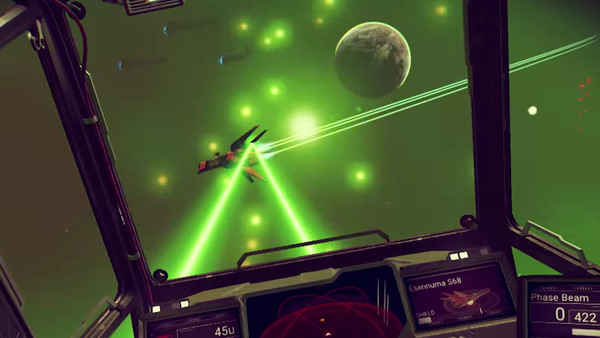
As the protagonist I'm designing is a total blank slate, you're still free to live as a space pirate if you like, pillaging transport vessels, dogfighting other ships, blasting apart Sentinels, etc.
You can do all of this in the base game, but chances are you've not put much stock in such a path, because space battles are hampered by one specific issue - reloading your weapons and shields.
Case in point: If you want to reload something, you're required - in the middle of a spiralling firefight - to hop back into a menu, highlight an element you need, drag it over the part of your ship that needs 'filling' and hit another button, before backing out into the action.
For this one, all the game needs is a dedicated reload button. As a handful of elements can be fed into one particular part of your ship, we need a button that looks at your inventory overall, calculates if you have enough resources to do so and refills accordingly.
Only after everything is depleted should it pop up and say so, but until then, our guns and shields need to be reloaded asap, not after precious seconds are wasted drag n' dropping resources in a menu.
2. Include Dynamic 'Multiplayer' Components

Putting it out there: No Man's Sky does NOT need multiplayer - not in the traditional sense, anyway. I honestly think Sean Murray was spot-on when he stated NMS was "not a multiplayer game", and to "[not] go in looking for that experience."
No Man's Sky is about serenity, exploration, isolation - it's about the cold, vastness of space, feeling like you're but a spec amongst the cosmic dust that makes up the fabric of the galaxy. I think Hello Games achieved that, but y'know what other series managed to create a feeling of solo tension mixed with occasional spots of online interaction? Dark Souls.
Now, I wouldn't have No Man's Sky beaming you into other peoples' games to join them on quests or anything, but I would bring across the ability to leave messages on planets, or perhaps care packages of rare elements could be stored at alien outposts which players would find after scanning for items of interest.
FromSoftware managed to create a brilliant community of fans helping each other throughout their games, and whilst Dark Souls does let you literally pop in and help out in person, being able to find the exact item or resource you need because some kindhearted soul left it behind or beamed it across the galaxy into a Galactic Trade Terminal, would be ideal.
Basically, anything that ticks the box of 'multiplayer interaction' but is still lightyears away from head-to-head battles or group dogfights would've been ideal.
1. Don't Lie About Or Embellish Features That Aren't Locked In
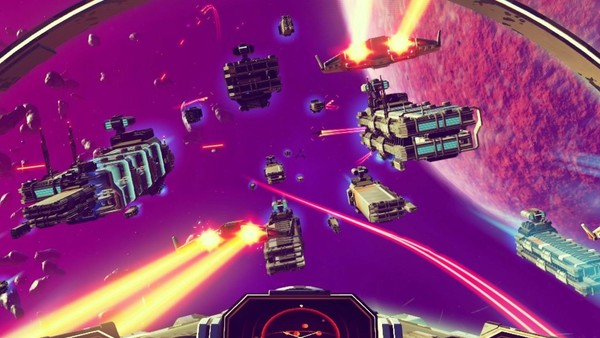
Since launch, Murray and anyone associated with No Man's Sky haven't tweeted or clarified any of precisely why the final product differs from that which was advertised and discussed, and while I'm sure this is down to their PR wing yelling, "Just don't say anything for a while!", it's resulted in a drop-off of 90% of players since launch.
At time of writing, it's still up in the air as to what Sean Murray was referring to when he discussed things like being able to "grief" other players, but as for being able to see each other in the game world - yeah, that just isn't in the game.
People naturally took the assumption of 'meeting up with your friends' to equal 'exploring the galaxy together', but it we focus on the specifics that were discussed, the only major smoking gun comes from Murray's appearance on Stephen Colbert, where he quite literally said we'd be able to see each other in-game.
I'm more than willing to give Murray and the team the benefit of the doubt with the amount of things that were discussed. Many elements of game design change over time, and it's natural that aspects get cut, refined or ditched altogether - the problem, comes in advertising the game off the back of features and functionality that aren't present or fully implemented.
To this day, the 'gameplay' trailer listed on No Man's Sky's Steam page shows an outdated version, highlighting creature models that aren't in the game, a HUD that isn't the launch version, and creature animations such as charging through forests that are nowhere to be seen.
The problem isn't that No Man's Sky isn't a brilliant game - it's a wondrous balancing act of innovation, mathematics and sci-fi wish-fulfilment - but more that what was advertised and embellished upon, still isn't what your money can buy right now.
If there's one thing that should have gone another way, it's most definitely this.
--
What would you change about No Man's Sky? Let us know in the comments!