Anthem: 9 MAJOR Revelations From Kotaku's Exposé
Cancelling Knights of the Old Republic 3 for a loot-shooter? Sounds like the gaming industry.

You knew it, we knew it, everyone knew it. Anthem's development was clearly troubled from the get-go, and its myriad problems - from barely communicating the premise across various adverts to a launch filled with bugs, an unbalanced loot grind and repetitive gameplay - now have answers.
They come in the form of a fascinating deep-dive exposé from Kotaku's Jason Schreier, who took it upon himself to tell the real story behind the game's conception and tumultuous, stress-filled production. Schreier has fast become the gaming industry's sole "insider" - an old-school whistleblower type who many are glad to have around, as the issues described within this latest piece point to a need for change in regards to triple-A game development.
Comprising 19 anonymous accounts all describing six years of narrative and gameplay overhauls, it's essential reading for anyone interested in the inner workings of the industry, alongside how a corporation like EA treats one of its flagship studios.
The fallout though? That's still ongoing. Bioware/EA posted a direct response, stating "We don’t see the value in tearing down one another, or one another’s work. We don’t believe articles that do that are making our industry and craft better". That would be a fair point... if it was the point of the article overall.
Instead, as you'll see, everything relating to Bioware and EA across the last 6 years has led to some fascinating revelations.
9. Bioware Revealed Anthem Before Knowing What The "Anthem" Part Was
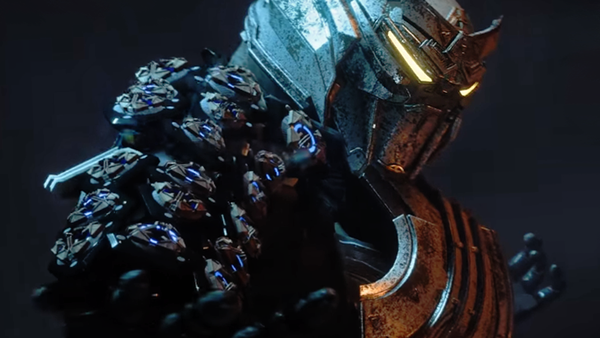
It's hard not starting each one of these with "one of the most insane things was...", but due to Anthem's development being so unfocused following the departure of creative lead Casey Hudson, literal years went by where core teams didn't know what they were working on, or towards.
Kotaku detail a staggering lack of focus and communication, and a suitably "Holy sh*t" moment is Bioware mentioning their new project for the first time at E3 2014, before the notion of what the "anthem" itself even was. In fact, it turns out the game - then codenamed "Dylan" (after the revolutionary musician, Bob Dylan) - was to be called "Beyond", and was something else entirely.
When the rights for the latter title couldn't be obtained, a decision was made to divert to Anthem, though the majority of Bioware didn't think it made any sense.
It's pretty stunning then, that one of the only unique and fairly cool ideas about the game - hearing the "Anthem of creation" as a Voice of God-type analogue - came about long into development, in response to another name change, rather than being the driving force behind its conception.
8. The Reason So Many EA Games Fail Is Because Of The Frostbite Engine

Chances are you've heard of Frostbite, the game engine pioneered by EA's DICE studio, and something that results in genuinely phenomenal visuals and physics.
The catch?
It was built for first-person shooters, and has now killed the potential of three third-person games in a row: Dragon Age: Inquisition, Mass Effect Andromeda, and now Anthem.
Why does this continue to happen? Because DICE's Patrick Söderlund ushered in an "initiative" to get all of EA's games on the same engine, regardless of compatibility to the vision at hand. In theory, this should've led to shared knowledge of the engine's pitfalls and potentials, but as one of Bioware's devs noted "The amount of support you’d get at EA on Frostbite is based on how much money your studio’s game is going to make".
As such, FIFA became the priority after they too were moved onto the engine, and that meant diverting staff off Anthem or other Bioware projects.
When it comes to general workload across their studios, EA set up an external "helpline" of Frostbite professionals, reducing game developers to a number of grandmas struggling to figure out their emails. Bug fixes would take days or a week to implement, and as another Bioware employee said, “If it takes you a week to make a little bug fix, it discourages people from fixing bugs”. “If you can hack around it, you hack around it, as opposed to fixing it properly.”
Apply that mentality across year's worth of dev time, and you get a launch game that bricks PS4s if you attempt to play it.
7. Dragon Age 4 Was Rebooted During Production

Codenamed "Joplin", as of October 2017, Dragon Age 4 was in production. Headed up once again by creative director/lead Mark Laidlaw, this would be his fourth Dragon Age game, after the fairly positively received Inquisition.
Annoyingly for fans, when Casey Hudson returned to Anthem, sheer resource management and prioritisation made Bioware redirect all efforts towards Anthem, which was now "on fire". As a result, Joplin was cancelled and Laidlaw quit Bioware, later joining Ubisoft to work on the next Assassin's Creed.
Laidlaw's departure was a stunning blow to fans of the studio considering he helped spearhead the entire Dragon Age franchise, and though we're still getting another Dragon Age as of the Game Awards 2018, it seems like it'll be a "live service game" like Anthem.
Urgh.
6. It Started Life As A Dark Souls-Esque Survival Game Called Beyond

Back to Anthem, and besides initially being called Beyond, the hook of gameplay was entirely on survival. The notion of a constantly changing world was still there, but it would be controlled in real-time by Bioware, triggering harsh weather storms or other environmental hazards for groups of players to deal with.
The challenge wouldn't be grinding through loot drops and bullet sponge bosses, but literally staying alive for as long as you could, returning with the spoils of your travels to commune with fellow survivors. Described as a mix of "Dark Souls, Darkest Dungeon and Shadow of the Colossus", a ditched mechanic involved "[attaching yourself] to a giant monster" amongst other things, but all of these ideas would go up against the awkwardness of Frostbite, being ditched one by one.
Honestly, this earlier concept is immediately far more unique and meaty than the generic "bro shooter" vibes of modern day Anthem. Kotaku's report details so many ditched mechanics and even games, that you have to hope there's a future for them somewhere down the line.
5. Discussing Or Mentioning Destiny Was Considered "Taboo" By Management

Now this is just... strange.
Despite Anthem slowly taking on more and more traits of loot-shooters - to the degree where Destiny was an incredibly obvious comparison, both tonally and structurally - actually mentioning Bungie's 2014 FPS was considered "taboo".
Bioware's leadership preferred to think of Anthem as something closer to Diablo 3, but this in turn lead to a moronic reality where creatives couldn't address their potential contemporaries or their features, whilst also making a game that was clearly going to be compared to Destiny no matter what.
“When you’re talking about fire teams, and going off and doing raids together, about gun combat, spells, things like that, well there’s a lot of elements there that correlate, that cross over” said a Bioware dev, but sadly, those directly involved with shaping Anthem just weren't afforded the freedom to do so meaningfully.
4. Knights Of The Old Republic 3 Was Conceptualised And Cancelled Between 2011 And 2014

One of the biggest catalysts for Anthem's mediocrity came from mismanagement, and splitting the game across two key Bioware studios, Edmonton and Austin.
The latter were sporadically called upon to aid the "main" team at Edmonton, but following Star Wars: The Old Republic shipping in 2011, they started a handful of new projects, including Knights of the Old Republic 3. The sought after sequel is routinely one of the most talked about and fan-requested in gaming, and it turns out Bioware Austin were trying to get this off the ground.
Another project was codenamed "Saga", a "multiplayer open-world Star Wars game that was in early development for a few months", but that too was canned.
Why? Because as development wore on and EA's mandated release date of March 2019 drew closer, Bioware's upper management attempted to unite all their teams under the "One Bioware" initiative, resulting in Anthem being the main priority, and everything else being scrapped.
Here's to KOTOR 3 making more financial sense, providing the conversations surrounding its potential continue.
3. Why The Cutscenes & Dialogue Felt So "Off"

Another fundamental failing came from scheduling, as following the disastrous, gif-filled reveal of Mass Effect: Andromeda's launch state, Anthem's top brass were determined to avoid a repeat incident.
The decision was made to use costly facial-scanning performance capture, to ensure the game would be "un-memeable". This process is common for anything in the triple-A space, but when Anthem's very fibre was being overhauled and rethought so consistently, to such drastic degrees, there was no room to nail down characters, motivations - even the progression of a given scene with specific characters.
With the cost of performance capture so high, bookings for actors and appointments had to be maintained, resulting in sequences and entire chunks of dialogue literally not making sense in the end. Say a story or mission point was changed, Bioware couldn't afford to revisit the booth for amendments, and to this day there are characters or referenced lore items being mentioned, that were actually cut after the scenes were shot.
2. The Current Flight Mechanics Were Built Over A WEEKEND

Like the game's lore being all over the place for years, Bioware also couldn't decide on how to implement the now-signature flight mechanics. Every subsequent tweak of how high you could go, for how long, how fast etc. resulted in the game's map and levels being overhauled so everything made sense, and the player wasn't breaking immersion or leaving the area altogether.
A fascinating extract involves the need to please EA DICE's Patrick Söderlund, who was very unimpressed with early builds of the game. For his second visit, a small team of coders added flight back into the game across a single weekend, literally because "flying was the only mechanic they’d built that made Anthem stand out from other games".
They focused on getting the weight, physics and momentum of everything just right, and thankfully it impressed Söderlund. However, staggeringly, this became one of the first times Bioware overall "got" what Anthem "was", leading to just a few days later, it being shown off at E3 2017.
1. Everything Came Together In The Last 12-16 Months Of Development

“They talk a lot about the six-year development time, but really the core gameplay loop, the story, and all the missions in the game were made in the last 12 to 16 months because of that lack of vision and total lack of leadership across the board”.
Yes, really.
After Dragon Age's Mark Darrah was brought across in Fall 2017 to help focus the project - following Casey Hudson and another "creative team" essentially only producing spun wheels - the only thing that HAD to happen, was shipping the game.
EA wouldn't grant any more release date delays, and it resulted in an incredibly stressful, focused period of crunch where a herculean effort was undertaken to ostensibly make the whole game in around a year and a half.
In that regard Anthem can be held up as an achievement in pure willpower, but the reality of various staff members leaving and/or suffering mental breakdowns sounds genuinely atrocious, and simply needs to change.