Bloodborne: 10 Ways It Succeeds Where Dark Souls 2 Failed

This is the experience everyone thought they were getting in 2014.

No doubt by now you've heard quite a lot about Bloodborne, the newest game from From Software whose sole selling point appears to be screaming "Come and have a go if you think you can handle it!" before disappearing into a blood-soaked mist and assuming you'll want to catch up. The thing is though, far too many people are being put off by everything surrounding its release, for two key reasons: 1. Sony aren't marketing it in remotely the right way, as instead of showcasing the unique horror-slasher-meets-stat-crunching-RPG makeup it has, their ads on TV and especially Facebook make it out to be some Devil May Cry-goes-Van Helsing hybrid. For the most part because of this the top comment on any given Youtube video or Facebook post is some poor casual gamer picking it up expecting a slash-fest, only to get their teeth fed to them in the opening few minutes. 2. All of Demon's and Dark Souls 1 and 2 cultivated a mixture of "It's not hard if you know what you're doing" and "If you die, it's your own fault" or "It's always fair" which is, in the words of the quiet Virgin Mary, "A load of old cobblers." Both these points applied to Dark Souls 2 as well, but it's worth pointing out to those sitting on the fence and forever wondering if its worth their time, that actually yes - it most definitely is. So cast aside your predilections that may spawn from the general consensus of just being "another Souls game" as there's plenty more under the hood that really make it far more worth your time.


10. There€™s Actually A Story

Like Destiny (now there's a comparison) if you scratch away at the surface hard enough i.e. go online to read about it after hundreds of others have compiled something worth taking in, both the Dark Souls titles had stories. And it must be said, as creator Hidetaka Miyazaki noted the sparse nature of the plot being compiled through a variety of items and some fairly well-informed speculation comes from his own experiences as a child, reading books and forming stories in his mind through the pictures alone - it's a very neat concept. All the same though, far too many people were put off by this DIY approach, and for Bloodborne there's much more onus put on player agency and world development, which is to say if throughout any of the previous Souls titles you yearned for someone to just stop and say "Here's what's going on, you're this thing and these others need killing" it happens multiple times here. The balance between obscurity and mystery is perfect, and unravelling your purpose as a Hunter within the city of Yarnham as it undergoes this strange ritualistic Wicker Man-esque night - replete with civilians talking through barricaded doors and windows - is already far more solid a foundation to set you off than anything in any of the Souls games.

9. Feel And Speed Of Combat Is Brilliant

Yes it was mentioned in the intro, but do away with the Devil May Cry comparisons - instead, Bloodborne's nearest contemporary is still the Souls series - except with some really cool twists that shake everything up. Chances are if you've seen any footage of people playing these titles, they're forever holding a shield up, darting around behind an enemy with the hopes of exploiting an animation playing out to score some major damage. Not so here, as not only can you not block in Bloodborne outside of a wooden shield who's only purpose is to make a mockery of the idea in the first place, the enemies will spin around and have you for breakfast if you're not forever parrying, dodging and taking note of the space around you. In addition, there's a cool health-regain system that siphons off a chunk of your bar to be reclaimed if you retaliate fast enough, somewhat solving the issue of getting rocked by a boss only to never be able to recover without running away for a few minutes and hoping the healing animation doesn't take too long.

8. It's No Longer Just Boss Rush: The Video Game

Speaking of bosses, one of the biggest complaints levied at Dark Souls 2 was that it essentially felt like 'Boss Rush: The Video Game', in that every few minutes you were locked into an arena against a grizzly monster who was more than likely about to send you back about half an hour's worth of game time. In contrast to the first couple of games this was a major misstep - one of many things that came from creator Hidetaka being in a supervisory role rather than being hands-on - and come even the half point in that game, the relentless head-versus-brick wall feel of the gameplay made all but the most hardcore simply give up. Luckily with Miyazaki back in full directorial mode he's able to craft a far better pace that rewards taking your time and grinding just as much as it does pressing forward. Like the first Dark Souls you'll just be thinking to yourself it's been a little while since any suitably monstrous creations showed up - only for a massive health bar to appear on the screen with the realisation that "It's AWN!" to settle in.

7. No Needlessly Harsh Restrictions

Something that surely no one asked be reprised from Demon's Souls was the idea that with each death, your maximum life gets chipped away, all until you either find a certain item to restore it permanently or consume a Human Effigy (in DS2) to ward it off until you next bite the bullet and it happens all over again. Not only that, but again unless you chose to use a certain item in the game, DS 2 was set up to only let you fight and defeat every non-boss enemy up to 12 times, before they'd simply not spawn any more - severely hampering your souls/currency count if you weren't acquainted with the series and were dying a lot. Bloodborne does away with the whole 'Hollow/human' thing, meaning you're only in one state of existence (barring certain pelts you can eat to get stronger) and it gets away from the overwhelming idea from 2 that even the very systems you were playing with were set against you from the get go.

6. Fantastic Weapons You Actually Want To Use
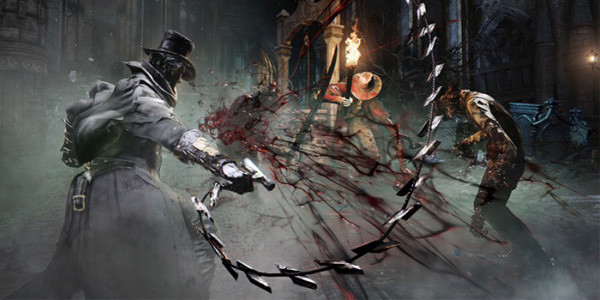
Whether it be a lightsaber or a Gears of War chainsaw-mounted Lancer, a damn fine weapon can be make or break for a new property. Luckily, Bloodborne has soon-to-be iconic, lovingly crafted death-tools up the wazoo. With the core control scheme adding a weapon-toggle button, it means everything included essentially has what Unreal Tournament called a 'secondary fire', letting something like a battle axe extend to twice its length for ranged attacks, a solid cane turn into a whip or a spear that comes mounted with sick rifle attachment. Oh, did you not know? It's not just the standard blades you've seen a million times before that you'll be taking out on a night on the town - instead there's the pneumatic Stake Driver for example, a powerful chargeable piston-blade that'll use up one ammo as it blasts enemies to kingdom come at the close of the combo if you opt for a stronger attack. Throw in gigantic maces where the handle itself is a separate sword, gigantic bladed sheathes that quadruple the size of a base blade and even some firearm variations that give you a full-on cannon to blast away with - and through some very fun experimentation the Monster Hunter-esque 'learn your weapon' approach pays dividends as you narrow down whatever setup suits you best.

5. An Intricate, Interconnected World

Something sorely missing from DS2 was the first game's approach to level design - that being the entire world map was one interconnected, sprawling maze of passages, lifts and doorways that just as you thought you were lost, connected you back to a safe point. It was genius, and remains one of the biggest flaws with 'Souls 2, as instead of this sort of world you're left to pick a series of locations from a menu, levelling up in the HUB world of sorts, Majula, before heading out and tackling your next area essentially one by one. It was fine for the most part, but didn't offer that sense of exploration and reward fans and critics loved from the first Dark Souls - something that returns in abundance in Bloodborne, easily providing the best designed world there's been so far on the new generation of consoles.

4. An Original Premise

Outside of the hardcore fanbase that got stuck into the Souls games as they were released, the series felt like it really hit its stride at the tail-end of 2013, with many more gamers and Youtubers getting stuck in until the newest generation of consoles had anything worth talking about. However, in playing through the first Dark Souls and heading straight into the sequel, it really made you notice the myriad of things that almost made the entire thing feel a bit like tacked-on DLC. Where the first game had a looming sense of mystery and foreboding when it came to exploration, characters you'd meet and the overall sense of progression, DS2 plonked you in this series of locales that definitely had variety, but outside the occasional visual clout and standard Soulsian thrill of tackling a string of enemies, sadly it felt too much like more of the same in the worst way.

3. Memorable Bosses

Go on, name the boss that left a mark on you from Dark Souls 2... it's the Old Dragonslayer isn't it? Also known as the palette-swap of Ornstein from the first game. Essentially due to the Ornstein and Smough boss fight being one of the most frustrating sections in gaming history (if you were playing a melee class), this reappearance was assumedly thrown in just to scare the bejesus out of you. And it worked - for a few seconds - until you resumed your standard 'rotate round and butt-poke' strategy to beat him again. The only really spectacular bosses in came right near the end where you were tackling a slew of dragons as many more circled overhead. It was a great visual setpiece, but one countered by the sheer laziness of then putting you in a repeat battle against multiple Dragonriders you'd previously defeated, and a last boss that was a total cakewalk. Bloodborne does rely quite heavily on werewolf-esque designs for its larger bosses in the first half especially, but you'll also come up against a slew of nimble Hunters as capable as yourself to shake things up pace-wise, a gigantic spider that'll make any arachnophobes run for the hills and a general sense of variation across every level's enemies that helps establish one hell of an intense atmosphere throughout.

2. It Forces You To Play Differently

Maybe it's something that's just quintessentially 'how you play Souls', but it became far too easy in those games to simply lock onto a foe and rotate round them, attacking only when their animation means they're forever swiping at thin air. Thankfully, although many thought Dark Souls 2 would force you out of this thinking whereby you're essentially exploiting the game's weaknesses, instead it gave you more melee-focussed bosses and enemies to cement it. Come Bloodborne and this very notion of combat is out the window. As mentioned earlier blocking has been removed so you're forced to play like the dual-wielding classes of DS2, which is to say perfecting enemy attack patterns and dodging to gain ground at just the right moment, as oppose to 'turtling' yourself behind their kneecaps and hoping for the best. It's a sensation that extends to general exploration to; no longer will you ever feel safe exploring new areas again, which is the quintessential ingredient missing from 99% of horror titles out there too. Knowing you might be about to be ambushed by a horde of ghouls is quite the palpable fear, and you'll have to hone your reaction times far more than ever before to get anywhere near comfortable - a word that came to epitomises the Souls II experience in retrospect.

1. Ironically, It Has Soul

Apologies for the jolly little pun, but really what stands out - and it's something you can see is completely missing in the likes of Battlefield: Hardline, Watch Dogs or The Order: 1886 - is that sense of an artistically-minded creative director watching over his creation like a hawk. It's the reason something like Metal Gear endeared itself to so many so fast, and as the years have gone by, plenty gamers have come to realise when they're playing something designed by committee versus when it's a more focussed and directed experience. With Miyazaki essentially sitting out DS2 it allowed Bloodborne to land with an almighty bang, as everything from the world architecture to the weapon designs, character outfits and dialogue itself is lovingly crafted to tell a very particular tale. If there was something about Dark Souls 2 that felt off and you just couldn't put your finger on it, chances are it's this lack of an overarching presence felt from the other titles - and with an entire world crafted from scratch all waiting to be put together by both you and the community surrounding it, finally 'the Souls experience' is back in a big and very enticing way. How are you finding Bloodborne versus Dark Souls 2? Let us know in the comments if you're a first-timer, if this one clicked with you, or if this style of game just isn't for you!

In this post: 
Bloodborne
 
Posted On: 
Gaming Editor
Gaming Editor

WhatCulture's Head of Gaming.