Football Manager 2014 - 10 Tips From Soccernomics That'll Improve Your Game
Does a successful approach to building a team in real life work in Football Manager?
 Soccernomics is a revolutionary book written by journalist Simon Kuper and economist Stefan Szymanski, and one that all football fans of all levels should read. The first chapter in the book takes a detailed account of the money thrown in the transfer window and how one can avoid making silly mistakes in the market", studying the transfer strategies of Lyon and Nottingham Forest (under Peter Taylor) to uncover the secrets of the transfer market that all other clubs are missing. It brings up intriguing facts and I wanted to see whether the points highlighted in the book worked out in Football Manager; that is, if I followed the books tips as to how to make good transfers, will I succeed? The sample club would be FC Barcelona, primarily because it offered a club with an excellent youth set-up, ample transfer funds (so that heavy splurges could be made if needed) and also a club where a minor overhaul over a prolonged period was required (bringing in youngsters and shipping out the deadwood). On paper, Real Madrids team was better than Barcelona's, so that rivalry immediately offered a comparison and an objective for where my Barcelona team would need to get to. Right now, I am in my first season, leading the La Liga and having recently qualified for the knock-out phase of the Champions League.
10. New Managers Waste Money
 Media Image LtdIn 2000, then Tottenham Hotspur manager George Graham paid Dynamo Kiev £11 million for the services of Ukrainian striker Sergei Rebrov, but after nine months, Spurs sacked Graham after Alan Sugar sold his stake in the club and the new manager, Glenn Hoddle, did not rate Rebrov. The latter spent much of his time on the bench for Spurs and after four years, he left on a free transfer to join West Ham United. Managers (both in real and virtual worlds) dont really care whether the club loses money in the transfer market; what matters is, the on-field performance. When we take over a new club in Football Manager, we look to make drastic changes in order to make our mark at our new abode, but that could result in a waste of money. So keeping this in mind, I made a total of just four permanent transfers in my debut summer window, earning a net profit of £21 million, and bringing in two youngsters - Lucas Romero (from Argentina, after intensive scouting) and Ricardo Rodriguez (from Vfl Wolfsburg), for a combined sum of just £14 million. Additionally, I allowed Martin Montoya to leave on a free transfer as he had become surplus to my requirements, and, I sold Pedro Rodriguez to Paris Saint-Germain for an astonishing £35 million, ensuring that the club's books were nicely balanced. Bringing in more players and selling the current ones could have disrupted the balance of the squad and resulted in loss of money.
9. Sell A Player If Another Club Offers More Than His Worth
 Andres Kudacki/AP/Press Association ImagesThis strategy was used by Lyon President Jean-Michael Aulus during the clubs reign over France from 2002 to 2008, when they won seven consecutive league titles. He used to claim that every international at Lyon is untransferable, until the offer surpasses by far the amount we had expected. Pedro was not on the transfer list and I had no intention of selling him until Paris Saint-Germain offered me much more than what the Spaniard was worth. Their first bid of £30 million was rejected, but after two rounds of negotiation, PSG increased their offer to £35 million, £10 million more than what Pedro was valued by Barcelona's scouts at that time. As Peter Taylor wrote in his book, its as important in football as in the stock market to sell at the right time and the moment when the player reaches the top of his particular hill is like when the stock market peaks. At Nottingham, Brian Clough and Taylor were always trying to gauge that moment, and sell. Pedros stock reached its peak when PSG came calling and I could do little other than accepting it and re-invest the same money in better players. Whenever Taylor signed a new player, he would give him a set speech, saying, Son, the first time we can replace you with a better player, well do it without blinking an eyelid. The money generated from Pedros sale enabled me to buy a deputy left-back (Rodriguez), a talented box-to-box midfielder (Romero) and Montoyas replacement, Mattia De Sciglio, who will arrive at the Nou Camp from AC Milan in January for a fee that could rise up to £15 million.
8. Bring In Replacements Before They Are Needed
 Nigel French/EMPICS SportSir Alex Ferguson pursued a strategy of early replacement at United: I did feel sentimental about great players leaving us," he wrote in his autobiography. "At the same time, my eye would always be on a player who was coming to an end. An internal voice would ask, whens he going to leave, how long will he last? Experience taught me to stockpile young players in important positions." After selling Pedro, I drafted Adama Traoré into the first-team, who quickly marked his first start with a goal and an assist, and then just two days after Montoya left, I commenced talks with Milan for the transfer of De Sciglio. At the end of my first season, I will most likely dump Victor Valdes, Alex Song, Xavi Hernadez and Carles Puyoll; Valdez has refused to sign a contract extension, Song's performances have been mediocre while Xavi and Puyol are nearing the the twilight days of their respective careers. I have eight months to find a replacement for Valdes but I have already started scouting for a potential successor to the 32-year-old. Songs replacement is already at the club (Romero) and Xavi's mantle will be passed onto the talented La Masia graduate Sergi Roberto.who boasts a passing accuracy of 92 percent - the ideal replacement. Finally, I hope I will be able to replace Puyol with Real Sociedads Inigo Martinez. Bringing in replacements before they are needed avoids a transfer period or a panic purchase after the players departure. Lyons chief Aulus claimed that his club used to rope in replacements for potential outgoing star one year or six months before the latter was sold. Football Manager addicts should do the same.
7. Transfer Fee And Team Performance Are Not Related
 Dominic Lipinski/PA Wire/Press Association ImagesAn analysis from the year 2003 to 2012 of the Premier League clubs showed that the correlation between the transfer fee and the performance of players was weak but over the long run, salaries explained about ninety percent of the variation in the league position. In short- spend wisely, but dont be afraid to pay your star players mammoth wages: "Soccernomics" states that to win more matches, "the obvious answer is to spend less of your income on transfers and more of it on wages" and it may be "better to raise pay of your leading players than to risk losing a couple of them and have to go out and buy replacements". Despite buying Rodriguez and Romero for cheap, the two are paid lavishly through wages and bonuses, and they shouldn't be coming in to the manager's office demanding better contracts or the right to move any time soon.
6. Buy Fewer Players
 Steve Drew/EMPICS Sport The best advice there probably is. The more players you buy, the more likely you will face a transfer bust, both in the real and virtual worlds. In 2009, then Barcelona CEO Joan Olivier had said that the clubs aim was to have one of the best, perhaps the best, team in the world, without having to spend x-million on players. Two years later, the Catalanshad seven home-grown players in the 2011 Champions League final, and according to CIES Football Laboratory in Switzerland, in 2014 Barcelona had the most stable squad, with every player at the club having been there for an average of 5.5 years. Theres no point in overhauling the team every year: instead buying one or two players every summer will work. I have bought three players so far and will try not to exceed that number next season. I plan to look to La Masia to replace my outgoing stars. As "Soccernomics" states, another advantage of not buying players in the transfer window is the one-second rule. The success of a player on the pitch is "decided in less than a second" and the same applies in Football Manager. If a player is not accustomed to a teams set-up, he will struggle to make the transition. Moreover, even in the game, new players tend to take some time to settle down (although it vastly differs). So continually overhauling the team could render futile.
5. Old Players Are Overpaid
 Martin Rickett/PA Archive/Press Association ImagesTaylor quotes in his book that he noticed, Liverpool sold their players as they near or pass their thirtieth birthday, and it is true that Bob Plaisley believed that the average First Division football is beginning to burn out at thirty. And to some extent, it is the same in Football Manager: Xavi simply cannot play two games in a week, while Puyol has returned from a lengthy absence of seven months and has just completed one game for my Barcelona side this season. It is interesting to note that we all tend to overpay the old players owing to their past performances. According to a report in 2012 from Fifa TMS (the department of Fifa that studies international football transfers), of all the players who moved to Brazil, Argentina, England, Germany, Italy and Portugal, on an average, they earned their peak fixed salary at the ripe old age of 32. In the game, Xavi and Puyol are earning £235,000 and £170,000 respectively each week but honestly, their output does not match their income level: Puyols fitness is a concern, while Xavi averages a rating of just 6.55 every game. Hence, I am planning to get rid of the two next season as the same wages can be can be invested in younger players and possible replacements.
4. Buy Players Between The Age Of 20 And 22
 AP Photo/Sang TanAustus told the authors of "Soccernomics" that Lyon bought the best players in the country, who were between 20 and 22 years old. This was because, how good a player is at 17 or 18 is not a definite indicator whether he will succeed at a club. However, in the magical age of 20 and 22, one can get a pretty good idea of how a player will perform for a new club. In this age group, players have matured a bit. They are old enough to be nearly fully formed but too young to be expensive stars. A study by Fifa TMS, analyzing the transfers to England in 2013, showed that the players moving aged 20 to 22 were 18 percent cheaper than players aged 25 to 27. There is no need to pay a premium for the big stars. Instead look out for the budding young stars not known in the international circuit. The strategy works very well in Football Manager. Rodriguez is 21 years of age, while Romero is 19, and they have an average rating of 7.5 and 7.4 respectively. As per the fans, Rodriguez is a truly inspired bargain singing, while Romero's transfer is billed as a marvelous piece of business. De Sciglio, coming from Milan in January, is 21, and labelled as an Italian wonderkid. All three are for the future and will significantly improve the squad in the next two seasons.
3. Avoid Buying Centre-Forwards...They Are Overpriced
 Lynne Cameron/PA Archive/Press Association ImagesThe center-forward position is the most "overpriced position" in Football Manager: as an indication, Edin Dzeko has a potential ability of three stars, but is valued at £25.5 million. Fernando Llorente's valuation is a massive £27 million, while Javier Hernandez has an asking price of £20 million, despite the proof offered in reality of his actual pitch value. All are good strikers but they are hugely overpriced in the game. By comparison, Alexis Sanchezs value is just £20 million (despite an average rating of 7) and Toni Kross is £24 million. Why on earth would someone be willing to pay more for Llorente or Dzeko than for Kroos? So the bottom line is, try and avoid buying center-forwards - they are overpriced. Either develop a striker internally, if possible, or look for free transfers you can lavish higher wages on to redress the balance.
2. Goalkeepers Are Undervalued
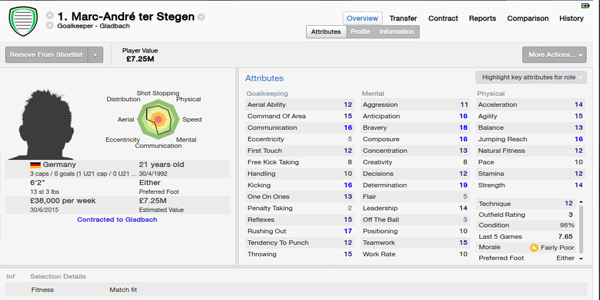 SI GamesYou will notice that in Football Manager, the goalkeepers are undervalued. The most "expensive" 'keeper is Petr Cech, valued at £19.75 million, while Marc-Andre ter Stegen, Valdes' most likely replacement is valued at just £9.25 million, despite playing in the Bundesliga and having a potential rating of four-and-a-half stars. The 'keepers will not necessarily be available at anything like those valuations, but strictly speaking, they will come at a significantly lower price than other areas of the pitch. This might be because the game tries to value the players as per how they are valued in the real world and goalkeeper is the "most underpriced position in the transfer market" according to "Soccernomics". This is not at all surprising, considering they cannot affect what is arguably the most important attribute any team can boast - ability to score goals, but it does mean in the game that you need to set aside less money to identify and bring in a new 'keeper if need be.
1. Scout Wisely Before Signing A Player
 Owen Humphreys/PA Archive/Press Association ImagesWhen Lyon were thinking of signing a player, a "group of me would sit down to debate the transfer". Lyon's method for choosing the players was obvious and smart and I tried to replicate it in Football Manager. Obviously, I can't have a discussion about a transfer with the board and staff but I scout the player wisely before buying him. I first get a general scouting report of the player and if he seems like a potential purchase, I send my scouts to watch him at the games. . There is no need to make any rash decision when it comes to making transfers. See the skill-set of the player and only buy him if you feel he can play in your set-up. If you scout and study the player properly, you can never make a "bad transfer" in Football Manager.