How Half-Life Broke First-Person Gaming Shooters Forever
Breaking the FPS to make something altogether more incredible.
For over two decades now, Valve Corporation is considered one of the most acclaimed and skilled game developers in the business. Their games are the highest rated on the PC platform and you'll be hard pressed to find a member of the wider community who doesn't use the Steam platform.
Their runaway success began back in 1998 with a little game called Half-Life, a title that would fundamentally change the first-person-shooter genre and gaming along with it.
Digging into the nitty-gritty of the game's qualities stems from both its internal development and the final design that turned up in its release.
--
Humble Beginnings

Valve was first founded in 1996 by Gabe Newell and Mike Harrington; having spent thirteen years at Microsoft piecing together the Windows software, the two developed an interest in video games and put the company together in Kirkland, Washington. For their first game, the team settled on a horror-based First-Person-Shooter.
The genre had seen its rise to power in the first half of the nineties, with progenitors like Wolfenstein 3D and Doom from ID Software having set the blueprint for the future franchises to come. Both titles were, much like their third-person action predecessors, simple and straightforward. You would run through the levels and lay on the trigger until all of your foes were dead.
With the faster-pacing of shooters being well-established, it was time for the next evolutionary step.

For its first time developing games, Valve struggled to find a publisher who would back them. While they eventually settled on Sierra Digital, Half-Life's production was still a challenge; in 1997, they decided to completely rework every level, feeling the experience as a whole wasn't fun despite its innovations.
A team of designers referred to as a "cabal" which handled both design documents and programming. The final product would arrive in 1998 to massive critical acclaim.
Putting The Player In Full Control

The first thing players were greeted by in Valve's debut title was a simple tram ride to work. As Gordon Freeman, a silent protagonist, you're on your way to partake in a critical experiment at the Black Mesa Research Facility.
This opening serves two functions; on an aesthetic level, it seamlessly introduces players to the setting they'll be fighting through, complete with robots, radioactive waste and scientists going about their daily business. Before it all goes to hell, you're given a window into how the place operates.
Secondly, the tram serves as its own tutorial, allowing players to get to grips with the controls. There's no forced training sequence that disrupts the pacing; instead you're planted into the game with its immersive qualities never breaking. There are no cutscenes, lines of text or setups to be found here. You see everything Gordon sees and this had never been done before in games of the time.
It wasn't just for the story however, as this affected gameplay as well.
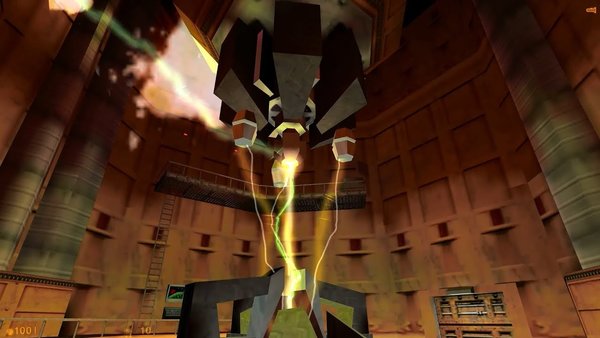
With the resonance cascade plunging Black Mesa into utter chaos, only Gordon Freeman, encased inside the hazardous environment suit (HEV) has the power to put an end to it.
You'll begin the core action in earnest by making your way out of the test chambers, acquiring new weapons and engaging deadlier foes. How you proceed is often open to interpretation; players can make use of the environment and other NPCs as well as their arsenal to tackle obstacles.
This goes hand-in-hand with Gordon's own identity; is he a heroic scientist or a bloodthirsty psychopath? Benefits for the former including offering a health boost for those who save scientists. Whereas killing security officers will yield a greater ammo supply and even the chance to get weapons earlier in the game's campaign.
Add to this the vast variety of weapons and tools and you've got a single-player mode with tons of variation.
A Masterclass In Pacing
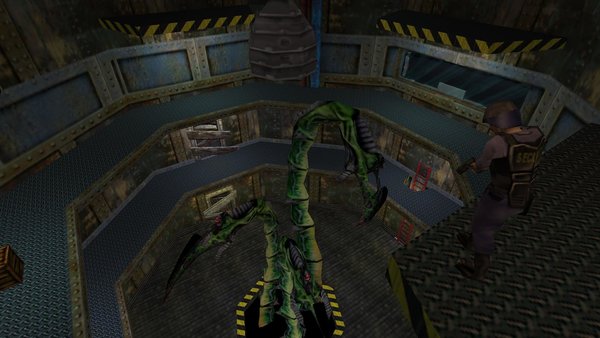
Half-Life successfully maintains a action-packed and visceral thrill-ride across its extended run-time, with each chapter blending into the next with little distractions.
The scenarios on offer here are simply fantastic; in the early portions of the facility, you'll activate a rocket to kill off a massive tentacled monster and start encountering a contingent of US Marines sent to cover up the catastrophe. The latter in particular are often a challenge to fight, as their artificial intelligence was very smart for the time. Flanking the player and flushing them out with grenades made these troopers far more aggressive and engaging to fight.
Unlike competitors such as Red Faction, every single one of Half-Life's pace-altering moments are wholly engaging in some form. There's no tacked on stealth sections that fail to leverage the game's systems. Instead, things are constantly switched up with new challenges. The showdown with the Icthyosaur's in a shark cage a-la Jaws is heavily claustrophobic, while later on the more experimental weapons Gordon uses in "Questionable Ethics" deliver a great sense of empowerment.
Many early FPS titles made use of similar layouts and level designs to ensure the player wouldn't get lost; Half-Life begged to differ by delivering an incredibly diverse setting for players to shoot through.
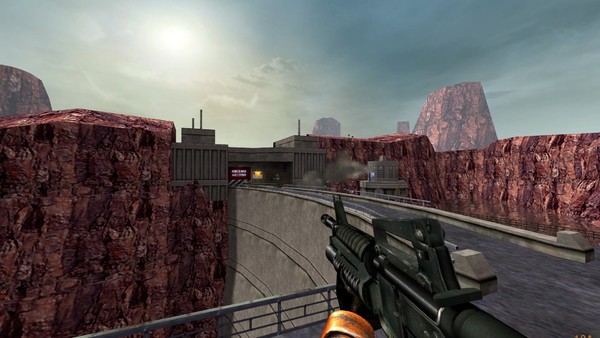
Everything culminates in Surface Tension; once Freeman finally gets out into the open, the game turns into a warzone. The US forces and aliens from Xen clash in an intense battle and it's up to you the player to navigate their way through, downing helicopters and military vehicles while avoiding the sidelines of snipers, mines and intruding enemies.
Everything you've learned regarding the weapons and environments comes together here alongside the greatest stakes. You feel like a one-man-army in this devastated environment and it's an excellent setup to the title's final chapters.
An Impactful Revelation For The FPS Genre

Once you reach the Lambda Complex and then enter Xen itself, many a player has argued this is where Half-Life falters a bit. This alternative dimension is so far removed from everything you've tackled previously.
Some elements, particularly the tough platforming sections, haven't aged too well, but Half-Life's final moments still have their own unique elements. For starters, the game makes you feel isolated from the moment you enter the source of the chaos, with flying aliens and an endless void stretching out before the player.
Through it all, Half-Life unparalleled immersion continued to impress as you took on a Gonarch and proceeded on through the alien factories to find the source of the Xen invasion. The Nihilanth is a challenging and unforgiving final boss, with its only blemish being the way it teleports to player away to fight their way out of random locations.
The game's final, mysterious flourish introduces players to the G-Man; one of the most elusive characters in gaming history. The mythos behind his backstory and powers was flawlessly established, leaving Half-Life wide open for a rousing string of sequels.
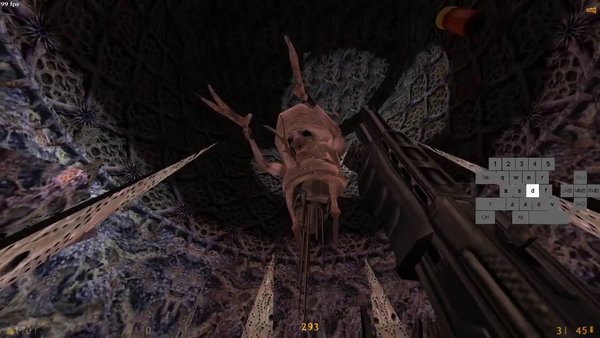
It certainly blew players away at the time; Gabe Newell predicted the game would sell a maximum of 180,000 units, but it would reach a whopping 500,000 in January 1999.
When the final retail result had been tallied in 2008, Half-Life had reached 9.3 million units sold and was named the best-selling first-person-shooter of all time in the Guinness World Records: Gamer's Edition. The game's inclusion on Steam at a cheap has only continued to get it into the hands of new players.
Half-Life has gone on to win countless awards, being named the best game of all time in PC Gamer magazine on three separate occasions.
Going Beyond The Base Game

Such a ground-breaking game was certainly ripe for further development. Gearbox Software was drafted in to develop two expansion packs from 1999 to 2000. Half-Life: Opposing Force and Half-Life: Blue Shift told two differing experiences of the Black Mesa incident.
The first involved US marine Adrian Shepherd and the second pressed security guard Barney Calhoun into full-on combat. Opposing Force was met with a great critical response, Blue Shift less so, but the way in which Valve was open to another developer highlighted their focus to game development.
Half-Life continued to make an impression with a port to the PlayStation 2 alongside the cooperative mode Half-Life: Decay. One port that didn't turn out so well was Half-Life: Source; intended as a conversion to Valve's source engine to tide players over before the sequel, it instead stood out for all the wrong reasons. Glitches and technical problems plagued the title when the new engine was plugged in, causing many to stick with the original version

Many years later, Crowbar Collective's full HD remake entitled Black Mesa is the most complete and fully-realised package in the game's history, a passionate fan project that successfully updates the classic title for the modern day. It comes highly recommended for fans and newcomers alike. The fact that a HD remake was put together entirely by fans with full endorsement from Valve speaks volumes of its lasting power.
A Developer Rocketed To Super-Stardom

Through a combination of new innovations, a higher focus on story and its breathless pacing, tremendous critical and commercial acclaim was bestowed on Valve after the game's release. This would continue into nearly every single one of their subsequent releases.
From 1998 onwards, Valve was considered a force to be reckoned with in the PC space, but the developer went the extra mile from here on.
Rather than resting on their laurels or taking advantage of their cultivated fanbase, the studio continued to ascend, wanting to improve and expand on what Half-Life had done. The environmental manipulation evolved into the Source Engine, which was integrated alongside Havok physics to produce the Gravity Gun alongside effective puzzles.
The platforming that drew some criticism morphed into vehicle sections that drastically expanded the scale of Half-Life 2's levels. The solid artificial intelligence on both allies and enemies alike was also carried through, maintaining the punch of the franchise's combat model.

Their overall attitude and approach to development also continued. Valve had some trouble making Half-Life and for its sequel, the developer was hacked. The source code for an early version of HL2 spread throughout the web. Yet despite these heavy setbacks alongside a falling out with their publisher, Valve kept pushing forwards along with their franchises.
Eventually Half-Life would lead the charge in launching the Steam platform, which has since gone on to become the biggest titan of purchasing PC games among countless other features.
Half-Life's Lasting Legacy

Alongside the likes of Metal Gear Solid on the PlayStation and The Legend of Zelda: Ocarina of Time for the N64, Half-Life ranked as one of the finest releases of 1998. But unlike those titles, its success transcended the base release as Valve released modding tools for the player-base to experiment with.
The likes of Counter-Strike, Team Fortress and Defense of the Ancients wouldn't exist without Half-Life's creation tools. This fuelled Valve's continued focus on putting players first and providing an excellent service across every major release.
What the game really makes a mark to this day is its focus on story. As games began to grow to tackle more mature content in their storylines, Half-Life put the player closer to the action than any other experience of its day. This would only continue in the equally revered Half-Life 2, which hit new strides in facial animation and immersion.
What's so impressive about the Half-Life franchise to this day is how its stellar gameplay goes hand-in-hand with major technical advancements. It took a long break from 2007 onwards as Valve chose to focus more on business to the disappointment of fans.

As of 2020 however, the series has made a stellar comeback with Half-Life: Alyx, arguably the best killer app VR headsets have to offer. WIth Valve Corporation being as celebrated as they are today, there's little doubt that they'll continue to sit at the top of the industry.
All it took was one debut release to stamp themselves onto the gaming scene. That is arguably Half-Life's greatest achievement and why it still resonates today.
Let's hope that the greater franchise is now back for good.
Half-Life: How Well Do You Know The Legendary Franchise?
