John Marston Vs. Arthur Morgan - Who Is The Better Hero?
Who's really the best in the west?
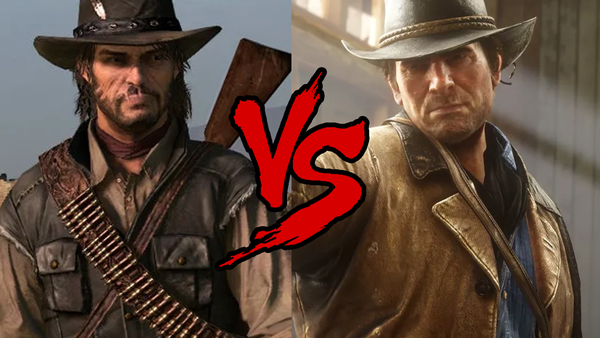
There’s this thing in science called relativity bias. It affects everyone, or, most people, and is a fancy way of saying that you love things more based on how recently you’ve come into contact with them. This happens a surprising amount in entertainment media. A shiny new thing comes out and suddenly the predecessor isn’t as loved anymore.
It’s like the inverse of nostalgia.
Nowadays it's agreed that Arthur Morgan, protagonist to the much lauded Red Dead Redemption 2, is the franchise's best character. The original Red Dead Redemption, the smaller, yet no less magnificent prequel -or sequel?- to Rockstar’s 2018 masterpiece, seems to have been left in the trail dust. John Marston, the not quite original Rockstar cowboy, while still remembered with a vague fondness, now dwells in Arthur's customisable shadow.
Yet the two characters are intrinsically tied together throughout the stories of Redemption 1 and 2 in many ways, going from bucking broncos at loggerheads to having an almost fraternal love for each other. “You always was my brother, Arthur.” Those are Marston’s last words to Arthur on the mountain, before the double-barrelled chaos of Micah Bell descends upon our stricken, grizzled enforcer. Arthur's death, much like John's, is a gut punch, and his character, much like John's, is flawed, full of twisted motivation and empathetic criminality.

So what happens if we compare the two characters?
If we take the original Red Dead Redemption properly into account, and not as a half remembered classic of a bygone console generation. Well, we get two very well written characters who are very similar in some respects and very opposite in others. And while both are equally deserving of the title of best protagonist, like so many western duels at high noon, only one can come out on top.
Motivations

Let's not spend too much time chewing the tobacco before spitting it out. John Marston has the better motivations as a character. A reformed criminal, forced to ride out once more to save the family he so desperately needs to save him from himself is just as effective now as it was back in 2010. It is this desperation to rescue his family that endears John to the player, for who among us can’t relate to at least the idea of family?
Arthur’s story is similar in this respect, but Arthur’s "family" are wide ranging and free thinking, perfectly capable of facing dangers themselves. The image of John Marston’s defenceless wife and child, tied up and legally snatched away, is much more harrowing. This image is the driving force behind the entire plot from start to finish, and every mission completed, every gangmate captured (or killed) and every deadeye shot executed is in service to getting John one step closer to Abigail and Jack.
Like Arthur, John doesn’t pretend to understand the world he inhabits, full of honest crooks and deceitful lawmen, but unlike Arthur he has not chosen to ignore these problems for the consideration of his betters. John has not the comforting bubble of the gang’s camaraderie in his story, he must engage with his world’s shortcomings himself if his family are to survive.
He cannot, as the early game Arthur can, say “pshaw,” to the world and choose to uproot himself.
Marston’s story may not be as sprawling as Arthur’s, but this is not always a negative. There’s a focus to John’s character and motives that is easily identifiable and understandable. And we’re behind him every hoof trot of the way.

Personality

A Western tale can live and die by the likeability (or unlikeability) of its protagonist, and the Red Dead series is no different in this respect. Both John and Arthur are uniquely and excellently portrayed and performed, but it's Arthur who you'd want to tell tall tales with over the campfire. The ham-fisted enforcer of the Van der Linde gang can at first seem a blunt, callous bear of a man, but he reveals himself to be more of a big brother than a bounty hunter.
While Arthur is undoubtedly a criminal capable of horrendous violence, he's also deeply layered, surprisingly empathetic and genuine in more intimate moments. He's full of a folksy charm, and a hard won, world-wise outlook full of tired sarcasm and cynical witticisms. He spouts plucky one-liners whilst headshotting bandits like any good action hero, but it is the air of tired regret when dealing with ne’er do wells like Reverend Swanson, and the gentle respect for characters like Tillie and Sadie and other hard working folk that makes Arthur Morgan intriguing.
It would have been very easy to set up Arthur, simple and savage, as the brutal antagonist to the hero Marston in a narrative prequel. Yet instead, we’re presented with an honest picture of a flawed man, who makes the ultimate sacrifice to save an irresponsible youngster who has not entirely earned his ride into the sunset with Jack and Abigail by this point. “Be a goddamn man,” Arthur tells John, and it appears that John spends the majority of the first game attempting to live by his old protector’s words.
That's not to say John is boring, or one note, quite the opposite. His air of annoyed reluctance when it comes to interacting with those like Seth and West-Dickens is both endearing and relatable. John can be surprisingly quiet and calm, especially in the cutscenes, when not enacting precise and deadly retribution on former gang mates, with a deep unspoken sadness permeating his speech. But despite this, there's so much more range and emotional scope to Arthur. Red Dead 2 is a much bigger game after all, and the switch back and forth between good humoured campmate Arthur and dastardly bank robber Arthur is both believable and enjoyable to sit through.
When speaking about personality, it's hard not to mention performances. Yet comparisons between Roger Clarke’s and Rob Wiethoff’s performances as their respective characters are mostly fruitless. The two actors are equally excellent in their roles for different reasons: Rob’s humble, everyman demeanour and Roger’s authentic and versatile southern drawl make both Marston and Morgan truly sound unique and believable. At a push, Roger Clarke as Arthur Morgan just about clears leather first, if only because Red Dead 2’s much larger script allows for a broader range of emotions and deliveries.
Story Arc & Character Progression

Every good protagonist needs a good arc: a beginning and an ending, with a few lessons learnt in the middle. In a video game, where character and story progression is the goal, this is doubly important. And while progression and evolution is present in both characters, it is John who ultimately has the best arc.
First, though, a word on Arthur. For the first few hours playing Red Dead 2, Rockstar works incredibly hard to make Arthur unlikeable. Arthur is too stupid, too complacent when listening to Dutch, and Van der Linde himself mostly steamrolls over the protagonist with his eloquent, quotable, railroading and his thick, smoggy charisma.
Yet slowly, like pulling back the thick hide of a butchered elk, the real Arthur is revealed and developed. Unlike John, whom we’re onboard with from the get-go of his game (quite literally, as the game opens on a train) it takes time to get to know Arthur.
The first few missions show him as something of an ignorant bully, uncaring for any who are not in his immediate circle, and even then, scornful of those who he considers to be shirkers (Marston included). He is unsympathetic to the plight of Thomas Downes, who, despite being crippled both economically and in regards to his health, is something of a wild west activist.
We first meet him fundraising to build a home in Valentine for those who need it. The player, can, if they wish, interact with Thomas here, but even Arthur’s “positive” response is a derogatory snort at the thought of helping others for no material reward. John was a reluctant criminal with good values. Arthur just seemed criminal.

This small showcase arc of Arthur culminates in him violently beating Downes for a pittance, something that is likely to sit as uncomfortably with the player as much as Arthur confesses it does with him. He vows to change, and it is the course of this change that makes many consider Arthur to be Rockstar’s greatest protagonist, topping John Marston and even Niko Bellic of GTA IV.
We begin to see a more vulnerable, contemplative nature from the veteran outlaw. He takes Jack fishing, like a kindly uncle, and more and more missions begin appearing on the mini map from gang members, who either need Arthur’s help or are just looking to pass the time. This, along with the story’s twists and turns, transform Morgan. He’s shown to be that friend on the night out who shepherds the drunk people home to safety, without ever losing his patience or killing the vibe.
We see how much he cares for the gang he calls his family, and despite actions to the contrary, how much he detests a life of violence and debauchery. He feels he is trapped by the very people he wants to save, and it is this sense of duty and responsibility to his friends’ wellbeing that causes him to lose his health, his lover, and ultimately, his life.

Yet it is John Marston's evolution from Red Dead 2 to Red Dead Redemption that truly earns him the winning spot. After the overwhelming success of the first title, it would have been easy to make John the protagonist again in Red Dead 2. To paint him as the sympathetic hero in a gang full of killers.
Rockstar took the beloved hero and turned him into a selfish, immature lout, concerned more with having a good time with Bill Williamson than he was the upbringing of his child. Throughout the game and its epilogue, Rockstar highlights that the Marston family’s predicament was not just the fault of duplicitous bureau agents, but also John’s hopeless failings as a Father and Husband in the formative years of the family unit.
What could have been a bland and vaguely heroic backstory transformed into even more depth for Marston, with his youthful arrogance and misplaced sense of self-righteousness clashing beautifully with the older, more temperate version of himself.
Not to mention putting him in the revolver sights of Red Dead 2’s protagonist.
While we're only given a snapshot of Arthur's life, the player is with John through two whole games. We see the arrogance and folly of his late teens and twenties, and we see how he learns and grows from these experiences in the original Red Dead.
John Marston has the better motivations, and in Red Dead 2 he EARNS those motivations, with his wayward laziness almost costing him his son's life at the hands of an Italian gangster. Arthur may shepherd John on his journey for a time, but it is John who has to learn the true value of what it means to be a man and a Father, and how to deal with the consequences of his old misadventures.
The Result

So now we come down to it; the “draw” part of the duel. There's been a lot of words testifying to both John and Arthur’s merits as characters, but which one is actually the better protagonist?
Well, as mentioned earlier, both characters are equally worthy of sharing the top spot. Both present differing pictures of flawed masculinity and the criminal mindset in a time when it wasn’t easy to be either.
But the definitive tip of the hat, with two points to one, has to be John Marston.
While Arthur is memorable, his arc increasingly lovable, and his end perhaps even more heart wrenching than his gangmate’s, John Marston is the epitome of the Western genre. His clear, defined morals, his family oriented values, and his no-nonsense, down to earth mindset all make him perhaps one of the greatest heroes of not just gaming, but fiction in general.
While sometimes Arthur’s actions and motives are a little muddy -he laments his forced violence but will happily slaughter a town at the gang’s behest- all of John’s actions are geared towards the single, defining goal of saving his Wife and child.
Watching him grapple with the fear that he has made one mistake too many for his family to forgive him is a fear that resonates with many today, if perhaps in less extreme circumstances. Humble yet dangerous, driven yet helpless in the face of encroaching and oppressive federal law, and fuelled by the same simple love that powers so many stories today, John Marston is the ultimate Western protagonist.

Watch Next
How Well Do You Remember Red Dead Redemption?
