Metal Gear Solid V: Phantom Pain - 10 Fan Theories That Save The Ending

They played you like a damn fiddle... but we've got the answers.

Okay, you should already know an article about the ending of Metal Gear Solid V is going to contain spoilers, but for those of you unlucky enough to accidentally click the wrong link: this list is going to be brimming with end-game discussion for Kojima's latest. Like, huge, huge spoilers. Like, for the love of god if you haven't played the game through to episode 46 then you've only got yourself to blame-type stuff. All sorted? Without further ado... Metal Gear Solid V released with big britches to fill. Hyped up for years after a wealth of mystery reveals, the fifth entry into the main franchise was marketed as the "missing link" in the saga, a game said to hold a story that would fill in all the gaps between Peace Walker and the original Metal Gear. However, the actual game's narrative is less the fan-service, exposition-spewer that was MGS 4 but more of a post-modern 180 more akin to the equally insane and meta-style MGS2. Instead of filling in the time between chapters, this new title has essentially raised even more questions - ones fans know will definitely never be answered thanks to creator Hideo Kojima's split from publisher Konami. Though, while that ambiguity might be infuriating for the most die-hard of fans, in the less than two weeks the game has been on shelves players have already come together to debate what the ending of this franchise-ending release actually means - and just like Metal Gear Solid 2 before it, the story for this new title can be viewed in a completely different light when taking into consideration all of these eerily valid fan theories.

10. Big Boss' Villainous Reputation Is All Thanks to Huey
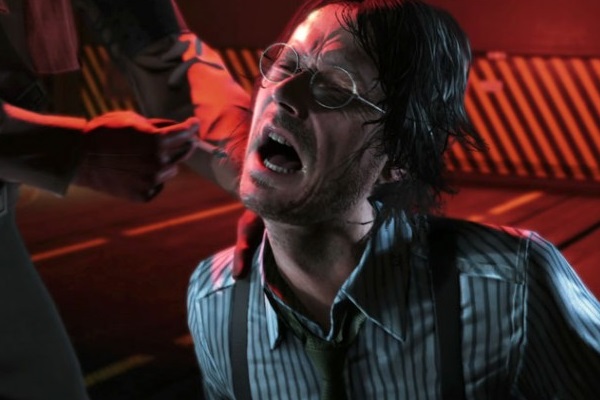
While a lot of people have questioned the villainous credentials of Metal Gear Solid V's supposed antagonist Skull Face - mainly because the character is actually barely in the game - it's pretty obvious that the title's most evil character is actually one Huey Emmerich. The once lovable nerdy scientist turns out to be nothing but a cowardly, murderous psycho by the end of V's story. In fact, the game might as well be Huey's decent into villainy rather than Big Boss', as the latter actually does plenty of heroic and noble things throughout. Although Emmerich is exiled from Mother Base after it's found out he's a pretty terrible guy, a piece of in-game dialogue alludes to the fact that Huey will end up having the last laugh over the Diamond Dogs. Free from the shackles of the Dogs, Huey swears that he'll spread stories about the horror of Big Boss, telling anyone and everyone about how monstrous the legendary soldier and his band of merry mercenaries actually are. Fans have hypothesised then, this could actually be the reason the legend of Big Boss is so vilified in those early Metal Gear games. Snake himself isn't really THAT bad of a person, but his legend has been warped by the tales of men like Huey and even Big Boss' right-hand man Kaz into something much more sinister, in order to get gullible heroes like Solid Snake to have no reservations about taking him out.

9. OR Venom Snake Sabotages Big Boss' Legend From The Inside

However, another theory is that the real Big Boss remains the semi-good anti-hero we all know and love, and that it's actually Venom Snake (aka, the "Big Boss" that's on display to the public) who purposefully tarnishes his reputation from the inside, so to speak. Given the ambiguous nature of the final cutscene that sees Venom Snake receive the "truth tape" from Big Boss revealing that he was only a stand-in the entire time, the final smashing of the mirror and sly smirk to the camera has been viewed as the rather sinister beginning of a quest that would ultimately warp the legend of Big Boss into something much more twisted than the man himself. Fans have argued that, feeling betrayed by the real Big Boss, Venom Snake spends the time between finding out the truth and the Outer Heaven uprising completely trashing the real Snake's reputation as a form of revenge. It would explain the character's 180 view on nuclear weapons and child soldiers, as Venom Snake is pretty against both ideas in MGS V but rather gung-ho about them in the original Metal Gear.

8. Big Boss' Hallucinations Completely Warp The Story

From the very beginning it's made clear that the shrapnel in Venom Snake's skull has the ability to cause the character to suffer anything from hallucinations to forgetting information that he should be privy to (although the latter is actually more of an excuse to hide the fact that the character you're playing isn't actually Big Boss,) and thus pretty much nothing in the game can be taken at face value. This is only exacerbated by the many quotes and references to fiction made in the game that warns you from believing every single thing you see. Hell, it fits right at home in the continuity of the series, as a big theme of Metal Gear Solid 2 was also about subverting player expectations and figuring out what was real and what wasn't. As a result, it's hard to tell what actually did and didn't happen in The Phantom Pain; did Snake really kill those child soldiers? Was the final reveal just a coping mechanism to shift the blame of every horrible thing he did during the game? Did all of those Diamond Dogs really need to be killed in the quarantine zone? It's one of the more ambiguous theories to be featured in this list, but it's one that opens up The Phantom Pain to a whole load of valid interpretations.

7. The Ending Made The Player Feel The REAL Phantom Pain

Potentially my favourite of the theories on the go is the idea that many weird design choices in the game were purposefully done to make the PLAYER feel the "phantom pain" the characters go on about so much - which is a meta twist that could only be pulled off by Kojima. Ridiculous, asinine, insane - but oh so Metal Gear. Oh so Kojima. The idea is that Chapter 2 lacking in focus and content, the disappearance of Quiet as a Buddy and the lack of closure overall is supposed to leave the player feeling like they're missing something that they can't quite put their finger on. Quiet especially sticks out on this one, as she's only taken away from the player when their buddy rating is maxed out. Essentially, the character is taken away so the player can suffer a loss just like everyone else in the main cast. It would be a brilliant twist if true, and it's not entirely out of the question. Not to bang on about MGS2 too much, but that game was entirely designed to play out almost exactly like the original game just to drive home the idea that players were playing something that was nothing more than a simulation. Not only that, Kojima himself mentioned that the disappearance of Skull Face before the end was supposed to replicate the characters' "phantom pain" by removing the identifiable antagonist. And if you look at any message board or forum about this new game, it looks like the tactic has worked. Everyone who has played the game is feeling the phantom pain of something being missing, something not quite right that they can't put their finger on, and if that was intentional by Kojima, it is brilliant.

6. More Content Is Coming

Another theory that fans have clung on to is that Metal Gear Solid V either has more content hidden away on the disc ready to be unlocked with a future patch, or that DLC is incoming for an unannounced Chapter 3. Because of the weird way chapter 2 plays out in the base game, forcing you to go through previously beaten episodes, as well as the fact that splitting the game into 'chapters' at all when there's only two, has been taken by some fans to mean that other story episodes are going to be released in the future. There's also the fact that in the run up to the game coming out, retailers mentioned that there would be playable areas other than the two included in the game such as Russia and the USA. While that could simply have been misinformation, these locations could see a release some time in the future. The USA in particular feels particularly relevant as in the cut episode 51 (which also wasn't a proper ending in itself,) the final shot is of a 1984 New York while while Eli says "It's not over. Not yet." While one of these in isolation could be easily explained away, all of them together makes a rather good argument for players who are sure extra content is coming.

5. 'Revenge' Is The Downfall Of Every Character In The Franchise

Say you didn't know "revenge" was a theme in The Phantom Pain going in, you'd definitely know by the game's end. Kojima practically beats you over the head with it; if naming a chapter after the theme wasn't enough, every other piece of dialogue that comes out of a character's mouth is all about vengeance or the sweet taste of revenge. But as it turns out, revenge as a motivator isn't something Kojima glorifies. In fact, it's not only presented as the downfall of all the characters in this game, but pretty much every terrible thing in the MGS series can be attributed to someone's never-ending thirst for revenge. It's what undoes Kaz in V, as his never-ending quest for retribution against Skull Face leads him down his darkest path yet, and the fact that the real Big Boss gave up his chance of revenge to go off and build Zanzibar is the crime that ultimately sets Kaz against his former comrade. And that's only one character. By the end of the latest game, everyone has been consumed and destroyed in some way by revenge, even though when they finally achieve what they see as "justice", it only leaves them feeling the titular phantom pain, no longer with a focus that falls outside of petty vengeance.

4. Characters Are Neither Good Nor Evil, Merely Pawns

Another way to explain why the game didn't chronicle Big Boss' descent into villainy is because no one character in the entire series is purely "good" or "evil". Even Zero, who was introduced in 4 to be the mastermind behind the Patriots and a pretty crappy guy, was revealed in V to have been a vegetable the whole time, and that everything that happened after 1984 was pretty much out of his hands. Sure the likes of Ocelot, Big Boss and Zero are pretty shady people who you wouldn't trust to pick you up on time, but every single one, and even villains like Skull Face, all think they're doing the right thing. Even the most moustache-twirling baddies with names like Skull Face still retain a semblance of humanity, with motivations only slightly worse than the game's supposed "heroes." Solid Snake himself isn't a through and through good-guy, and MGS1 makes several allusions to the fact that he enjoys the killing and the trail of destruction that he leaves behind. In the end, everyone in the MGS series has been manipulated and played at some point, pitted against each other thanks to some higher power. Big Boss is played to kill The Boss, Solid Snake is played to kill Liquid Snake, and just about everyone has been tricked into murdering someone they weren't supposed to. MGS V, more than any other game in the series, blurred the morality of every character forever.

3. Everyone In The Series Is Chasing Phantoms, Not People

Like I mentioned earlier in the way all the characters in the Metal Gear Solid series are being played and manipulated constantly by those behind the scenes, the miscommunication is even more pronounced when you realise that characters aren't chasing other characters, but their "phantoms". For many of the protagonists in the games, they aren't ever really chasing down true people, but the idea of the person that's been left behind. Hear me out, it turns out Big Boss isn't the evil person he's been made out to be, yet Solid Snake is attempting to stop that version of the character, a version that is actually a far cry from who the real Big Boss actually is. The same can be said for Ocelot in his definitely-Liquid-but-also-kinda-not form. Snake is chasing him down, but that's not the real Ocelot who's been established in these prequel games. That's not to say every confrontation in each game boils down to a mere misunderstanding, because of course they aren't. It's more that these rivalries were spurred on by the "phantoms" and reputations each character left behind. Big Boss wasn't the evil conqueror in real life, but that's how his legend became known - and he ended up paying the price for it.

2. The Legend Of Big Boss Has Always Overshadowed The Man Himself

A recurring theme throughout all of the pre Solid Snake games is the thought that anybody under the right circumstances could be Big Boss. The legacy of Naked Snake himself has always overshadowed the abilities of the actual man, with his legend becoming exacerbated and exaggerated by the regular soldiers and comrades he encounters. And with The Phantom Pain, Kojima completely solidified this thought by turning a completely random soldier into Big Boss to continue his legacy. It's kind of like Batman's more recent run with his Bat-Family or by seeing Jim Gordon step up to protect Gotham; the idea of 'Big Boss' being merely a symbol, a symbol that Venom Snake is tasked with upholding while the real Naked Snake goes about his plans of creating a whole new nation. So, by revealing Big Boss' glorified reputation over the course of the games post Metal Gear Solid was never real to begin with, Kojima has used the ending of his finale to truly cement the fact that the legend of Big Boss, ostensibly the most important character of the entire franchise, was nothing but an exaggerated lie.

1. Big Boss' Legend Is An Ode To The Player

Perhaps the most heartfelt reason to explain Metal Gear Solid V's twist ending is that the entire thing was orchestrated as a huge ode to the player. After all, we are the ones who have been controlling Big Boss throughout these games. We have been the ones building his legacy in the eyes of the public. If anything, the legend of Naked Snake isn't down to the man himself, but the actions of the player. And the end of V perfectly sums up the player's influence on the whole series. Only the medic (you), Big Boss' best and most trusted soldier, can be given the task of upholding the icon's epic legacy. This change rests everything on the players shoulders; you have been the linchpin of the entire franchise, and you were the one who set everything in the series' story in motion. Kojima has always been a fan of breaking the fourth wall, yet in Metal Gear Solid V he smashes straight through it, breaking down the barrier between the characters and the player in a glorious way. He toyed with the same thing in MGS2, however here, for his finale, Kojima has made it clear that Big Boss was never a legend because of the things he did himself, but because of the actions of you, the player. What did you make of the ending? Let us know in the comments if you buy any of these theories, and what your own are!

Contributor

Josh has over 11 years of experience as a published writer, having worked nine of those years as a full-time content producer at WhatCulture. In that period he has created hundreds of articles, videos and podcast episodes for multiple WhatCulture channels, specialising in gaming, horror and film & TV. He now primarily works as a senior content producer and presenter on WhatCulture Gaming where he co-hosts the WhatCulture Gaming Podcast, a top 3 UK most listened to gaming podcast that he co-created in 2018. Over the years he has reviewed several high-profile gaming releases, covered industry events with on-site reporting, opined on breaking news, and even kicked off his interviewing career by chatting to childhood hero, Tommy Wiseau.