Monster Hunter World: 10 Tips & Tricks The Game Doesn't Tell You
The hunt is on.

The New World is a mystery no more.
The floodgates have swung open, ushering in a new generation of aspiring monster hunters, naive yet eager to test their mettle against beasts so grand in size that to even be considered worthy of a place on the menu would be complimenting our kind's meagre presence.
Shouldering an unwieldy sword forged from the carcass of a fallen enemy you may be, it's nought but a decorative toothpick in the eyes of Monster Hunter World's megafauna. The odds are, and will always be, stacked against you in this inhospitable land, and that's the way Capcom likes it.
Make no mistake, World marks an important milestone for the series in that it's the most accessible entry to date - easily digestible tutorials aplenty punctuate the game's first few hours - but Capcom's made a few omissions to the Hunter Handbook, some intentional, others not.
You won't be taught how to mount gargantuan beasts or what the lucrative benefits of fishing are without an external primer such as this - you're expected to discover their importance on your own - or, for that matter, the myriad systems put in place to safeguard your delicate digits, but worry not, that's what we're here for.
Dread every visit to the Smithy for fear of being overwhelmed by special properties and number-crunching stat sheets? You've come to the right place, friend.
10. Weapon Affinity

As you begin to accrue rarer and more lucrative upgrade materials out on your travels, Astera's Smithy will become the go-to port of call after every mission to see what - if any - weapon upgrades are available. Damage, elemental infusion and sharpness are all self-explanatory benefits, but accompanying those on the stat sheet is the mysterious Affinity rating.
Represented as a percentage, any given weapon can bestow a positive or negative Affinity bonus, but what do those digits mean and why should you care?
Simply put, Affinity measures the chance a weapon has to deal a critical hit. Anything zero or above is bang on the money, but you'll want to steer clear of crafting weapons with a negative Affinity rating, at least until you're able to offset the deficiency with armour skills, as it'll put a dent in your damage output.
That might make the latter seem useless, but different Hunter builds number in the millions by the time endgame rolls around. There's every chance that -30% Affinity Switch Axe you've ignored for the last 20 hours just so happens to make the perfect pair with an as-yet undiscovered armour set, so be sure to keep checking back.
9. Never Go Hunting On An Empty Stomach

In an office environment, sure - you can skip lunch and get away with running on fumes until it's time to clock off for the day, but for more physically demanding jobs that involve, for example, scaling building-sized megafauna for a living, keeping your strength up is key to success.
Prior to the beginning of any hunt, you can visit the canteen - either at home base or camp - for a bite to eat. Besides pandering to immersion, every item on the menu, be it meat, fish or veggies, will bestow a handful of buffs to your Hunter when eaten. These range from boosts in attack power and defence to a bolstering of elemental resistances and health, and they're sizeable increases to boot.
Chowing down on a pot roast or flame-grilled tuna steak can - and will - mean the difference between victory and defeat on the frontier, and they cost a pittance, so there's no excuse.
Be kind to your Hunter. Feed them to bursting point.
8. Push And Hold

Given its heavy RPG leanings, for Capcom to have managed to cut down on the micromanagement side of play in Monster Hunter World to the extent it has is no mean feat, but even so, you'll not escape having to spend a solid amount of time harvesting corpses, juggling backpack space and collecting resources during your adventures.
But a mere few hours in, the process will pass by unnoticed, but as time passes, constantly mashing the collect button will start to grate.
Thank the stars, then, that Capcom, having clearly expected as much, proactively implemented the ability to hold down face buttons to mass collect end-of-stage rewards, saving you from developing the dreaded RSI. The same goes for mining, harvesting and the transfer of resources from the pouch to storage. Just one tap is all it takes.
Such a simple quality of life option it may be, but it's one that developer's all too often forget to implement, and for that, Capcom deserves praise.
It's the simplest things.
7. Auto Crafting

Like many of Monster Hunter World's core systems, brewing elixirs and crafting traps on the go can appear far clunkier than it is.
Manually crafting the bare necessities like ammo coatings and potions can be frustrating when there's a fire-breathing T-Rex about to chomp your head off, but fortunately, Capcom's introduced a system that allows players to automatically craft the essentials.
Accessing the crafting menu allows you to designate which consumables you want to be crafted without requiring direct input, freeing up focus for the hunt at hand. Gathering herbs and honey, for example, will restock your potion reserves automatically and add them to the quick-use inventory.
Once you're confident in knowing what items best suit your playstyle, more complex inventory like antidotes, barrel bombs and traps can be added to the list.
6. Get Your Rod Out

Scavenging useful materials on the go in the lush forests and fetid swamps that make up Monster Hunter's wonderfully diverse ecosystems is a necessity when tracking beasts 50 times your size, but it's not just solid ground that's rich with natural resources.
As soon as you're granted access to the initial Ancient Woods biome, your Hunter will have the built-in ability to whip out a fishing rod and test the waters for a bite. Besides providing a spot of relaxing off-time from the eternal hunt, any slippery critters snatched up can be used in cooking custom dishes for hefty bonuses, but that's still not all.
When caught, certain fish will yield unique or rare items like scales. Similarly to potions and rations, they're consumables that restore health and stamina but with the added benefit of being an instant-use item, making them a valuable commodity when you're up against more nimble predators.
Bonus tip: your hunting net can also be used to dredge shallow rockpools of their inhabitants, sometimes yielding multiple fish in a single attempt. Efficient!
5. Don't Dawdle After A Kill

Skinning, scalping and gutting your prey after every kill will swiftly become second nature in the wilds of the New World, but it's important to remember that, outside of free-roaming Expeditions, all assignments are timed.
For non-optional assignments, your limit is 50 minutes, providing plenty of leeway to get the job done, but once your main target gives up the ghost, you'll have less than a minute to get your affairs in order before being whisked back to home base. Fail to carve up the carcass of a kill in due time and your loot will go to waste.
For Hunters flying solo, this isn't too much of an issue, but in multiplayer sessions - where it's all too easy to get separated from your crew - the hunt could end with you coming out empty-handed if the main target goes down on the other side of the map.
Just remember to make sure the squad's together when going in for the final battle and everything should work out hunky-dory.
4. Train Your Heart Out

Though it'll be hard to resist jumping straight into the wilds, your first port of call as a fresh-faced Hunter, upon reaching the safety of Astera, should be the training grounds.
Once the whistlestop tutorial tour of Hunter HQ is over, you'll be shepherded into your lodgings for a brief breather, but don't lay your head on the pillow just yet. Head over to the Palico lingering in your doorway and opt for a trip to the aforementioned area for your first true taste of Monster Hunter World's combat.
Here, you can put each of the 14 weapon classes to the test without fear of reprisal from dragons and dinosaurs in order to ascertain which best suits your tastes. It can't be stressed enough how drastically different each armament performs from the last: knowing the strengths and weaknesses of each before taking on your first live operation is a must.
Test dummies and barrels can only prepare you so well, of course, but once you venture outside those gates for the first time, you'll be glad to have done your homework.
3. Clean Bill Of Health
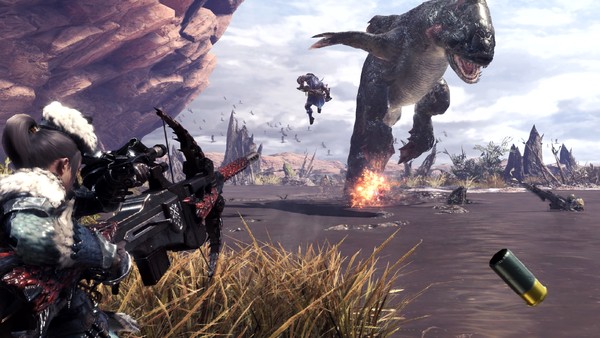
In the absence of health bars, there's no surefire method of determining how much fight a mark has left in it, but there are a handful of visual tools to help you discern the current state of play.
The first and most identifiable method is to watch your enemy's movements like a hawk. At set periods throughout a hunt, monsters will begin to flee the fight. Think of these as phases, periods where both parties have time to catch their breath and come back with a renewed sense of murderous intent.
The more phases you proceed through, the closer you'll be to having your quarry beat. Likewise, if the beast begins to limp and/or retreat back to its nest, you have it on the ropes.
The other, more subtle indicator, is a heartbeat monitor in the bottom left-hand corner of the screen. If it's pulsating wildly, you've still got ways to go. Conversely, if it's flatlining, the beast is either dead or sleeping.
You'd be surprised at how often it's the latter. Don't be fooled.
2. Use The Environment To Your Advantage

If your prey can use the environment to its advantage, so can you.
Capcom's gone to great lengths attempting to ensure that every berry bush, knotted patch of undergrowth and pint-sized amphibian serves a purpose in the sandbox, all it asks of the player is that they survey their surroundings for a strategy before charging headfirst into a Rathion's nest and to certain death.
That option's always there if you need it, but why take the obvious, grossly inefficient route? Use your imagination. It'll pay off in the end.
Punt a Nitrotoad into the oncoming path of a frenzied Jagrath and it'll spontaneously combust in its face, causing it to reel in terror. Likewise, if you happen upon a species of flora that can't be harvested, chances are, it can be struck with a well-aimed slingshot strike, dousing your prey in particularly corrosive goo.
If that's too underhanded for your liking, there's always the option of luring two different predators into a primal confrontation of fire and brimstone.
Remember: The enemy of your enemy is your friend.
1. Take The Bull By The Horns

Mounting is a core component of Monster Hunter's combat - your kills will drag out for longer than they need to without mastering it - which makes it all the more intriguing that Capcom seemingly left out a tutorial on how to engage in the act.
Ranged weapons excluded, jumping from a height greater than that of your prey and squeezing the right trigger moments before making contact will stick your Hunter to the monster like glue. It's here that you'll be prompted to repeatedly jam a knife into the monster's flesh, taking care to yank the trigger as a means of holding on for dear life when your host takes offence to its unwanted passenger getting a free ride.
Repeat the process enough times and the dirty assault will conclude with an impressive special attack that floors the opponent for a good 30 seconds. Enough time to dish out some serious damage.
A word to the wise - if you're not confident in your ability to carry out the task, don't. Every monster gains an immunity to mount attacks after the first - successful or not - so don't let them go to waste.