Resident Evil Remake Has Always Secretly Been The Best Resident Evil Game
The original was iconic, but Capcom knew they could do better.

Nobody is ever going to agree on what the best Resident Evil game is. Hell, the series has reinvented itself so many times, few people will even have the same understanding of what it “is” or should be.
It doesn't help that so many of the main entries have been amazing, either. The original defined survival horror, the second gave players Leon and Claire, Resi 4 not only transformed the franchise, but third-person shooters in general, while 7 reinvented the wheel yet again with a new first-person perspective. There’s probably even people who think Resi 5 is amazing. Probably. I’ve never met them, but they've got to exist.
With so many great titles to choose from though, it’s the remake of the original Resident Evil that’s the peak of the series.
Like the most recent release, this 2002 title is less concerned with delivering a prettier version of a game that already exists, but presenting the original game how you remember it being. On the one hand, there’s a superb attention to detail when it comes to recapturing the atmosphere, visuals and geography of the original title, but on the other, the developers weren't afraid to shake things up, remixing puzzles, making subtle quality-of-life changes to the map itself and even adding in completely new story and gameplay elements.
It could have gone oh so terribly wrong, but it ended up creating perhaps the best distillation of why everyone loved Resident Evil in the first place.
6. Enter The Survival Horror

First up, it’s probably worth establishing that a lot of what makes the remake so good is obviously down to what made 1996’s Resident Evil a seminal survival horror experience. But while that title laid the groundwork, it wasn’t without its rough edges. It was famously a surprise hit for Capcom, who barely gave the devs enough money to cobble together voice actors and a localisation team to knock up a story. That’s how we got brilliantly stilted lines about Jill Sandwiches.
Though the title is ostensibly an “action” game, in that you’re head-shotting zombies and battling giant snakes, every piece of gameplay is treated more like a puzzle to be solved. Your limited inventory space requires you to equip items as tactically as possible, forcing you to weigh up how much firepower you want to bring with you, how many health items you want to rely on and how much space you’re going to need for puzzle items.
There’s constantly a trade off to every decision you make. For instance, you might have 30 shotgun shells saved up, but you might only have the space in your inventory to carry the 10 already loaded into the weapon, which reinforces the idea of limited ammo even if you technically have a lot.
Just because you've got plenty of bullets stashed in the item box doesn't mean you can actually rely on them at all times, which creates a strange dichotomy between how well-equipped the player is, and how powerful (or powerless) they actually feel.
In the early game you’ll probably find yourself clinging on to as many weapons as possible, but that only gets you in even more trouble when you have to backtrack through dangerous areas once you realise you don’t have the space for key items, which in turn could lead you to waste resources or take damage.
Consequently, growing in strength and confidence isn’t all based on figuring out how to scavenge the most ammo, but how to use resources smartly. By the end, you’ll know exactly how much ammo you’ll need to get from one end of the map to the other, freeing up space to to progress through the game as quickly as possible.
5. The Dead Don't Stay Dead

Though the inventory management system and the ammo conservation already got players thinking tactically about their approach to each objective in the original game, Remake takes that idea one step further.
Just like in the recent Resident Evil 2, zombies are incredibly hard to put down. They can take over half a handgun clip to actually kill, and the generous stun animations of the first release are gone, meaning they can eat your bullets and continue to close you down.
Taking down even one of these guys is a task; you need to put a lot of space between yourself and the zombie in question, make sure there isn’t another one that might be able to get the drop on you, and then pump it with about 8 bullets. And even then, you’re not done.
If you don’t want the zombie to come back as an even tougher Crimson Head, you’re going to want to burn the body. The problem is, to do that you need to have kerosene, which there’s a limited amount of, and a free inventory space (two, if you’re playing as Jill).
If you don't have the time or the health left to completely dispose of it, then you're essentially taking a short-term win now for a long term problem when the zombie comes back to life. Taking out just one of these fellas (outside of tactical headshots which can’t be relied on like in the original) isn’t just a drain, then, but can prove to be a far bigger problem than it’s worth, and might completely screw you on return visits through an area.
A problem I had with the original Resident Evil when going back to it was how, playing as Jill anyway, I could always ensure certain hallways would be safe. Especially when I got the grenade launcher, clearing out rooms became routine. Consequently it made for far more boring backtracking, as there was no danger to the areas I was travelling back through. Remake avoids this problem entirely.
There's only enough resources to completely secure a couple of rooms (which most players will use on the areas with the typewriters and item boxes) and so the constant backtracking never feels like a chore, but a chance to interact with a difficult combat challenge in a new context. And that’s made all the more intense because saving is finite, and a death could set you back a lot of progress.
4. A House Is Not A Home

Perhaps the biggest strength of Remake is the Spencer Mansion, an iconic gaming location that’s memorable because of how it interacts with the feeling of powerlessness, and later powerfulness, you get as a player.
Initially you’re overwhelmed with options: you can check out the bottom floors of the East and West wing, explore their offshoots, run up to the first floor via the stairs, or investigate a brand new area tucked away behind a door in the main room that leads out to the graveyard.
It’s an overwhelming amount of options (even if there is an optimal route the game ushers you down), and fighting the sheer size of this house that's trying to kill you is spookier than any zombies.
This, again, becomes a puzzle to solve. As you familiarise yourself with the environment, you eventually gain a mastery over it, as you’re able to minimise interacting with enemies and figure out the shortest way from point A to point B.
It’s another subtle progression system that interacts with the moment-to-moment gameplay, and aids your growth as a player and a survivor in a way that isn’t just tied you gaining more powerful weaponry and more items.
Again, all this was present in the original, but Remake adds a bunch of elements to make the ebb and flow over your understanding of the location even more challenging; for instance a door with a dodgy handle that’ll break if you backtrack through it too many times, forcing you to juggle the risk/reward of taking the long or short way around; new enemies who can break through doors usually separated by a loading screen, and even greater interconnectivity between rooms via shortcuts.
Unlike the original, these additions inform the pacing of how the game makes you feel comfortable, and then totally lost, in this environment, throwing players new challenges that tests their mastery of the space in order to keep that growth as a survivor constantly happening.
Like how having a stash of guns and ammo doesn’t automatically mean you’re safe, simply knowing the layout of the map screen doesn’t translate to total mastery over the game space. This comes in knowing which enemies are where, the safest routes to the next objective and which hallways you need to clear out.
3. Everything Is A Puzzle

All of these mechanics coalesce into one incredibly compelling gameplay loop, where pretty much every decision the developers made compliments the larger puzzle of how to survive.
The fun of Resident Evil Remake isn’t in the action, it’s in planning and executing specific routes through the mansion, in thinking five steps ahead, in doing something difficult in the moment and expending your resources in the hopes it will pay off later.
There’s a lot of methodical downtime, but there’s a certain satisfaction that comes with loading your weapons up with just enough ammo, backtracking through three doors to make sure a zombie is burned, and knowing a problem has been dealt with as efficiently as possible. You might kill one enemy and it might take 15 minutes, but it’s unbelievably rewarding.
Of course, it’s also about these best laid plans coming tumbling down, going from thinking you have a handle on everything, to making one mistake and barely scraping through alive, and then learning from that experience. Most Resi games are fuelled by this rhythm in some way - with scarcity of resources popping up in 2’s remake and even present in 4’s limited inventory management - but no other one commits its systems as holistically to the idea as Remake.
2. This Is What Horror Looks Like

The praise so far has just just been on the core gameplay loop as well, not to even mention the absolutely pitch-perfect sense of atmosphere and dread conveyed by the visuals and music.
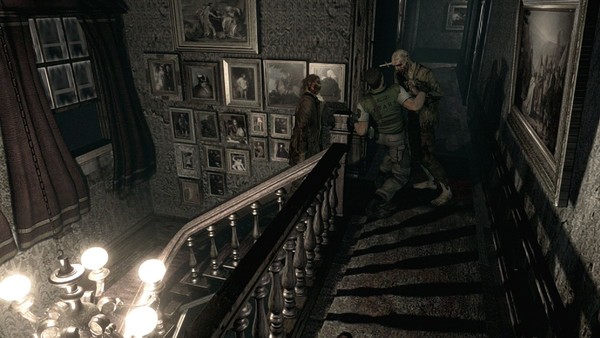
No matter which platform you’re playing on, Remake looks incredible. If there’s ever been an argument for why static cameras are still relevant, it’s this game. Every shot feels purposeful; the camera isn’t just stuck in a corner, but positioned in a way to maximise the tension of simply walking through an empty hallway.
Resident Evil has always worn its B-movie influences on its sleeve, from its monster designs to its gothic maps, and Remake delivers that in spades, but it also manages to make those designs scary. With the exception of maybe the hunters, the zombies in Remake are terrifying, as are the Cerberus dogs, and the crows, whose squark pierces your very soul.
The Spencer Mansion also works to really drive home the isolation felt by the player and the characters. The way it links to graveyards, underground laboratories and caves full of spiders awards it with a certain surreal quality. Like the European villages of Resi 4, there’s no feeling that society even exists outside. You’re so far removed it’s like you’re in another world, a nightmare that you just can’t wake up from.
1. Conclusion
Of course, it's not like Resident Evil Remake is a perfect game. The second half’s move into more linear, isolated levels is a bit of a step down from the mansion, the script isn’t exactly anything to write home about, the boss battles are pretty basic and the Hunters are, in my opinion, quite rubbish enemies.
Likewise, you have to be on board with its methodical style of gameplay to enjoy yourself, but even with these criticisms in mind, Remake comes together so well, with every little element informing one signature vision of what survival horror should be.
Other games in the franchise might reach higher highs - and I still might find myself jumping into the instantly gratifying arms of Resi 4 more regularly - but there’s nothing quite as consistent at delivering pure, survival horror brilliance as this initially overlooked entry from Capcom.
Watch Next
The IMPOSSIBLE Resident Evil Quiz: How Well Will You Do?
