Sekiro: Shadows Die Twice Review - 7 Ups & 3 Downs
You will die WAY more than twice.
Fromsoftware’s latest entry in its series of tough-but-fair (for the most part) action games is Sekiro: Shadows Die Twice. An absolutely stunning addition to the Soulsborne library, Sekiro takes us to ancient Sengoku Japan, puts us in the shoes of a broken shinobi, and lets us journey with him in a story of redemption, revenge, and sacrifice.
I’ve spent a solid amount of time getting my butt handed to me by pretty much every single enemy inhabiting this exciting new world, and it's worth breaking down just how it measures up to the likes of Dark Souls and Bloodborne, alongside what you can expect as a new player.
From screaming in anger at unfair hitboxes to bursting into tears with an explosion of emotion after defeating a difficult boss, Sekiro grips you with perfect pacing, and its notably prominent emphasis on keeping the player feeling powerful, encouraging you to never give up.
Downs...
3. Death Is More Punishing Than Ever
Unlike in Dark Souls and Bloodborne, when you die, you do not leave behind a little puddle of your experience to pick up later, you straight-up lose it entirely. Half of your progress towards your next experience point and half of your Sen (currency) is lost when you die, with no way of recovering it.
This might sound awful, but it's not actually so bad, considering how quickly your experience is banked in the form of a skill point, and sen can be exchanged, for a price, for a safer alternative that you won't lose when you die.
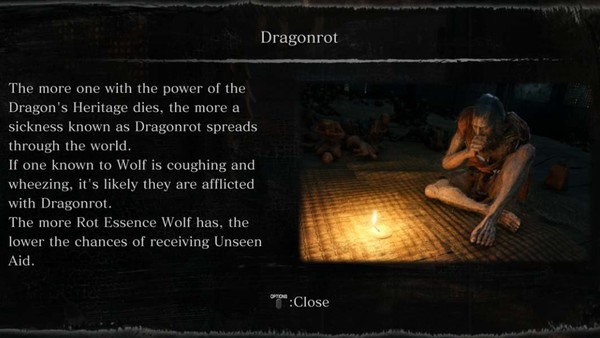
But it is the Dragonrot that makes death so punishing.
Every time you die and resurrect, you are essentially "borrowing" life force from another living being, and you will begin to afflict every friendly NPC you meet with the fatal disease, Dragonrot. It is - eventually - curable, but the means of doing so comes at a great price, and is very limited. The more denizens of the world are afflicted with Dragonrot, the less likely you are to hang onto your experience and sen when you die.
But screw the experience, the worst part is every time you meet a new person, you get a sinking feeling in your stomach knowing that you'll eventually be causing them a great deal of pain. In a way, it just forces the empathetic among us to "get good" more than ever.
2. Controls Are A Bit Fiddly
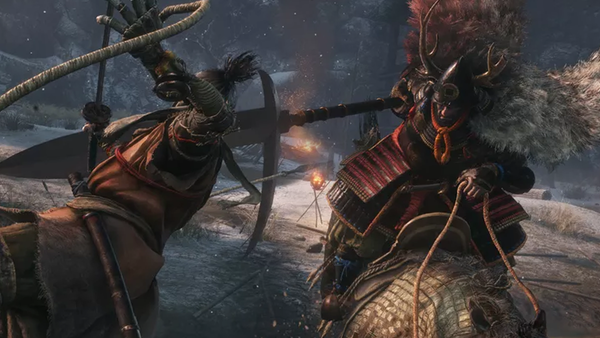
It takes some time to get used to Sekiro's controls, but the one thing that persistently annoyed me was the use of Quick Items. You can set around 5 different items to be used by cycling through them, and when this is done in a hurry, it can lead to a couple of knotted fingers.
Cycling through items is done on the D-pad using left and right directions, then you tap up to use one. Considering we use this same thumb to control our character's movement, I often found myself either standing in a dangerous place for too long, or trying to stretch my fingers over, and ending up pressing right instead of up, using a long-cast item instead of my heal - essentially a death wish.
The lack of control over where we can throw distracting pottery shards is also frustrating. Considering how many we find lying around the place, when you try to actually use them in a helpful way, they never seem to work. A trajectory indicator would have been VERY useful here.
Also, obligatory "hitboxes are broken - it's not me, it's the game!" complaints can also go here.
1. You're Stuck With The Same Katana Sword

From the very beginning to the very end, you will use a single weapon, the Kusabimaru. Although it's a very special weapon gifted to you from Lord Kuro, this one blade - and the majority of its moves - will be by our side throughout the entire game.
One of Dark Souls' strengths was always the myriad of choice when it came to which weapon we chose to wield, and we could level up that weapon however we chose - something we do not have a say in, in Sekiro.
This is offset, of course, by instead having unlockable weapon arts and techniques that keep combat varied and interesting, and of course, the shinobi prosthetics are vastly customisable.
Still... one main weapon?
Ups...
7. It's More Of The Same, And Then Some
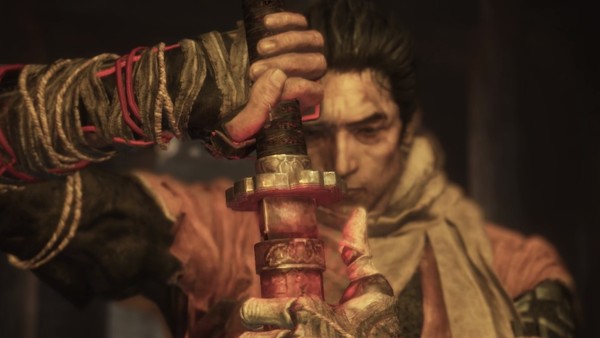
Veterans of the Soulsborne games will be glad to hear that Sekiro is indeed a continuation of the level of majesty from previous Fromsoftware games that we adore, but it is also full of surprises to keep us on our toes.
Fans of the first Dark Souls game may feel a warm glow of deja vu in the few moments leading up to gameplay, as Sekiro begins with an almost exact parallel of Dark Souls' intro.
Shinobi combat is a breath of fresh air, but still has that same Dark Souls/Bloodborne feel to it. You cannot play this game as if it were Soulsborne, but having those skills from playing those games will transfer over to this one, especially the skill of keeping your patience!
However, this time around, we have a pre-set character and a much more personal story to discover alongside him. The world and its inhabitants are much more clearly defined, and we will learn about Sekiro's situation as he does, as we work to piece the broken pieces of his memory back together. You will genuinely really care about recovering young Lord Kuro.
There are so many new items to collect and discover their uses, and excess inventory is stored at idol checkpoints, as seen in Bloodborne. Loot is picked up from all enemies at once by holding a button to channel a little loot vaccuum with decent range, so stopping to pick up a shiny item is no longer perilous, although now that conversations with NPCs stop you in your tracks, interactions have become perilous instead!
Also... I fell off a cliff and did not die. What a welcome change!
6. The High Level Of Customisation

There are a huge range of techniques and skills to learn and master, and the game introduces them to you at a steady pace. By the time you have managed to fill an experience bar and gain a skill point, you will be ready to have these new skills introduced to you. I cannot stress enough how perfect the pacing is in this game.
Some skills are passive, and some have to be equipped, but every single one is massively useful, and it does not feel like any are just filler. A very early shinobi arts skill can make one of the early bosses infinitely easier to tackle, and another can make groups of enemies easier to handle, so you can start to feel more confident when you alert multiple enemies at once.
Each time you unlock a complicated technique, there is a kind punching-bag gentleman by the Temple who is more than happy to let you try them out on him, in a safe environment. I've never been so happy to spend so much time training and trying to master all the techniques.
5. The Bosses Are All Unique

It's why we're here, isn't it.
FromSoftware's games always have incredible bosses. Memorable designs, telegraphed moves that are satisfying to learn how to counter, and often each being vastly different to those who came before them.
Sekiro cranks this up one step further. The line between boss and miniboss is blurred as every named tough enemy with more than one health bar easily brings enough challenge and diversity to be classed as its own boss. They each have unique designs, carry different weapons, and each have a secret, unique tool or technique that can help to bring them down.
Every boss in Sekiro is a joy to fight; to learn their moves, and defeating them is euphoria unlike any other. Frequently you will find yourself in a situation where you are almost giving up, to then find a new tool or unlock a new skill, and suddenly the entire fight is illuminated in a brand new light.
No boss feels unfair, or impossible, it's all about the fun and the excitement of figuring out the best way to defeat them.
4. Combat Is Tighter Than Ever
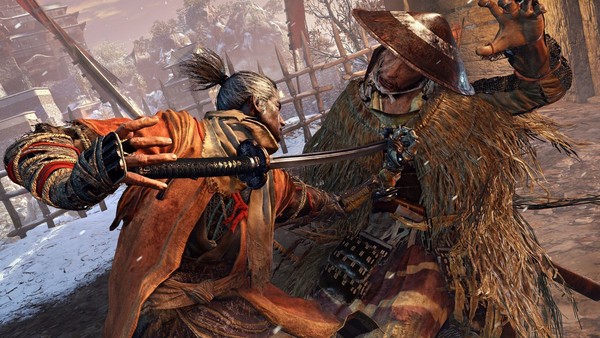
The combat of Sekiro differs somewhat from that of Dark Souls and Bloodborne. Instead of simply focusing on whittling down an enemy's health, there is a focus on breaking their posture, referred to in Dark Souls as poise. Deflecting, dodging, and blocking are all still present, but their emphasis varies depending on the enemy you are facing, and deciding which evasive manoeuvre to use is up to you in the heat of the moment.
The sound design compliments the combat brilliantly, building in atmosphere as you uncover beautiful landscapes, and warning you of danger when you are sneaking around in stealth. The roaring boom of the soundtrack as you are facing a difficult enemy really gets your heart pumping with excitement.
Every enemy you fight has the potential to overwhelm you if you are not cautious, and locking swords is scary, pulse-racing and exciting. There is nothing quite like that feeling of delivering a death blow to a boss that has been giving you trouble for a while.
We may have lost an arm, but we gained so much more. The Shinobi prosthetic is incredibly useful, and fun to use, and has massive potential for upgrades. New tools are so exciting to find and try out, and each has its own special strengths. Up to three different prosthetics can be equipped at once, and it is very easy to cycle through them.
There are so many different ways you can approach a dangerous situation, and it is down to the player to decide on their preferred means of tackling a problem, which leads me to my next point.
3. Stealth Is A Welcome Addition

Although stealth always has had a presence in the Soulsborne games, it could never be truly relied upon. Sekiro has a massive emphasis on using stealth right from it's very beginning, and the resulting gameplay strengthens the narrative as a whole.
Sekiro is a shinobi, a warrior who will defeat his enemies by any means necessary, not above resorting to what the samurai might call dishonourable tactics. Not only is stealth a useful way to thin enemies ranks, it's also a hugely fun way of playing the game.
With the mobility being as flexible as it is, you can often get a lethal deathblow by stealthing behind your enemies, or even on to buildings on top of them. The environment of the villages and cliffs surrounding them is so well designed, that there are always a few ways that you can approach a group of enemies, and there is usually a safe option to pick off one or two straggling enemies from a safe, stealthy place. Enemy A.I. is very clever, but also easily manipulated as if it were a real person, and therefore easy to predict, but still able to surprise you.
Coming from someone who usually can't be bothered with stealth in games, and always prefers to tackle a situation heads-on, guns-blazing, it says a lot when I say that I absolutely adore the stealth in this game. It almost turns the action gameplay into a sort of puzzle-solving, and it is at home in the soulsborne combat style very comfortably.
Not only is stealth a great addition to combat, but also to the exploration and world-building. Shadows Die Twice rewards players who take the time to explore every nook and cranny of its vast, populated world, and you can stealth up behind enemies to learn useful hints as to how to defeat powerful enemies, or how to find valuable treasures.
2. The Tutorial Is So Gentle

The most immediately noticeable quality of Sekiro, aside from it's gorgeous environmental design, is its incredibly user-friendly opening area. The game has a really gentle introduction to each of its mechanics in a way that does not feel overwhelming.
When you first gain control, you don't even possess a weapon, and the game instead teaches you mobility and stealth before combat, which is a very interesting and welcome deviation from the norm. Similarly, when we do receive a means of defending ourselves, we are slowly drip-fed techniques so that we may gradually learn everything that our shinobi can do, more advanced skills are all locked off until later, to let you get to grips with the basics of combat first.
Button prompts are plentiful, and the ability to pause the game to read the tutorial messages, as well as using it to take a break from intense gameplay, all culminates in a very comfortable opening hour with the game. Not that I remembered it had a pause, most of the time - it's a very welcome addition.
Even still, this is a Souls game, and we are very quickly reminded of that when we face our first real "boss", as all of that comfort and security is completely shattered, and we have to get back to work to build it back up again. This is the perfect title for those looking to get into these tough-but-fair action games, but may have always been a little intimidated by FromSoftware's other titles.
1. Pacing Is PERFECT

By far, without a doubt, Sekiro's greatest strength is its perfect pacing.
From its gentle tutorial to its heart-stopping surprise enemy jumpscares, Sekiro pushes and pulls you in all the right directions, at the right times. The game giveth, and the game taketh away.
Every time you leave the safety of the Temple, and step out onto the road, having mastered a new skill, there will always be a period of feeling strong, followed by a new threat that shatters this confidence immediately. Once, that new threat is neutralized, the feelings of confidence return for a while, and the entire game is one big cycle of confidence and challenge. It is perfectly balanced.
A lot of thought has gone into the placement of bosses and checkpoints. Because of how mobile Sekiro is with his grappling arm, you only ever at most a minute away from a difficult boss you may be practicing against. This eases frustrations greatly, and definitely encourages that "one more go" mentality.
Right at the start of the game, we are introduced to a man who cannot die, who volunteers to be our training dummy. This is a pleasant surprise and a very useful addition. Come up against a boss that has you absolutely stumped? Take a breather, travel back to the Temple and practice honing your deflecting or evading skills in a safe and secure environment until you feel confident enough to try again.
By far Sekiro's biggest strength is that it is perfectly designed to make you never want to give up, which, in such a difficult game, is a true mastery of craftsmanship.