The Dark Age Of PlayStation (2005-2008)
Overpriced hardware, under-delivering on games. When Sony completely misread the market.

For over twenty-five years now, PlayStation has been a major pillar of the gaming industry.
Their titular console recently reached its fifth major iteration and on the whole, Sony appears to be maintaining their success.
For three of the last four console generations, they were a nearly unstoppable juggernaut that cultivated an enormous community of gamers across some of the biggest hardware sales the industry had seen.
However, their third chapter in the console hardware space was not nearly as well received. Plans to make the most powerful console in history at the time fell prey to ridicule and muted critical success.
From 2005 to 2008, the PlayStation 3 struggled to gain ground, and when it came out of the gate so sluggishly, it would create a dark age for its creator.
As we enter the ninth console generation, it's time to look back on Sony's litany of mistakes.
Let's dig in...
A Corporation At The Top

When the PlayStation 3 was announced in May 2005, its predecessor had already achieved cumulative sales of 87 million. The PlayStation 2 was well on the way to matching the original PlayStation, which achieved a total of 104.25 million units.
In both the fifth and sixth console generations Sony had rode a wave of success, being miles ahead of the Nintendo 64 and the original Xbox respectively.
Such a massive success two times in a row undoubtedly bestowed Sony with ludicrously high profits from 1996 through to 2005 and this compelled them to begin work on the PlayStation 3 far sooner.
The third iteration began development as early as 2001 when the Japanese corporation starting pouring heavy funding into the development of a powerful new cell processors that would form the backbone of the system's architecture.
In cooperation with Toshiba and IBM, the project was very ahead of its time, aiming to be a substantial leap forward not just for gaming, but the entire tech sector.
Around the same time, the successor to the widely used DVD format was also in the works.
Sony had formed the Blu-ray Disc Association in 2002. In partnership with several television makers, they also wanted to push physical media. It was a forward-thinking philosophy, one that the PS3 would take full advantage of, though little did Sony know that this would also damage the brand.
Cockiness & Greed

After two full generations on top, any company would be feeling rather over-confident, and that's exactly what happened.
In the PlayStation 3's first major showing at E3 2005, the video games on display were mostly limited to brief technical demonstrations. Some titles like Metal Gear Solid 4 and Killzone 2 generated excitement, but immediately the gaming populous could tell something was wrong.
Tech demos are common in the early stages of console development, but they're also not representative of the final product. Sony made their first major mistake by attempting to pass off pre-rendered trailers and demonstrations as actual gameplay. Both gamers and developers alike were not pleased with this assertion and it was clear the system would not be able to render final releases at this level.
This tepid initial response would only get worse as time went on.
The low point of Sony's entire gaming crusade came a year later, when they embarrassed themselves at E3 2006.
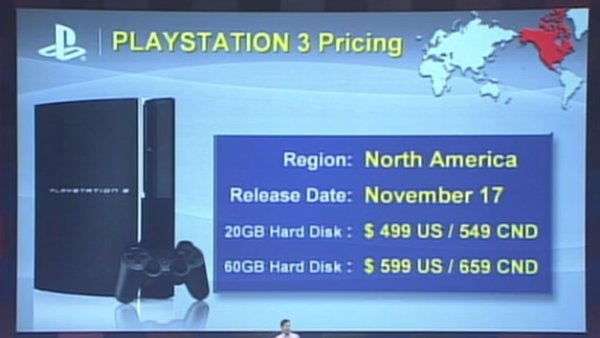
Instead of walking back their overzealous claims and putting more focus on games, they instead doubled down on the techno-jargon and put out countless underwhelming. "Ridge Racer" and "Giant Enemy Crab" were already bad enough, but the PlayStation 3's fate was sealed when Kaz Hirai took to the stage and announced the infamous "$599 US dollar" price tag.
Thanks to their intensive focus on technology that was difficult to develop for, a lack of exclusive games and little emphasis on competing with Xbox Live, Sony had branded themselves as a corporation hungry for the cash of their most loyal fans. The system would arrive later that year on November 17th 2006 in the US, already lagging behind the competition.
The Laughing Stock Of The Industry
Overblown promises mean little as opposed to proper games and Sony learned that first-hand as the Xbox 360 and Nintendo Wii powered ahead in both sales and critical reception.
The former head a year's head-start alongside Gears of War and Halo 3 to tide players over, while the latter was able to outsell both competitors in its launch period. Meanwhile the PS3 trudged along, managing three million units sold by the end of 2006.
The poor critical reception came at a bad time for Sony, as user-generated content on the internet exploded from 2006 onwards. Many took to forums or made videos mocking the PlayStation 3's weak offering. Outside of the ability to play Blu-ray discs and its free online service, the console didn't have a lot going for it and Sony didn't do much to assuage gamers who were on the fence about making a purchase.
It also didn't help that the few exclusives the PlayStation 3 did have weren't making much of an impression. Genji 2: Days of the Blade, Ridge Racer 7, The Eye of Judgement and Lair all failed to catch on in the early stages of the system's life-cycle.
In both the production and initial release periods, Sony had no killer app with which to sell its product. Sure, the likes of Warhawk, Ratchet and Clank: Tools of Destruction and Uncharted: Drake's Fortune did make an impact, but none of these reached "must-own" status.
The Turnaround Begins

Knowing they had to make back the cost of making the expensive system, Sony began damage control in 2007. They announced cheaper models of the PlayStation 3 while also cutting the price of the base 60GB model by one-hundred dollars. It was a step in the right direction as they continued to add to the PlayStation Network and secure greater support from its development base. Notably E3 2007 saw Sony abandon much of the technical details and put the focus back on games.
It took time to regain the trust of consumers, but it started slowly but surely. Once 2008 rolled around, the big-name titles were finally starting to come to fruition. It was certainly a case of better late than never.
In June, the highly anticipated Metal Gear Solid 4: Guns of the Patriots finally arrived after five years of development. As a title that could only be accomplished on the PS3, it was a massive helping hand and showcase for the system. Many of its copies sold one-to-one with console purchases.
This much-needed success was further assisted by Media Molecule's LittleBigPlanet and Resistance 2 from Insomniac Games. With high critical recognition from both reviewers and the masses, the PlayStation 3 began to gain momentum. A trinity of quality titles would become an approach Sony would adopt in the years to come.
Big-Name Exclusives Arrive

2009 would be the year Sony pulled the PlayStation 3 pulled itself of its dark age, proving itself a major competitor in the seventh generation. With system adoption having increased to over ten million units at the end of 2008, it was time to land the heavy hitters. Luckily, the likes of Guerilla Games, Sucker Punch Productions and Naughty Dog were on hand to make the system's best year yet.
The PS3's third year kicked off with Killzone 2, a phenomenal shooter that overcome its initial disappointments to create a rousing sequel.
With this title, Sony now had its own first-party FPS franchise to compete with Halo. Around halfway through the year, this was followed up by InFamous, a standout franchise debut with explosive third-person combat. Last, but not least; Uncharcted 2: Among Thieves delivered the system's biggest and best killer-app. All three titles could only be played on Sony hardware and drastically upped the sales figures.
In addition to this, the PlayStation Network had also expanded and Sony was repairing its fraught relations with other third-party dev teams. One key moment was when Valve's Gabe Newell took the stage at Sony's E3 presser in 2010 to announce Portal 2.
While there was no chance of catching up to the Nintendo Wii, it was a dramatic turn-around. From here Sony would continue to rise in both critical and commercial success. In 2010, this continued with the likes of God of War 3, Heavy Rain and MAG: Massive Action Game.
These releases, despite arriving to different receptions, continued the PS3's ascent.
Maintaining The Momentum

In doing so, the overall reputation of the PlayStation 3 among the masses began to massively improve. Once the system moved past the initial ridicule it had received in the first three years. The focus on continuing franchises guided Sony through 2011 and 2012 as Killzone 3, Uncharted 3, Resistance 3, Starhawk and Twisted Metal all succeeded in tiding players over.
All was not perfect however; the PlayStation Network hack in April 2011 was a critical blow that seriously damaged both consumer and corporate trust in the brand. With over 77 million console owners and their details compromised, it stands as one of the biggest consumer tech breaches in history. Sony issued a solemn apology and got a lid on the situation, offering two free games to players as a consolation. Had the hack been worse, it would have surely torpedoed their rising momentum.
The arrival and subsequent abandonment of PlayStation Move didn't help either. In a bid to compete with the Nintendo Wii's continued success in motion controls, Sony put their own spin on it and released their own motion controlled peripheral.
At best, it could be viewed as an improvement on existing technology, but at worst it was viewed as a rip-off product that didn't offer much beyond the competition. Thankfully, Sony wasn't shoving the device down player's throats like Microsoft with the Kinect, but that's a tale for another time.
Pulling Ahead In The Final Stretch

When it came to the final years of the PlayStation 3, it was a case of rounding off the seventh generation with a strong line-up while avoiding any issues that could break the trust of consumers. It came down to three major titles to accomplish this; Gran Turismo 6, Beyond: Two Souls and The Last of Us.
The first two of these achieved recognition in their own right, but it was Naughty Dog's magnum opus that delivered the most exceptional send-off the PS3 could have hoped for. Naughty Dog's tale of Joel and Ellie trekking across a ruined post-apocalyptic United States was a smash hit both critically and commercially. Just as Uncharted 2 had persuaded gamers to run out and buy the console, The Last of Us assured them beyond a shadow of a doubt that Sony was now worth sticking with.
Sliding into the best-selling games on the PS3, The Last of Us was a major propellant that allowed Sony to finally overtake Microsoft in the generation's home stretch. With the eighth generation of consoles on the horizon, the console had pushed beyond 80 million units sold by October 2013.
As the Xbox 360's line-up of exclusives started to fizzle out, the PlayStation 3 remained firmly committed to its first-party titles, a trend they have carried through to this day.
The PlayStation 3 In Review

The final success of the PlayStation 3 has since carried through into its successor; Sony learned thoroughly from all of its mistakes in the seventh generation and was able to put themselves back on top of console gaming with the PlayStation 4. To date, that system has sold over 106 million units and on top of that, its creator has established a consistent approach towards producing cinematic, story-driven games.
It's quite the redemption arc to look back on in retrospect. With this identity etched in the minds of millions, the recently released PlayStation 5 has a clear route ahead to further success. Whether or not it will achieve this while competing with the Xbox Series X and Nintendo Switch is anyone's guess. The ever-changing landscapes of gaming may require them to broaden their exclusive line-up as we enter the ninth generation.
To cover each of the big three gaming giants equally, we'll be looking at the dark age of Xbox next week. See you there...