Why Arthur Morgan Is The Best Video Game Protagonist Of The Generation
Rockstar wrote a great character, but it's the players who turned him into an icon.

The PS4 and Xbox One era will be remembered as the time where video game protagonists finally grew up. From established icons like Nathan Drake and B.J. Blazkowicz, to brand new characters like Celeste's Madeline or Horizon's Aloy, gaming heroes are still larger-than-life badasses, but now between beheadings they wrangle with real human emotions as well. Sure, this started at the tail-end of the last-gen with games like The Last of Us and Spec Ops: The Line, whose complex characters made the meathead space marines of yore look cartoonish in comparison, but this practice was really popularised from 2013 onwards.
What makes that trend even more fascinating though, is how the changes in the industry during this period seemed to indicate a move away form authored protagonists. The current generation - broadly speaking - has been defined by "player choice". From the push towards open-world sandboxes to the increase in live services and shared-world shooters, the focus has been more on the people playing the games, rather than the people they're controlling. Yeah, they might not all be mute protagonists or blank avatars, but in one form or another, they're intentionally made to be an extension of the player first and foremost. Obviously, there have been exceptions, and Sony in particular have doubled down on exploring their characters without this element of freedom, but there has been a notable push towards open ended, player-driven sandboxes from the major publishers.
That's not necessarily a bad thing, and releases on both sides have birthed great characters. Avatars for player expression like Morgan Yu have been just as compelling as headliners like Kratos, but out of all the memorable heroes and anti-heroes to grace consoles over the past five years, it's Red Dead Redemption 2's Arthur Morgan who's been the most important, particularly because of how he synergises both of the industry's currently in-vogue approaches to constructing main characters.
6. Writing, Story And Acting
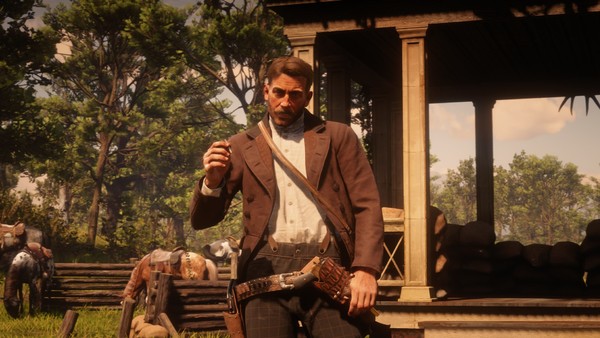
In the run up to the game's release, there was the worry that Arthur was going to be the most bland character out of Dutch's gang. Was he just going to be yet another grizzled, square-jawed white dude in a sea of grizzled, square-jawed white dudes? Was he just going to be yet another extension of the player that passively takes in the stories of the people around him? To an extent, both of those assumptions indeed came true, but immediately Arthur is far more compelling than the boxes he falls into.
His journey and redemption is superbly written, with the character himself thematically embodying the dying embers of the Old West, and a way of living that's no longer compatible in the new world. It's clear he wants elements of a normal life - stability, family, love - but the only thing he's ever known is his gang, and the violent lifestyle they all lead. You get some of this characterisation through the cutscenes, and of course it's brought to life with such energy and nuance thanks to voice actor Roger Clark, but it's only by digging a little deeper that you get a full view of who Arthur is.
Arthur's journal is particularly helpful on this front. In fact, it's here where players get true, unfiltered insight into his thoughts and feelings. From a gameplay perspective, it's puzzling to section off so much of Arthur's character into a feature many people might not even check, but narratively it makes perfect sense. His role in the camp is a trustworthy pillar who gets s**t done; he's not necessarily concerned about himself, more so making sure the only family he's ever known is thriving and well. Not only that but he still feels indebted to Dutch (who's essentially a father figure to him) after all these years, and he wants to maintain the image of the man everyone views him as. Like a lot of manly men action heroes, he's not all that keen on getting into long chats about his feelings. He's there to do his job and not complain, and it's a role he's perfected.
Unlike in cutscenes or dialogue with other characters then, in his journal, Arthur is free to be as vulnerable and as honest as he wants. Conundrums and personal failings he'd never dream about sharing are lamented over in this prose, and you get to understand the complex human behind the cliched gunslinger exterior. For instance, where he doesn't outwardly speak about his feelings after Mary leaves him for good in-game, they're laid bare in the journal, as he questions his foolishness over ever thinking he could have a "normal" life with her, all the while pondering whether he really is the ruthless criminal he's painted as.
You'd never get this added layer if you didn't regularly investigate the journal, but that makes total sense, because it's not something he'd be comfortable talking about with anyone else. The very fact that this characterisation is locked away in a book is a decision that, in itself, leads to a deeper understanding of Arthur's character.
5. The Different Faces Of Arthur Morgan

However, it's more than mere characterisation and story that makes him a protagonist of the generation contender though. In fact, plenty of heroes over the past few years have enjoyed even arguably stronger writing than Arthur. Instead, Rockstar's creation succeeds so much because of how the devs have used the unique features of games as a medium to further push the emotion of his story.
By slowing the title down so much and essentially forcing you to interact with the minutia of the world, Rockstar award both the player and the character with a sense of belonging. You spend as much time in Red Dead Redemption 2 hunting for your camp, talking to friends and strangers around campfires and satisfying core human needs as much as you do gunslinging, and that has a profound impact on how you contextualise and understand Arthur's actions.
Another important distinction is that, unlike other open world games where the end goal of a menial task is an in-game reward that will boost skills or unlock upgrades, the end goal of these actions in RDR 2 is always rooted in character, story and world. Hauling a bag from one part of the camp to the next, or spending five minutes monotonously chopping wood, doesn't have much of a systemic reward from a mechanical perspective (bar a slight boost in honour), yet you're invited to complete these actions because you're invested in his - and your - relationship with these camp mates. You want them to be happy.
Consequently, the way Rockstar slowly makes you a part of this world on your own accord through these player-driven interactions, combined with the strong characterisation the developers have included, often makes you think about what Arthur Morgan would do when you're given free reign over decisions in gameplay.
For instance, when you're going to meet love interest Mary for the first time, how will you dress? Well, my Arthur would definitely want to spruce himself up, maybe get a shave and a sick new faded haircut, dust off that posh coat, make it look like he'd tried, but not to the point where it's obvious. Others, on the other hand, might be content to rock up stinking and with a full, unwashed beard, with the idea that she can take him as is. This is just a tiny moment in theory, but RDR 2 is full of little personalisation touches like this, and it's during these moments of player choice where Arthur subtly stops being a character authored by the writers at Rockstar, but one they're co-authoring with you as well.
4. Player Choice Vs. The Intended Path
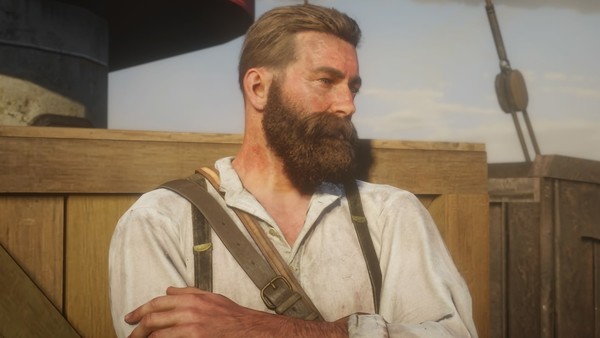
This approach is what leaves Arthur's character feeling so personal and unique to the player despite him following a near-universal authored path through the main story, with only a couple of narrative variations here and there. The incremental way RDR 2 is intended to be played means the experience of living in this world is different for just about every player. Nobody will look the same, nobody will choose to help/not help the same strangers, and nobody will interact with the camp members outside of cutscenes in exactly the same way either.
Though these little gameplay choices might not have the huge narrative ramifications players are used to in role-playing titles - suiting up in Saint Denis to blend in isn't on the same level as, say, saving Ashley or Kaiden in Mass Effect - in a way, they're just as significant. As exciting as it is to make grand story decisions, every outcome is still rigidly controlled by the writers and developers, and will be similar to someone else playing the game. The small choices in Red Dead 2 on the other hand, while lacking major narrative stakes (until the end, anyway), are there specifically to further synergise the experience of both Arthur and the player.
It's not just that customisation options in the game are bloody good, but that they all impact each player's individual understanding of who their Arthur is. There's a reason why, when you see the character in someone else's gameplay footage, he might as well be an alien. Despite starting off the same, each Morgan becomes your own despite, from a narrative perspective anyway, being no different from the million others out there. All of these versions are still Arthur, but they're not your Arthur.
As a result of this, you're encouraged to filter what you think Arthur as you know him would do in any given situation. In this sense, the story beats maintain the same authored finesse as a God of War, while the experience of being Arthur is unique to the individual player and how they've interpreted who he is.
3. The Life Of An Outlaw
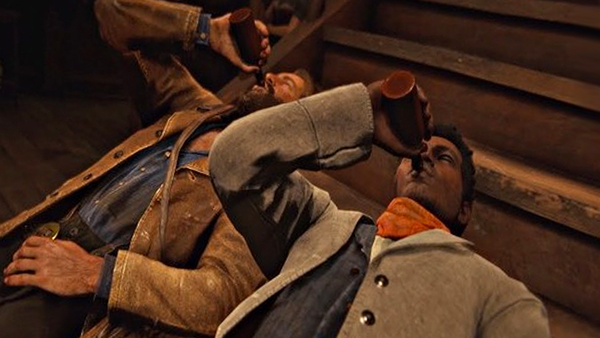
From the big to the small, you're always motivated to do something in RDR2 because Arthur is, but the game plays on this connection between player and character in some pretty unusual ways. It's established early that Morgan, while an outlaw, has a moral code. He doesn't enjoy killing for the sake of it, and while he might have a warped definition of who deserves to be murdered, his discomfort with needless violence is reinforced in the first hour by his reaction to Dutch needlessly killing a bystander during the botched Blackwater job. Likewise, it's revealed he loathes the work campmate Strauss partakes in, selling loans to the impoverished and then bullying them into paying them back. Still, that belief doesn't stop him - or the player - from helping Strauss out in quests for the benefit of the camp.
Unlike the other missions though, where blowing the faces off goons with shotguns comes with a sense of satisfaction, the violence is far uglier despite being far tamer. You're essentially just beating people up, but the power dynamics make it clear there's no glory in it. The only real crime the people you're bullying committed was giving in to desperation in order to provide for themselves or their families. Consequently, you wailing on them, in some cases in front of said families, feels... wrong. There's an incongruity between your actions and what both you morally feel about the situation. In one of the first missions, Red Dead Redemption 2 gets you thinking about the consequences of the violence you're inflicting as Arthur, a theme that becomes the entire focus of the story in the final chapters.
However, it takes a while to get there to that point, and your connection to this character, for potentially tens of hours, is built around the freedom of this outlaw way of life. At every turn you're encouraged to do whatever's necessary to make money and contribute to the camp. Hold up this settler, rob this farmer, bring in these bounties. Most crimes seem like fair game, and Arthur is the best in the business when it comes to completing these tasks. It's all justifiable because it's not needless - everything benefits either Morgan himself or the camp.
2. Arthur And The Player's Redemption

This dissonance felt in those Strauss missions, between the player's actions and the character's personality, only comes into full view following Arthur's TB diagnosis. It's at this point, with inevitable, tragic death staring him in the face, that the character comes to analyse just what his way of life has achieved. The only family he's ever known are crumbling around him, and the people he's spent the entire game, and in the narrative his entire life, protecting don't return the favour. At one point, Dutch even leaves him to die.
It's here where the titular redemption kicks in, but skilfully Rockstar makes it not only a redemption for the character, but the player as well. Where once the violence of the Old West had meaning, and was justifiable because of how it allowed you and the camp to prosper, it's now just violence for violence's sake. The justifiable context you were once operating in has vanished, and despite nothing mechanically changing, there's no incentive to continue playing as you were.
In the narrative, Arthur's actions change, and he starts to make amends for his past mistakes, uses his blood money to help others, and becomes hellbent on getting John and his family to safety before the whole thing implodes. But the game also encourages you to support these story developments through gameplay, and the way you interact with the systems in place. It no longer feels right to continue indulging in the bloodshed. Money becomes pointless; Arthur can't take it with him when he dies, so you're encouraged to be charitable when the option arises.
For many of us, the implications of the diagnosis completely sucked the fun out of some of the game's core mechanics and gameplay loops that had been drilled into us for a hundred hours, but that's the point. From here on out, the violence is supposed to feel as empty and meaningless as it does in many other games, inspiring a change in how you interact with the mechanics to find satisfaction another way.
I can't say whether sacrificing the fun in this final stretch makes RDR2 a better game, but it does do wonders to further that connection between Arthur and the player, and ultimately make his redemption more directly compelling, as you're encouraged to change just as much as he is.
1. Conclusion

Like God of War before it, and Spec Ops: The Line even before that, this final act also works as a wider commentary on video game violence in general, and the industry's continuing reckoning with its own history. Like Arthur does in the game, players are starting to think about the way violence is portrayed and contextualised in this medium. That's not to say games can't be violent, more that there's so much dramatic material to be gained from using the player's interaction with said violence to tell a story or explore character.
That's just the added metatextual cherry on top of the lush cake that is Arthur Morgan, though. While you might enjoy other heroes more, Arthur is the only one that's really synergised the two main approaches to protagonists we've seen this generation. He embodies the very best aspects of player-driven avatars found in this gen's role-playing and open-world games, making the personal expression of the people controlling him part of his story. But that's only so resonant because of how much it's informed by the strong characterisation Rockstar drive home in the writing and cutscenes.
Through him, Rockstar have delivered an authored experience that's still deeply personal and built around the actions of the player, with his arc reflected in how you're actively encouraged to control him, as opposed to just passively watching it play out in a cutscene. There have been countless amazing characters that've graced consoles since 2013, but none embody the trends and philosophies of the generation quite like Arthur Morgan.