Why Dragon Age Is Secretly Better Than Mass Effect
Two fantastic RPGs, but Dragon Age deserves more love.

Founded back in 1995, Canadian development team BioWare were quick to distinguish themselves as giants in the gaming industry, with early hits Baldur’s Gate and Star Wars: Knights Of The Old Republic showcasing their knack for crafting engaging narratives within grand environments.
While both titles received vast amounts of praise, it wasn’t until the studio bestowed upon us Mass Effect and Dragon Age: Origins in 2007 and 2009 respectively where they demonstrated their full creative might, cementing themselves as masters of the RPG genre.
Earning the admiration from both critics and players alike alongside winning numerous awards and commendations, these franchises have seen themselves reach the pinnacle of the RPG genre.
Engaging plots driven by meaningful choices, detailed worlds founded upon rich lore, and a gallery of well-written companions to interact with on your epic journeys, it’s easy to see how the BioWare name has earned its prestige over the years – even if their more recent releases haven’t been able to reach the same heights.
Both franchises are outstanding achievements in storytelling and game design in their own rights. But, if we had to choose between one or the other for which reigns supreme, our choice needs to be Dragon Age. And we have a good reason for this.
Science Fiction Versus Fantasy

At first glance the main difference that appears to distinguish these landmark titles is their respective genres: science fiction for Mass Effect and fantasy for Dragon Age. And – on the surface at least – this distinction opens vastly different worlds to players.
In Mass Effect, players are whisked into a technologically advanced future in which humans have cracked interstellar travel and are able to forge relationships with different extra-terrestrial species across the galaxy. Dragon Age, on the other hand, transports us to the fantastical lands of Thedas where magic, fantastical creatures, and (of course) dragons exist.
Swapping Mass Effect’s futuristic technology for medieval weaponry and spells, Dragon Age is by and large your typical epic fantasy experience as much as Mass Effect embodies what you’d expect from a spectacular sci-fi saga.
Of course, there is an element of personal preference when it comes to these settings. If you’ve never been able to buy into mythical worlds of magic and fantasy creatures, then Dragon Age isn’t going to win you over. And, likewise, if sci-fi isn’t to your tastes Mass Effect won’t change your mind either.
In fact, both franchises play so much into their genre’s tried and tested tropes that it could be a crucial factor in your enjoyment.
Mass Effect: A Serviceable Shooter
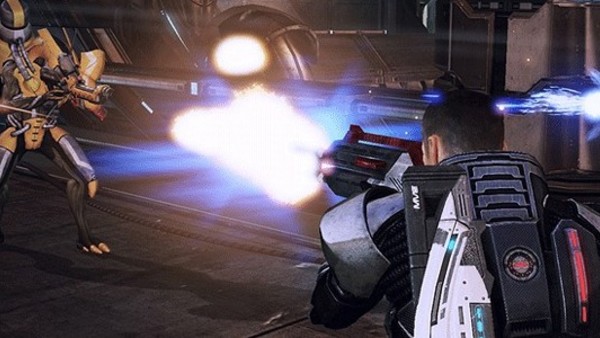
On closer inspection, the differences go deeper than simply sci-fi versus fantasy. Underneath the aesthetics of their chosen genres, both franchises also play rather differently from one another too. Namely, how each game utilises combat drastically alters how they’re played.
Mass Effect’s combat plays more like your conventional third-person shooter. You duck in and out of cover while using a selection of weapons and gadgets to take out the enemies in your way. Over the course of the trilogy (and Andromeda), the combat became more fast-paced and fluid.
Likewise, weapon upgrades, party abilities, and character classes give combat a good amount of depth and customisation, subsequently allowing you to play your Shepard how you like.
Although combat lacked the punch and polish of other contemporary third-person shooters (both the Gears Of War and Dead Space series released around the same time as Mass Effect, for example), the sci-fi saga nevertheless injected exhilarating action to punctuate its dramatic narrative.
However, Mass Effect’s combat paled in comparison to what Dragon Age offered its players.
Dragon Age: In-Depth Strategy
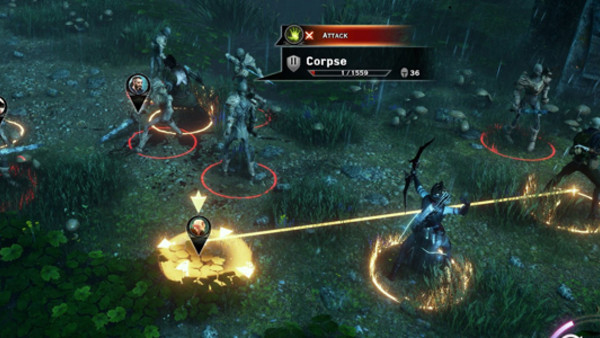
Dragon Age, on the other hand, offers a radically different approach to combat. Swapping cover-based shooting with a more strategic approach, this fantastical RPG series lets players pause combat scenarios at any given point to switch to a tactical view.
This enables you to micromanage each member of your party by telling them where to go and what to do, giving you full control over how battles are handled. Whether it’s setting traps, executing perfectly timed ability combos to maximise their effects, or strategically positioning your team, you have the freedom to control the battlefield,
Even if you choose to play out combat encounters in real time you still have the option to switch between party members and issue commands to them on the fly. Moreover, the game lets you tweak the behaviour of individual characters to determine how they would act in certain situations.
Comparatively, Mass Effect’s combat lacks the depth of BioWare’s other series. While you can choose equipment for your party members and give them basic commands during gunfights, not being able to alter their behaviour on top of leaving out a tactical camera entirely leaves the action feeling hollow in contrast.
Mass Effect: Telling An Intimate Narrative
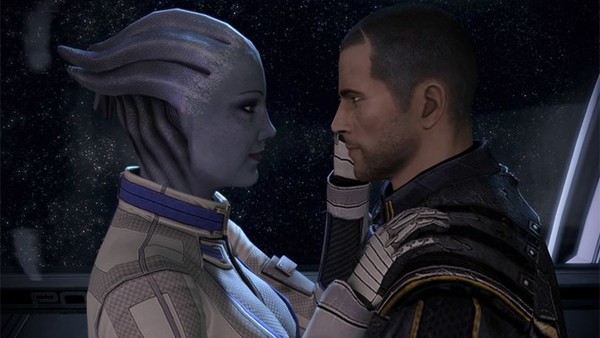
Despite this, though, there’s an even bigger distinction between these titles that gives Dragon Age a significant edge against Mass Effect. Whereas the latter tells one contained narrative spanning an entire trilogy, the former tells multiple tales, each as epic as the last. Consequently, the realms of Thedas make for a richer and more interesting place than Mass Effect’s futuristic Milky Way.
This is not to dismiss Commander Shepard’s interstellar saga entirely. In fact, playing as the same protagonist throughout the span of three massive games is an arguably more intimate experience. Especially if you play each entry chronologically by carrying over your saved data from the previous game, the series is a continuation of your adventure.
Each difficult choice you’ve had to make, all the relationships you’ve forged through dozens of hours with your companions, everything that you’ve been through has all been part of your Shepard’s quest to save the galaxy.
All you need to do is look at the impact of Mass Effect 2’s suicide mission to see the emotionally devastating impact your choices can have.
Dragon Age: There's More Than Just One Hero

In Dragon Age there isn’t just one hero: there are multiple, each leaving their own mark on the franchise as they carve their own legends and build upon the overarching lore.
Origins saw us as a newly enlisted Grey Wardens tasked with recruiting an army from across the kingdom of Ferelden to stop a powerful demon from unleashing a blight upon the land. In the sequel, players take on the new roll of Hawke as they gradually become embroiled in the ensuing political chaos in the city of Kirkwall. And in Inquisition, players were The Inquisitor, the unexpecting leader of the eponymous sect who must forge alliances to unite the lands of Thedas to oppose an all-powerful entity.
Though each title tells its own isolated story of heroism that newcomers can dip into in any order they like, the series is nevertheless connected by lore that reaches across the trilogy. Each subsequent instalment is chronological and any choices that effect the state of Thedas will, should you choose, continue to impact the subsequent game.
Recurring faces like Varric, Leliana, and Morrigan likewise give the series some continuity whilst the inclusion of new companions and characters further add to the broad scope of the world.
Thedas Is Surprisingly Bigger Than The Milky Way

The sheer scale of Dragon Age’s world is also reflected in its level design. Huge sprawling maps are filled with new areas to discover, lore to uncover, and side quests to complete. The more linear design of Mass Effect has the opposite effect. Despite having an entire galaxy as your playground, the scale of Mass Effect’s world feels a lot smaller than Thedas in comparison.
Additionally, it isn’t just the quantity of heroes that makes Dragon Age bigger, but also the extent at which the series allows players to customise them. There isn’t just one version of Origin’s Warden, for example. Depending on which race and background you choose, your Warden will have a completely different origin story than another and will also be viewed differently by the other characters you’ll meet.
While there’s some flexibility in how you can play your version of Shepard, the options offered to Dragon Age players during character creation adds yet another layer to the staggering worldbuilding on display than gender and dialogue choices could ever accomplish.
Sometimes Bigger Really Is Better

The Mass Effect trilogy tells an epic sci-fi adventure fronted by a cast of memorable and beloved characters. By spanning one spectacular and hard-hitting story over the course of one continuous trilogy where your choices carry over, the experience is an immensely intimate one.
In comparison to Dragon Age, though, Mass Effect is simply too contained to compete with the sheer scale offered by BioWare’s other RPG franchise.
Although Dragon Age doesn’t allow players the opportunity to establish the same connection with their trio of protagonists to the same extent as they could with Commander Shepard, the amount of world-building and intrigue that’s formed as a result is more than worth the trade-off.
From the depth of its combat system to the incredibly detailed lore that each entry builds upon, not being tied to one character’s story opens the lands of Thedas to endless possibilities helmed by their own heroes.
With BioWare announcing new instalments in both Mass Effect and Dragon Age, we have another opportunity to dive back into Thedas for what is surely set to be another epic fantasy adventure.
Meanwhile we're similarly left waiting to see how - we assume - Shepard’s story will continue. Hopefully the next Mass Effect will broaden the series’ horizons a little more this time around.