Why Final Fantasy 7 Remake’s Controversial Ending Is GENIUS
The secret meaning behind THAT cryptic message.

"We have to meet people's expectations, give them what they want to see, but we have to go beyond that and give them new surprises as well [...] We had to go further and provide a new experience." - Yoshinori Kitase, FF7 Remake Producer.
- Full game spoilers within -
Well, after more than 20 years of discussing remakes, re-imaginings and recreations of the legendary Final Fantasy VII, Square Enix dropped the first part of their "FF7 remake project" in April 2020, and the response has been phenomenally positive.
Positive that is, until you get to the ending.
While I'm personally a huge fan of what's been changed and overhauled, the fandom is notably fractured, and it centres around what goes down in the closing 40-ish minutes of the story.
Here, we discover that the "Whispers" (ghostly apparitions that appear across the campaign) are essentially a manifestation of destiny itself.
Stray out of line, get killed when you're not supposed to and the Whispers will appear to set things straight. Jessie going on the second reactor mission instead of Cloud, Barret being killed by Sephiroth, Aerith almost falling to Reno's grasp - the Whispers prevent it all.
It's a way for the new FF7 Remake to address events from the original game - not to mention factor these "rules" into the new story.

However, after this information comes out and the gang are leaving Midgar, both Aerith and Sephiroth open portals directly "into" destiny itself (targeting masses of the Whispers that Sephiroth has managed to control), and all hell breaks loose.
After defeating destiny, we now have a story where the characters KNOW what's expected of them, have visions of the "future" (scenes from the original game's post-Midgar story), and are literally conquering their own fates to create a new path.
Obviously this works in regards to not knowing what the next FF7R game will be like, but even crazier, Sephiroth and Aerith KNEW it was all going to happen.
Final Fantasy VII "Remake" is actually more of a sequel, and I can explain.
3. Sephiroth Knows What Happened In The Original Game

The absolute key thing to focus on - and what gives the game away - is Sephiroth mentioning to Cloud that he has "7 seconds until the end" in their final scene together, saying it's "time enough for you, perhaps", and asking "what will you do with it?"
While sounding mighty cryptic, seven seconds is the exact amount of time it takes Sephiroth to descend from the sky and kill Aerith in the original game.
Right here, Sephiroth is showing knowledge of what went before, and hinting pretty obviously that when the time comes for Cloud to make the save, it's going to be a do-over.
Will FF7R's future instalments give us a direct choice on saving Aerith? Perhaps. But what if Tifa, Barret or someone else has to be killed instead?
The party certainly defied fate and destiny by defeating the Whisper Harbinger and its three minions (more on them later), but what happens next?
After Harbinger goes down, Sephiroth still states "not now" when Cloud gains the upper hand during the "Edge of Creation" fight, further implying he knows how things have to go. Whilst I'll get to Aerith's role in this new version of the timeline next, it seems Sephiroth is yet to fully play his hand.
Whatever happens, Sephiroth is untethered from the events that lead to his death in the original game, and he is more than aware of them.
In many ways, this makes him an even more fearsome villain.
2. Aerith's Role

Onto Aerith, and the opposing cosmic force to this dark "weaponisation" of destiny.
Where Sephiroth appears to be in control of the Whispers to some degree (he fires them at the gang in the final duel), Aerith refers to the idea of challenging Harbinger as "boundless, terrifying freedom".
It seems that although Aerith knew how events would play out (which I'll get to), her mood and tone noticeably drops before fighting the Whispers, and it's likely because she doesn't know what happens next.
Until this moment, Aerith almost "shows off" with how much she knows about the path the gang are on. In Chapter 2 she notes the flower given to Cloud symbolises "when lovers are reunited". In Chapter 12 she cuts off Tifa and offers to save Marlene, despite not knowing who Marlene is. This leads to a scene where a crying Marlene is calmed by a vision triggered from hugging Aerith, to which Aerith puts a finger to her lips and the pair walk away.
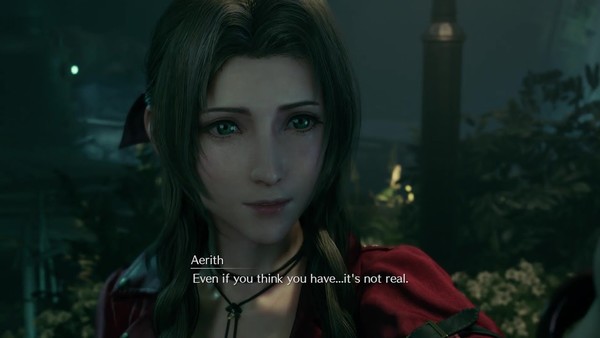
After all this, in Chapter 14, Aerith tells Cloud not to fall in love with her, saying it wouldn't be "real", but also thanking him for all the memories he's given her. Whilst the pair have only known each other for a couple of days, this too feels like a reference to how much time they've spent together across the original game.
I could go on as almost every line from Aerith references her wider role. There's mention of "straying from the path" and how "the future is not set in stone", culminating in declaring that Sephiroth is "wrong" when seeing him at the end of the game.
This "wrongness" feels like the very existence of Sephiroth after his previous defeat - that he's found a way to wield time and space, and that itself is unnatural (something Aerith, a manifestation of the lifestream, would oppose).
Final Fantasy VII Remake is more about the battle of Aerith and Sephiroth, almost on a cosmological level - than the direct clash between Cloud and Sephiroth.
The last piece of the puzzle though? Confirming that we're dealing with multiple timelines at once.
1. How Multiple Timelines Converge
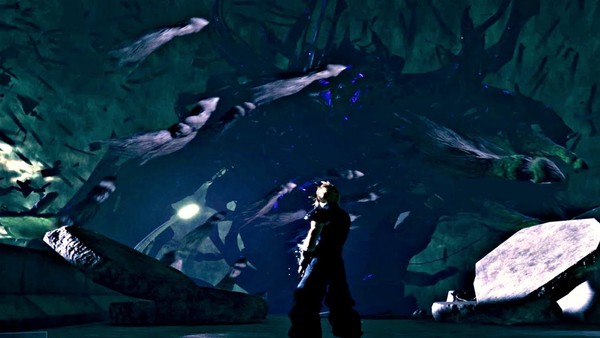
To get this information you'll need to equip the Assess materia in the Harbinger fight, and use it both on the main villain, Whisper Harbinger, and its three minions, Croceo, Rubrum and Viridi.
For Whisper Harbinger, the game describes it as "An accretion of Whispers, the so-called arbiters of fate. The creatures appear when someone tries to alter destiny's course. They are connected to all threads of time and space that shape the planet's fate."
That "someone" is clearly Sephiroth, and his meddling with the natural order of things has triggered all of this in the first place.
As if it wasn't plain enough that defeating this entity frees up the rules of time and space, Whispers Croceo, Rubrum and Viridi are described as "entities from a future timeline that has manifested in the present day", with each one "protecting the future that gave shape to it".
Things get even more insane, as we then get footage of Zack Fair surviving the attack that killed him, meaning that Cloud never took his identity.
Zack is shown looking over a Whisper-covered Midgar, further implying that literally anything goes, as the entities in charge of destiny and fate have been defeated. We know this too is in another timeline, as the breed of dog for "Stamp" (Shinra's cartoonish mascot) is a different breed entirely.

After, the gang resolve to track down this now time and space-bending version of Sephiroth, but it's worth taking away that ultimately, expectations have been reset as to what happens next.
We now have a collection of characters that have fought supernatural entities, being rewarded with knowledge of their own pasts and futures. Multiple timelines seem to be progressing simultaneously, and for all the times Aerith avoids answering questions as to what's going on - shaking her head when asked "where are we?" in the final scene - ALL of that will no doubt unfold.
Is it a blessing or a curse to know when you're going to die, and how? This is what Aerith grappled with in the original game, and bringing it to the front of the Remake is a stroke of genius.