World Of Warcraft Classic: 10 Reasons Why J. Allen Brack Was Right
"You think you do, but you don't"

At Blizzcon 2013, the then Executive Producer for World of Warcraft, J. Allen Brack, infamously responded to a fan's question regarding the widespread appeal for legacy servers with "you think you do, but you don't".
Brack was proven just how wrong he was when the WoW player base more than doubled its size at the launch of Classic WoW and the game remained on the number one spot on Twitch for several weeks. But is Classic WoW really all that we had hoped it would be?
For many of us, WoW was our first ever MMORPG and the magic of Classic, as I remember it, was the mystery and sense of wonder that it instilled in the player. Back then, Azeroth was as of yet a world unexplored, vast and teeming with possibility. The mountains of Dun Morogh were tall and the jungles of Stranglethorn Vale dense, and the forbidding peak of Blackrock Mountain was only seen from afar, out of reach, its pathways unwalked and its secrets withheld.
Despite being the same game, the experience that Classic WoW offers is very different from the one that we once knew and fell in love with 15 years ago. In this article, we look at just how different it is.
10. A Polarized Community

The realization of Classic WoW was first and foremost an achievement of the fans and yet instead of bringing the community together, it acted to divide it in two.
On one side you had players of the current version of the game and on the other you had veterans who had either stopped playing or played on private servers which still supported WoW in its 'vanilla' state. Each party, of course, had their own demands.
The private server community was of the mind of keeping the game exactly as it was back in 2004. Referred to as 'purists', they authored many a 'no change' thread on the WoW forums and were regarded as the stiff-necked greybeards who were stuck in their old ways.
The retail players or young whippersnappers pushed for what was termed as 'quality-of-life changes', which they argued would improve the game while not directly affecting its gameplay. These included the ability to change your name, race, and server and even use modern-day graphics in the old world.
You can probably guess where all this went and the two communities continued to butt heads all the way up until launch and beyond.
9. Queue Times

The queue times were enormous and showed no signs of decreasing weeks after launch, so much so that you would spend more time stuck in queue than actually playing the game.
It was so bad that my friends had to use an application called TeamViewer, which would allow them to log into WoW remotely from work just so that they would have a chance of playing when they got home in the evening. Due to connectivity issues, however, this was not a reliable solution and a couple of them had to resort to waking up at 4:00am just to avoid the queue altogether.
Once you were in-game, you were still not safe. A prolonged trip to the toilet could result in you getting booted from the game for being AFK and put you right at the back of the queue. Various creative methods were developed by players to combat this issue like making their character auto-run into a wall or constantly jump on the spot, all of which were promptly hotfixed by Blizzard.
8. Layer Switching

Sharding or layering is when, due to the overcrowding of an area, a copy is created of said area and players are transported there instead to reduce the stress on the server. Layering, while a necessary evil in Classic WoW due to the large server populations, shattered the impression of an open immersive world, which is what gave the game its magic.
Layer switching quickly became an accepted norm among players. For those unfamiliar with the term, layer switching is when, as the name implies, a player switches layers depending on their needs. For example, if the mobs that they need to kill for a quest are all dead on one layer, they can switch to another where they are still alive.
This is done by having someone on another layer invite them to their party. As a result, guild chat just became a place to make 'layer me' requests.
7. Dungeon Abuse

In Preach's highly viewed video 'The Problem in the Mists (of Pandaria)', in which he addressed certain concerns that he had with WoW and its trajectory in 2012, he makes a point of how the game used to place more value on the journey than on the journey's end.
At the release of Classic WoW, however, it was evident that many of the players did not share the same value. The journey from level 1 to 60 was meant to be a long and epic one. However, players seemed more concerned with reaching the level cap as fast as possible than with re-experiencing the old content again.
Dungeons were abused, so much so that Blizzard had to hotfix them in ways that they never had to back in 2004.
For example, in Blackrock Depths, players would stand outside The Lyceum, which was a hall in which there were countless mobs that would respawn quickly. A warlock would use 'Eye of Kilrogg', an ability that summons a floating eye which the player can control for a short amount of time. Using the eye, they would aggro a bunch of mobs and easily dispatch of them with crowd control and AoE spells before rinsing and repeating.
By doing this, players would level much faster than usual and in the end, Blizzard had to nerf the mobs so that they would no longer give experience.
6. World PvP

World PvP was remembered fondly with memories of epic battles between Southshore and Tarren Mill, stealthy skirmishes by small gank parties into enemy territory, and the constant fighting for control of Blackrock Mountain. The experience that we got in Classic WoW was not quite the same, however, and in the end players were crying out for battlegrounds.
While leveling, certain quests were nigh impossible to complete due to the sheer number of players from the enemy faction in the area who would kill you on sight; only by switching layers could you ever hope to make any progress. Zones like Stranglethorn Vale and Felwood were particularly grueling to get through.
Once you reached the level cap, the excitement of journeying to Blackrock Mountain to tackle those long-awaited end-game dungeons and raids was quickly curtailed by the fact that you would get ganked 10 times before you got there. The flight node of Morgan's Vigil was almost always controlled by the enemy faction with nary a friendly face in sight (except when you were dead and saw that there were 20 other poor souls just like you).
As an Alliance player, the moment my gyphon landed, death was certain and if I was lucky enough to escape, I would not make it far before getting one-shotted and having an orc perform the 'MC Hammer' dance on my corpse. It got to the point where my group members would even hold contests to see who would die the most before they reached the safety of the instance portal.
5. LFG

In Brack's aforementioned response, he reminded the WoW community about the time when they had to spam 'LF tank' in cities for hours on end just to form a group. This was easily brushed aside as a minor inconvenience and not a valid reason not to bring back Classic WoW. Come 2019, however, the reality of it was not so easy to digest.
It must be said that Blizzard's own solution to the problem, namely the cross-realm Dungeon Finder that was implemented in patch 3.3.0, posed problems of its own; it made the world a lot smaller by eliminating the need to travel to instances and took away the social aspect of dungeoneering since you would never see the players that you grouped with ever again.
But forming groups the old-fashioned way was no less painful than the now president of Blizzard took great pleasure in reminding us. During my time in Classic WoW, tanks were always in high demand, so much so that on several occasions each one of our group members would have to offer them a share of gold just so that they would come on the run with us.
Finding a tank for dungeons like Scholomance, which boasted few item drops for them, could even take longer than completing the instance itself.
4. Exploitation Of Game Mechanics
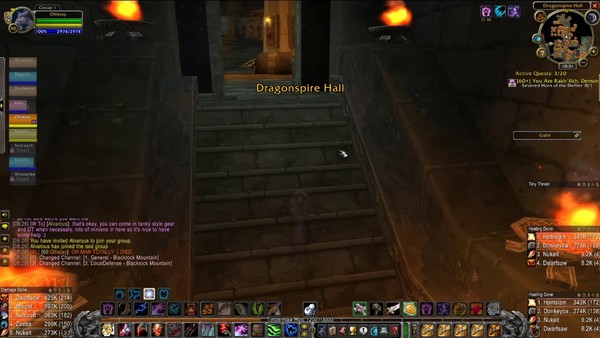
No one would run Upper Blackrock Spire (UBRS) unless they had a Jed ID. What is a Jed ID, you ask? Well, in WoW there are what are called rare spawns that, as one might guess, drop rarer items than usual. One such rare spawn can be found in UBRS, namely Jed Runewatcher, who drops a best-in-slot (RPG lingo for really, really good) healing trinket called Briarwood Reed.
Players, being what they are, had figured out that by creating a macro that could target Jed and entering the instance, they could find out whether he was there or not. In the latter's case, they would exit the instance, reset it and try again. Due to a restriction of 5 resets per hour, the duty of 'finding Jed' was shared among party members and once a player had found him, the party would be reformed with said player as its leader.
This rather laborious process could take more than an hour and parties would even disband if they were unsuccessful. Oh, and you would hope that after all that trouble, the boss battle would at least be somewhat climactic, but more often than not the unremarkable-looking orc would be dead even before you realized it.
3. Nerfed Content

When Classic WoW was announced, there was much dispute surrounding what patch the game was to be released on. In the end, Blizzard settled on patch 1.12, which was the last major patch before the launch of the game's first expansion: The Burning Crusade. This is important to note because in Classic WoW, we are effectively dropped into the final stages of a game that was in the process of closing an old chapter and opening a new one.
This meant that all the content had been nerfed in anticipation of Naxxramas, allowing players to catch up and attempt what would become the most notoriously difficult raid in WoW history. For players of Classic WoW today, this has dire implications, namely that raids like Molten Core and Blackwing Lair, which were challenging back in the day, are now a walk in the park. Indeed, the guild 'Salad Bakers' on Gehennas EU can speedrun Blackwing Lair in just 20 minutes.
2. Streamers
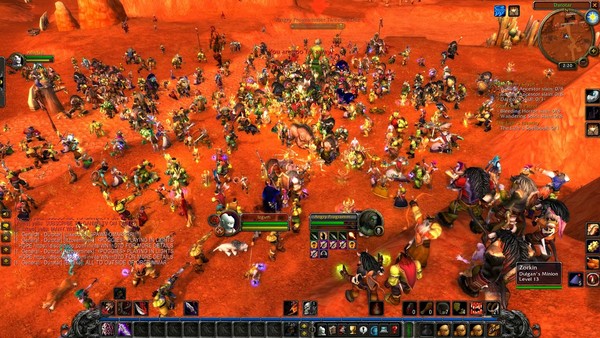
Streaming and the level of influence that it has nowadays was non-existent back when WoW was first released. Indeed, a large part of the reason why Classic WoW was even possible in the first place was due to streamers like Kungen, Esfand, Asmongold, and Sodappopin who voiced the pleas of the community.
There is, however, a lot of toxicity that surrounds streaming that affects both the everyday player and the streamers themselves. This includes stream sniping, DDoS attacks, hate spam, the mass gatherings of fanboys and their resultant server crashes. Server overpopulation and faction imbalance can also be by-products of the presence of a streamer on a server.
Let's just say that if you joined a server with a big name streamer on it, you were sure to know it, for better or worse.
1. An Already-Read Book
All of what I have just mentioned aside – the main problem with Classic WoW is that the players knew too much; they had the game down to a science and would min-max everything so as to progress in the most efficient way possible. But was that really what made WoW fun back in the day?
It seems to me that the players had lost sight of what really made Classic WoW special and had been on the gear treadmill for so long that they did not know how to enjoy the game in any other way.
The excitement of Classic WoW was much the same as that of reading a really good book for the first time. Not knowing what will happen is half the fun, after all, and the second read through is almost never as good as the first.