WTF Happened To Guitar Hero?
From millions gained to millions lost.
Allow me to set the scene for you: it’s 2007, earlier in the year the very first iPhone has been introduced, rock hero Keith Richards is fighting accusations that he smoked his late father’s ashes, and Bleeding Love by Leona Lewis is number one in the charts.
In the gaming world, people are raving about an amazing new puzzle game called Portal, and Call of Duty 4: Modern Warfare has made the bold step to a more modern setting. In amongst all these remarkably dated memories, you’re certain to have another thing knocking about somewhere in your brain - a link between music, technology and gaming all at once.
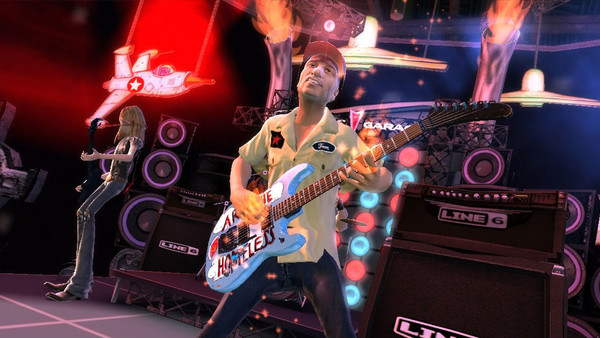
This is of course the rise of the humble rhythm game, more specifically the shooting star success that was Guitar Hero. By the aforementioned 2007, Guitar Hero was on its third release (Guitar Hero III: Legends of Rock) and was absolutely in its prime.
Publicity around the title was pumping, with people rushing to try their hand at the trickiest new tracks on offer, and this third entry to the franchise was breaking records - with Activison claiming that it was the first single videogame to sell more than one billion US dollars at retail.
The first of the Guitar Hero franchise was released in 2005 on Playstation 2 and was not expected to become the behemoth it eventually morphed into. Out of seemingly nowhere the game started raking in millions, with critics and players alike declaring their love for its simple premise and charming execution. It’s safe to say when developers Harmonix were looking at their game initially they weren’t seeing it launching a billion dollar franchise, a million sequels and rip-offs and expansion across multiple consoles and devices.
cont.
Popularity & The Big Cash Conundrum
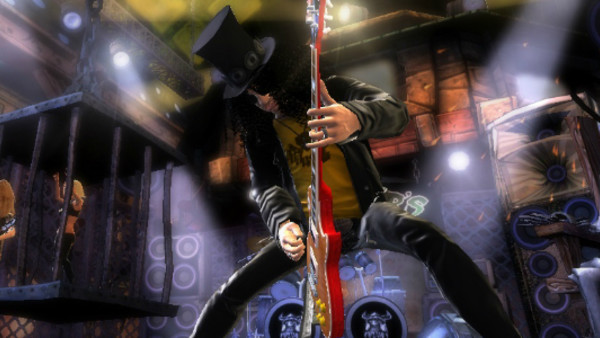
Now the thing about capitalism is that if businesses see someone else doing a thing that earns them a hell of a lot of money, they are going to copy it to hopefully also cash in; they say capitalism breeds innovation, they are idiots.
Because Guitar Hero had become a confident sleeper hit and was just seemingly forever on the up, countless other developers and companies hopped on the rhythm game trend. The biggest rival to Guitar Hero was probably Rock Band, a game developed by the same people that brought us the first Guitar Hero game: Harmonix.
Harmonix may have developed the first Guitar Hero but it was published by RedOctane, and in 2006 RedOctane was bought by Activision, whilst Harmonix was purchased by MTV Networks. Because of this changing of hands, Harmonix was no longer involved in the Guitar Hero franchise (that instead came under a branch of Activision called Neversoft), and rather fittingly moved on to Rock Band.
It’s not surprising then that Activision went on to call Rock Band an imitation, a less-good rip-off of the legendary Guitar Hero. The obvious response to that is, ‘duh’, but that’s neither here nor there. The point was that two huge companies were now occupying the very popular space of rhythm games - and many more were to join.
And here we encounter the first step in Guitar Hero’s walk to the pit of irrelevance: oversaturation.
cont.
Oversaturation
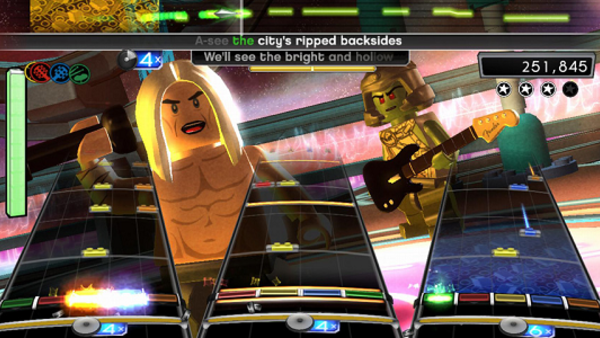
If it wasn’t already intense enough having two companies vie for the attention of the exact same audience, those companies were constantly pushing forth even more content to compete with each other and beg for audience preference (and obviously, audience cashola).
Rock Band got about a million releases of different versions, each one adding to the ever-growing list of plastic instruments available and also becoming more niche in music offerings. We had a LEGO Rock Band, AC/DC, The Beatles and Green Day specific releases - the whole shebang. And the whole time, Guitar Hero was doing pretty much the same thing.
Neither of the franchises seemed to have a distinct identity. This comes back down to those famous plastic instruments, and the sad fact that after a while they get kind of old. There was a DJ-themed rehash of the concept, as well as a more poppy ‘Band Hero’, the list goes on.
In the peak of the craze, some families had a whole band’s word of imitation kit crammed into their living rooms. While this was one of the main things that led to Guitar Hero’s underdog success in the first place, the charm can only be spread so far when suddenly what was a unique selling point is everywhere.
If one style of game is becoming particularly popular that doesn’t necessarily mean it’s doomed to fail - I mean look at the rise of the Battle Royale genre, and the huge numbers of people still playing PUBG, Overwatch and Fortnite despite the fact they are well past their prime times. What is needed to stay relevant though is innovation, and there’s only so much you can innovate with the premise of Guitar Hero or Rock Band.
cont.
The Music Industry Fights Back

Another thing that always haunts the site of a big payday is the constant threat of legal action for any and all reasons - whether justified or not. Where Guitar Hero and its contemporaries were cashing in hugely on artists’ music and likeness, said artists and their estates were becoming more and more unhappy with the situation.
Seeing how much was being made from the games, Warner Music decided to make public jabs at Guitar Hero - demanding that they begin paying higher licensing fees for the music they used.
"The amount being paid to the music industry, even though their games are entirely dependent on the content we own and control, is far too small," claimed then company Chief Executive, Edgar Bronfman.
CEO Bronfman demanded that the games’ creators start paying more money otherwise Warner would boycott them and stop any licensing agreements in the future. In response to this, instead MTV (Rock Band owners) started boycotting them instead.
It all looked rather petty and ridiculous to any non-concerned party, but it was symptomatic of the wider upset between the gaming and music industries. What was being paid wasn’t exactly chump change, with the Los Angeles Times claiming that each song cost at least somewhere around $35,000 to license. Given that songs featured in the games were in turn making money from iTunes and other purchases due to their elevated exposure, many in the gaming industry thought the suggestion of having to fork out even more was borderline offensive.
When Activision Blizzard finally disbanded its operation and called it quits with Guitar Hero, one of the main reasons cited by the company was “continued declines in the music genre”.
cont.
The Credit Crunch
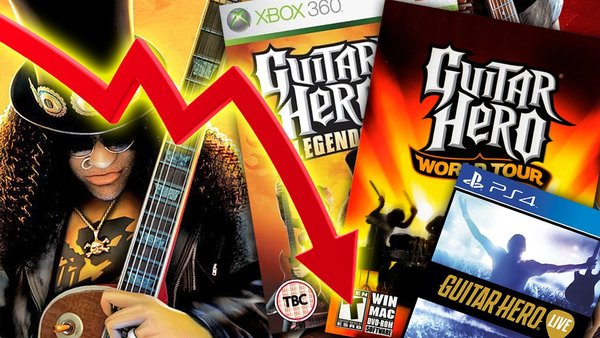
“Boo!”, you cry, “Economics are boring, I don’t want to hear about that!” You’re right, I know, but we would be fools not to acknowledge the drastic impact that 2008’s global financial crash had on consumers, and thus the games industry. I’ll make it quick.
By the late 2000s, sales were missing their targets hard and it was starting to become incredibly obvious that the genre’s popularity was taking a nosedive. Everyone was struggling financially, and I think it’s no big leap to assume that families who previously had loads of disposable income to spend on yet another shabby plastic instrument were then having to re-evaluate their priorities.
The games and their accessories weren’t cheap: the first Guitar Hero retailed for $69.99 complete with one guitar controller. This doesn’t sound too bad at all when you consider it came with the disk and a bit of kit, but when you account for inflation the equivalent amount today is around $100. And that $100 was for a game that wasn’t exactly full of endless replayability or top of the line graphics.
With Guitar Hero bringing in lawsuits and bad faith from the music industry, being pitted against and alongside a million other practically identical games and also not making as much money as it once did (some sales missing their targets by over 50% ), it made sense to just cut it. Following these disappointing figures, Activision shut down RedOctane and by 2011 they put the whole project on hiatus - allegedly after cancelling a Guitar Hero 7 game.
cont.

The Attempted Resurrection
Some things just aren't meant to be, and Activision found this out the hard way when they tried to make Guitar Hero happen again in 2015.
Activision released Guitar Hero Live, a reboot of the classic Guitar Hero IP but with a whole new controller. This was their attempt at innovation: getting rid of the old five-button guitar design and replacing it with a complex six-buttoned, three-fretted bit of kit. Their hope was that they could get their big revival with the advent of a new console generation, but failed to account for the fact that - frankly - their whole plan was not very good.
The appetite already wasn't there for the kind of game being offered, and so the nail in the coffin of Guitar Hero's ill-fated reboot was the ridiculous monetisation model they were leaning on. If people aren't that interested in your game in the first place, they're certainly not interested in shelling out more and more money to make it fun and playable.
Some elements were cool - people enjoyed the new controller for the most part, and appreciated the efforts behind Guitar Hero TV (GHTV), a section of the game that introduced new music regularly.
This wasn't enough to make up for the bad pay-to-play situation. People were most upset with the fact that they regularly had to grind to earn enough points to unlock one song they actually wanted to play in GHTV, with the game offering a way to bypass this inconvenience by using real money. Even then there was no way to permanently unlock the songs you liked, obviously in hopes you would just keep paying to skip to them.
All this aside though, fundamentally, the heyday of the plastic instrument was over. No matter how much they tried to design a controller that you "wouldn't be ashamed to have in your living room", they were fighting a losing battle.
cont.
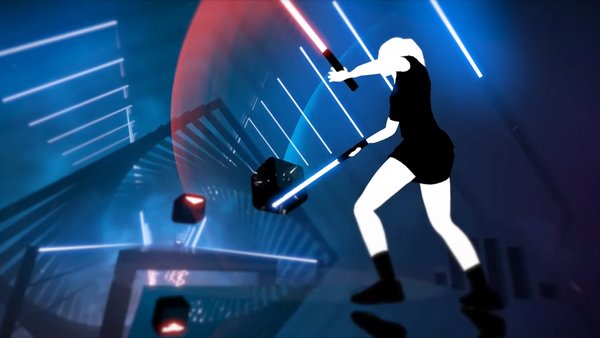
Resurgence Of The Rhythm Game
It may have been a long time since any of us have thought about Guitar Hero, but I can almost guarantee that more recently you’ve seen a slight uptick in the amount of rhythm games on your radar. Guitar Hero and Rock Band, as well as all their semi-identical brethren, are now long outdated - but their spirit and style has been revived as of late as VR gaming has been on the rise.
If you’re an avid user of TikTok, chances are that you’ve seen your fair share of Beat Saber, whether that’s people playing it or adverts for it. With other titles including Pistol Whip and Synth Rider, we’re starting to see an appetite in the mainstream again for rhythm-based games.
Unsurprisingly though the rise in interest is thanks to a serious change and innovation in the genre’s output. What eventually killed Guitar Hero, at its core, was a failure to innovate in favour of flooding a saturated market until the cash ran dry. Now with everyone exhausted and uninterested in that take on it, it’s time for something new - and these VR offerings certainly fit that criteria.
The important thing now with rhythm games on VR is to make sure that it’s not the only thing we’re seeing, as it’s not controversial to say that the market is so far lacking in diverse quality titles. Hopefully we won’t see a repeat of the Guitar Hero arc with the new generation of music-driven, rhythm hitting games, but only time will tell.
Honestly though, if Guitar Hero released an immersive, VR rehash tomorrow, would you play it? I’m not sure I can say for certain that I wouldn’t be drawn in…
Watch Next
Can You Beat This Quiz On 90's Rock And Metal?
