A Beginner's Guide To: Colonising Mars
How to turn the Red Planet into a home from home in 11 easy steps.

11. Why Would We?
Why, indeed. Why would we leave the cosy, comfortable bosom of our own planet for the barren wastelands of Mars? Scholars and experts have been tossing this one around since the early 20th century and there are a number of compelling arguments as to why we should fly the nest. Survival: The primary concern of most Mars advocates is the preservation of the human race. Stephen Hawking has argued on numerous occasions that space colonisation is the best means of long terms human survival. Hawking has gone so far as to say that we can either establish space colonies in the next 200 years, or face extinction. By moving some of our population off-world, the human race would be able to survive in the event of a disaster, either natural or man-made. The basic idea behind the survival argument is one of not keeping all of humanity's eggs in one basket. Resources: With our ever-dwindling resources here on Earth, the prospect of the untapped riches in the wider solar system are looking ever more tempting. There are a wide variety of estimates as to exactly how much is out there, ranging from several thousand to more than a billion times that which is available to us on Earth. With almost limitless material and energy resources up for grabs, the arguments for leaving our exhausted little planet in pursuit of galactic goldmines are ever mounting. Overpopulation: Our expanding population is a cause for growing concern. We are now getting to the point where we can no longer feed, house and employ large swathes of the population and things are only going to get worse. By colonising other planets, we offload some of the pressure on Earth's resources and the boundaries of our home world would no longer be the limitations that they are today. Economic: Whilst it might be nice for some to imagine that an off-world colony would be a good excuse to start again and build some kind of egalitarian utopia on Mars, the reality is that space travel will likely become as commercialised as any other industry here on Earth. This is not necessarily a bad thing, in fact it's already happening. Ever since we figured out how to get things into orbit, we've been sending satellites up there that do everything from help your navigate to beam TV channels into your home. It is likely that, in order to be successful and financially viable, space travel and space tourism will follow a similar suit. Exploration: A good answer to the question "Why should we go to Mars?" is "why not?". As well as all of the practical implications of solar system colonisation, there is also the very basic human drive to explore. If we can go and live on Mars, and enough people want to, then we should at least give it a go - we'd be mad not to.10. Okay, But Why Mars?

9. The First Phase
The first phase of Mars colonisation will likely be more of a tentative toe in the galactic water, rather than a swan dive. Before we see any kind of mass exodus, we'll send an advanced party to case the joint before we all rock up. The first expedition would likely resemble the Moon landings, with a small crew sent to carry out the preliminary analysis of the surface that we haven't yet managed to achieve with robots. They might take equipment with them for resource extraction and the production of food, oxygen, water, energy and fuel. It has been suggested that those first Martian explorers would use a carbon dioxide based fuel as the ingredients can be extracted from the Martian atmosphere rather than attempting the process of extracting hydrogen from Martian water. Alternatively, solar power could form the basis of energy production on Mars. They might live in rudimentary "pop up" habitats, but we could also send them there with 3D printing technology for future building. If they were able to use the materials already on Mars, this would drastically reduce the amount of materials we would need to transport from Earth, cutting the time, money and resources needed for the trip. The first habitats might even be 3D printed and lowered down from orbit. Martian soil is poor, but not necessarily impossible to cultivate. It already contains many of the nutrients needed to grow crops, and with addition of fertiliser (handily provided by the crew's, er, excreta), the Martian settlers could grow crops and become at least partially self sufficient. Whether or not we are able bring these early explorers back to Earth again is still being debated. The prospect of a one-way Mars trip is a daunting one, but it might not stay a one-way trip as we develop the technology to get ourselves to and from the Red Planet.8. A Colony

7. Terraforming
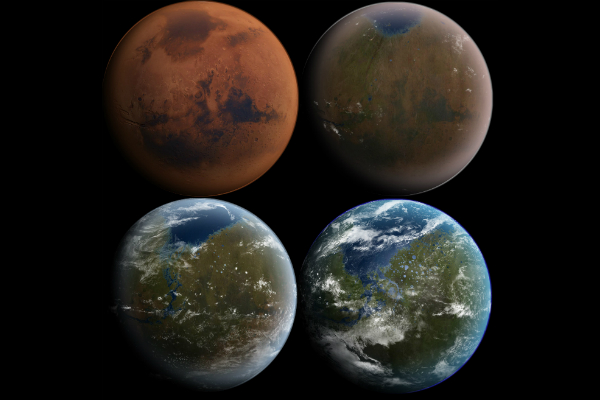
6. Whos Going To Get Us There?
To get ourselves to Mars, we're going to need a spaceship. Not only that, but we're going to need one that is relatively cheap and preferably reusable if we're going to start building a colony. It used to be a given that, if we were going to Mars, it would be NASA who would take us there. However, in the last decade, a number of private companies have come out of the woodwork with their own plans to reach the Red Planet. Although Mars One (the ones who said they'd make a Mars mission into a reality TV show) turned out to be a bit of a bust, the likes of Boeing and SpaceX having been making real strides towards making the Martian dream a reality. The main driving factor behind how and when we reach Mars is cost. NASA is publicly funded and therefore vulnerable to budget cuts and public opinion, private companies such as SpaceX are vulnerable to the markets and whether or not the can turn a profit from their products. Perhaps a joint effort between the public and private sectors could be the answer. NASA and SpaceX have come together to propose the Red Dragon lander - a modification of SpaceX's Dragon craft that could one day transport a crew to Mars. SpaceX's main raison d'etre is to lower the cost of space travel and they are already delivering payloads into Earth orbit at a lower cost than ever before. The ultimate goal of SpaceX is to get to Mars, and the CEO, Elon Musk, has said that he plans to retire there. The Boeing Affordable Mission is another one working in tentative conjunction with NASA and is developing technology that would be crucial on a Mars mission including radiation shielding, centrifugal artificial gravity, and a reusable lander that could return the crew back to Earth again.5. Structuring Society

4. Becoming Martians
The people that settle on Mars probably won't come back to Earth and, inevitably, some of them are probably going to get busy. Presuming that exposure to cosmic radiation hasn't immediately sterilised them all, we could well be dealing with Martian babies. A large enough population would allow them to avoid inbreeding and perhaps produce the first ever, proper Martians. At this point, the population stop being migrants and become natives. Anthropologist Cameron Smith believes that this is how we secure our long term future in space. Not just by exploring and pushing back that final frontier, but by settling down, having families and attending the school sports day. An implication of this is, with Mars' weaker gravity, about a third of Earth's, the Martian babies might actually end up looking more alien than you'd think. It is thought that children raised on Mars would grow much taller than those on Earth. Obviously, the genes they inherit from their parents wouldn't change, but the reduced pressure on the spine would probably give them a good couple of extra inches in height. However, they would be much weaker than their Earth counterparts and even their parents (unless a special training programme was put in place) due to the fact that they are only fighting a third of the gravity to stay upright. This would mean that they would be unable to visit Earth, even if the technology made it possible, as it could cause them all kinds of muscular, skeletal and balance problems.3. Possible Locations For Settlements

2. Should We?
