5 Years Later Twin Peaks The Return Ending Finally Makes Sense
Dale Cooper: Special Agent, or something deeply sinister?

There is no set way of approaching, much less understanding, Twin Peaks.
"A real mystery can't be solved, not completely. It's always just out of reach, like a light around the corner."
If Mark Frost wrote that, in The Secret History of Twin Peaks, then there is no true answer. Frost is (unfairly) maligned as the nuts-and-bolts framework man of the Peaks universe. A lot of the more esoteric material is actually driven by him, but regardless: Twin Peaks is a "continuing story" that does not exist to be resolved. However, after years of delving into that world, as much taunted as enthralled by its mystery, what Dr. Jacoby described as a "personal investigation ongoing for the rest of my life" has, for this writer, concluded.
Spoilers follow, but you're likely reading this as a long-time fan similarly captivated by the unsolvable puzzle. In Part 18 of The Return, a man we don't really know leads a woman he believes to be Laura Palmer to her old home. This follows, on some strange diverted path or other, the events of the whole story. Cooper is freed from the Black Lodge, and after his best, inherent qualities are transferred to Dougie Jones, the tulpa created by his doppelgänger Mr. C, he recovers his true self through the vessel of electricity. In league with the Fireman, he makes it back to Twin Peaks. In a remarkably neat resolution to Mr. C's ambiguous campaign of terror - it is penned in an almost Seinfeldian manner, with every major plot thread converging in a scene that plays off an earlier gag - Lucy Brennan in Part 17 shoots the double, and then a chipper cockney destroys the orb inhabiting BOB with a magic green glove in a deliberate deus ex machina.
The day is saved, and all is well, until Cooper comes face to face with Naido. It is here that Cooper's enlarged face is superimposed on and dominates the screen. The tone shifts from a neat albeit gloriously wacky take on a mystery drama to something profoundly unknowable at this precise moment.
Why?
CONT'D...(1 of 6)
The expression Cooper wears is deeply unsettling. He looks racked with guilt. The detective transforms into the culprit. It is as if the memories of Mr. C's rape of Diane flood through him, and his being culpable in some horrifyingly abstract way causes him to disassociate from himself, hence the visual effect. And yet, when Naido is explicitly revealed to be Diane, Cooper beams, as if some elaborate plan developed across various timelines and planes of reality has finally been realised. This is denial, the same denial at the very dark heart of the Twin Peaks story; because it feels impossible for such darkness to exist, it actually becomes impossible.
We saw this at Laura's funeral in the first season. It's no coincidence that Bobby Briggs, the teenager who sought to puncture the facade, evolved into the good man he did 25 years later. The townsfolk almost created a tulpa version of Twin Peaks itself as the idealised "slice of heaven". The mist hovering over those majestic, swaying Douglas firs doubles as a visual metaphor for this self-imposed obfuscation.
The true nature of Laura Palmer's murder was so harrowing, so unbelievable, that nobody allowed themselves to believe it - even the genius magician detective, until it was too late, and Maddie Ferguson was brutally murdered. Laura herself may have projected the image of BOB onto her father's face; in one of very few explanations, Lynch himself has stated outright that BOB is not an actual demonic entity from a different realm. He is an "abstraction in human form".
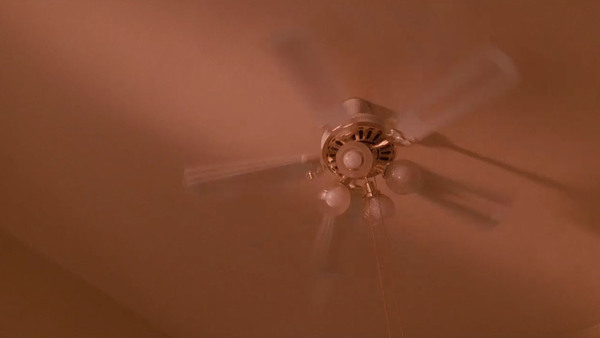
Twin Peaks is a story of trauma. Laura is the one. It is also, in Lynch's words, a continuing story. The ceiling fan still whirs. The world spins. Trauma is cyclical. Abuse is never-ending, and often perpetrated by those you'd never think capable of it.
In Part 18, having travelled back in time to 1989 and failed to return Laura to a place inferred as the White Lodge, Cooper emerges from the Black Lodge and is met by Diane. Together, they "cross over" to another plane seemingly controlled by Judy, the "extreme negative force" chased by Cooper in the retconned overarching narrative. Diane is reluctant to follow through with the plan. Cooper is determined. When they cross over, everything does indeed change. Or is "change" one of many misnomers that the real people use in Twin Peaks to describe the metaphysical? Is "revert" more accurate here?
CONT'D...(2 of 6)

They enter a motel room. Cooper is insistent that they have sex. They do, although the term takes on a more horrifying definition as the act unfolds. Diane blocks Cooper's face with her hands, unable to disassociate her friend and lover from her rapist. As chillingly conveyed by Kyle MacLachlan, wearing the dead-eyed malevolence of Mr. C, they are one and the same. Diane, or Linda, leaves him behind in the night. She leaves a note for "Richard," whom she no longer recognises. When Cooper reads the name "Richard," something unsettles him. Subconsciously, he senses from a distance that the rapist is literally a part of him. Richard Horne of course is his son. When he ventures out, he finds Judy's diner, and uses the intuition that quickly deserts him to arrive at Laura's home address. As soon as we come to question our Special Agent, he earnestly implores three cowboys to stop harassing the waitress. When one steps towards his table, and asks "F*ck are you doin'?". Cooper, not remotely intimidated, says "What?"
He then grabs the gun from his hand and shoots his friend in the foot. It's a badass moment, until you recall the scene from Part 11, in which Lynch lays bare the bleak reality of gun ownership and how it will never change. Then the triumph recedes. It's Twin Peaks. It's slippery in here.
Cooper locates Laura, learns that her name is Carrie Page, and attempts to take her back home via the highways of America. En route, they stop at a gas station. This scene parallels with Big Ed mournfully eating soup over the closing credits of Part 13. There, Ed peers through the windows of the gas station. At the sight of two cars passing by, he looks perturbed, as if this is somehow significant, before returning to his meal. When Cooper sets back off on the journey, another car immediately follows his. Ed can feel a psychic reverberation of Cooper's turmoil at his own lowest moment. It is no coincidence that much of Part 18 is spent watching Cooper drive in the black of night. Mr. C did this frequently during the series. This is yet another parallel that Lynch asks the viewer to draw between Cooper and his doppelgänger throughout the finale. Perhaps it was Mr. C chasing Cooper, not as a physical entity, but rather an abstraction in human form; Cooper's unshakeable guilt. We know every version of Cooper is somehow connected; in a huge clue, even the two diametric opposites are. In Part 11, before his fateful meeting with the Mitchum Brothers, Bushnell Mullins tells Dougie to knock 'em dead. When Dougie parrots "Dead" back to him, he rubs his own face, mirroring the method with which Mr. C somehow murdered Jack in Part 2.
CONT'D...(3 of 6)

In another parallel, towards the shocking coda, Cooper leads Carrie up the steps towards the Palmer house. In Part 17, Mr. C, having received the coordinates he believes will lead him to Judy, accesses the opening where Naido was found by the Sheriff's department. On a projector screen, he is shown an image of the Palmer household, the implication of which is that Judy, following the events of the original series, has inhabited Sarah Palmer, whose grief-plagued tragedy of a life has positioned her as the ultimate sorrow harvester. (Or, the frog-moth that crawled into her mouth in 1956 has finally metamorphosed through the sustenance of garmonbozia). The Fireman thwarts this plan and instead situates Mr. C at the Sheriff's station, where Cooper and Freddie enact his own.
Co-writer Mark Frost provides a key narrative clue in his supplementary novel 'The Final Dossier', penned in the voice of FBI Special Agent Tamara Preston:
"[This species of wandering demon] particularly thrived while feeding - and I quote - "on human suffering'. These beings were said to appear in both male and female forms - "Joudy" indicated the female, and the male was known as "Ba'al" - and, while they were considered beyond dangerous individually, if a male and female ever united while on the earth, the ancient [sumerian] texts claimed, their resulting "marriage" would create something far more perilous. As in: the end of the world as we know it. A few centuries later, Ba'al becomes better known, in both Christian and Islamic sources, as "Beelzebub," a false god, or, as he's known more generally and generically today, the devil."
The wordplay between "Beelzebub" and "Killer BOB" should not and likely has not gone unnoticed; after all, Frost drew criticism for undermining the mystery upon the publication of this novel.
Mr. C wished to bring about the end of the world, and Cooper's tentative or even terrified demeanour as he approaches the door indicates that he has meddled with something far greater than his own, vast understanding of time and space.
CONT'D...(4 of 6)

He is unwittingly mirroring the masterplan of his shadow self. If Mr. C is still in there, and Judy is lurking somewhere within the Tremond residence, the world ends. When Laura hears an echo of her mother's call, the lights go out, and she screams. Even without this overt explanation of Mr. C's motivation, we can infer from the atmosphere created and the brilliance of Kyle MacLachlan's performance that something ominous is imminent.
Does the world end?
With no electricity, the ceiling fan, the eternal metaphor of abuse, no longer spins. This timeline ends, but there is no one timeline, no one world. As indicated in Part 17, Cooper is deemed to repeat his mission ad infinitum. The lights going out in the Palmer household feels like a cruelly layered taunt. Judy - and this is behaviour consistent with the mischievous leanings of the "Lodge spirits" - is at once telling Cooper that he has succeeded at the ultimate cost and sending him on his way to failure all over again.
What Judy is also doing, by conflating the real Cooper with his doppelgänger, is exerting her extreme negative force onto him. She has locked him in an eternal battle with his Dweller on the Threshold, and he is now facing him for every second of his being. He is reliving the worst and most transformative point of his life, constantly, and in a particularly cruel twist, he has been robbed of his deductive reasoning to work it out. He doesn't even know what year it is. The moralistic "greatest lawman" has been doomed to a life of residual guilt and strange, unproductive thinking.
What Lynch did, somehow, using his unparalleled genius, was convey the extreme negative force through cinema. This is more telling than any narrative reading.
CONT'D...(5 of 6)

Lynch's oeuvre works on a subconscious level.
Through the moods only he can create, it is not difficult to intuit the story as it plays out, but then, like in a dream, articulating the meaning becomes more difficult with each passing second after it fades. To delve into the first person here - using the third is pointless when there is no objective truth - when I first watched the finale, I felt awful. It wasn't so much a bone-deep reaction but a molecular shattering. What's most impressive about the feeling Lynch elicited is that he did so, as ever, through mundane imagery. This irreconcilable version of Cooper isn't seen gorily ripping through victims; indeed, Mr. C feels like an overtly fictional genre villain in deliberate contrast to Richard and his awful, suppressed secrets. The sheer desolation Lynch captures - the empty roads, the empty RR diner, the blackness, the silence - is utterly antithetical to the whimsy of season one. There's a striking, "real" quality to this world. This isn't in support of any meta narrative, but another reminder that we are intentionally being confronted with something stark here.
Angelo Badalamenti's haunting Dark Space Low captures the real meaning behind the finale. It is the aural translation of despair. Cooper, Richard, whoever the man is, is capable of something we never thought possible.
The very idea of accepting that Dale Cooper or some part of him is a monster is so unthinkable that we, the viewer, cannot sanction the reality - but isn't that, to quote Ray Monroe, the "key to all this"? Is mentioning that Cooper gave away the best part of himself to create the improved version of the Dougie Jones tulpa another form of denial? Would Dale Cooper or any part of him have done this had he never encountered the Lodge? Does asking these questions power the ceiling fan?
Laura died because the truth of her life was too much for the townsfolk to sanction. They looked away. In the devastating conclusion of Twin Peaks, the hubristic Dale Cooper, who meddled with forces beyond his understanding, is unable to look away from himself.
He is, literally, always in the rearview.