8 Fantastic Doctor Who Continuity References That You Might Not Have Noticed
 Rewarding the loyalist members of a fanbase is sort of a given. These are the people who have been with you from the beginning, stuck with you through thick and thin and loved you unconditionally. The least you can do is repay them. (No ComicCon trailer irony intended. Honest.) The way to reward fans within the 45-minute time frame of a Doctor Who episode though is to reference something that we know and love. Maybe a past Doctor, a visited planet or one of our favourite stories. And as Doctor Who fans, we love the references. Frankly, it's expected that the writers should be huge fans, like us, and so many of them are. Here are 10 examples of NewWho writers paying tribute to the past - often Classic Who - in various different ways. What are your favourite references and nods? Please let us know in the comments!
8. Items And Objects
 It's understandable how often the Doctor's carried an umbrella when you consider that he lands in London more often than anywhere else in the universe. In 'The Doctor's Wife', the Doctor meets two patchwork people that remind him of his old umbrella, and he's probably referring the multi-coloured one that Colin Baker's Doctor wielded in the 80s. Of course, he still owns the one he carried in his Seventh incarnation, as it's seen in 'Journey to the Centre of the TARDIS' when Clara's going through the Doctor's stuff, Come Dine With Me-style. Other than umbrellas popping up here and there though, the distress cubes from 'The Doctor's Wife' were originally used by the Second Doctor in The War Games, the Tenth Doctor's skill with a cricket ball ('Human Nature') probably comes from his Fifth incarnation (Black Orchid) and the jelly babies that the Fourth Doctor handed out were also a favourite of the Eighth Doctor (and John Simm's portrayal of the Master). Also, the glass that the Doctor used to listen to Prisoner Zero with through the crack in Amy's wall turned up in 'The Power of Three' during the meal that the Pond family had at the end. Was that deliberate? That can't be deliberate, surely. And then there's the sonic screwdriver, first introduced in the Second Doctor's era: perhaps he got the idea for it when trying to examine a spaceship in Trap of Steel with an ordinary screwdriver? And whilst there has been so much continuity within the series, from the Tenth Doctor remarking that Five went "hands free" ('Time Crash') to Tosh from Torchwood having a replica for a sonic on her desk, quite possibly the finest piece of continuity was in 'Cold War', when the Doctor used the "red setting" that River talked about three series before.
7. Previous Companions
 The Doctor's travelled with so many companions that every now and then, of course he mentions a few. In Series 7 alone, Tegan was referred to as "a gobby Australian" in 'The Crimson Horror', Susan was mentioned in 'The Rings of Akhaten' and Amelia Willams was credited as the author of 'Summer Falls' in 'The Bells of Saint John'. But perhaps more subtle in 'The Bells of Saint John' was the look on the Doctor's face when Clara tells him, "People always have plans", perhaps evoking the memory of Amy saying in her first episode, "People always say that". Subtler still was the Doctor's quote in 'Fear Her', that "You dismissed it, because what choice do you have when you see something you can't possibly explain?" This was a reference to Susan mentioning in An Unearthly Child that "Their minds reject things they don't understand." Hey, the Doctor even mentioned in 'Fear Her' that he was a parent once. Also from Series 2, the Doctor used his former companion Jamie McCrimmon as an alias when pretending to be Scottish (a Scottish actor playing a Gallifreyan with a Southern English accent pretending to Scottish... wrap your head around that one). Oh, and it was Jamie that gave him that pseudonym, John Smith, that he's been using sporadically ever since. Now you know.
6. Clothes
"Smart bunch, Time Lords. No dress sense, dreadful hats, but smart," the Eleventh Doctor once remarked upon the attire of his people. Or more specifically, himself. Well, admitting you have a problem is the first step. Not only has the eccentric hat been a recurring theme of Smith's tenure, Eleven paid tribute to the Tom Baker scarf in 'A Christmas Carol', when both the Doctor and a young Kazran are seen wearing one. Even when Eleven picked his brilliant outfit out, he did so in a hospital, just like Three and Eight did before him, and when he updates his clothes in 'The Bells of Saint John', his bow tie in a box once belonged to Patrick Troughton. Of course, Ten got his trainers from Five, Five got the question-marked collars from Four, and Four's scarf has appeared in a hospital locker and the TARDIS wardrobe when Eight and Ten picked out their outfits respectively. Also, did you know that different Doctors have alternated dress depending on episode? Both Ten and Eleven would change their ties depending on whether the episodes were in the past or future, perhaps a reference to Tom Baker, who had different coats depending on the tone of the story. Perhaps the least flamboyant though was Nine, who only ever changed his jumper, except in a photograph of him in 1912, when he's dressed more in line with the Classic Series ('Rose'). Good to see he'd kept his old coat stand though.5. The TARDIS
 The oldest companion of them all, there is so much continuity surrounding the old girl, that a lot of it's scrambled; not least in 'The Name of the Doctor' when Steven Moffat rewrites the idea that the TARDIS stole the Doctor, only a series after Neil Gaiman had written that line. Gaiman however did continue many ideas from the Classic Series; the Doctor had rebuilt a TARDIS in The Claws of Axos and The Horns of Nimon, both the Fourth and Fifth Doctor had deleted rooms (Logopolis, Castovalva) before the Eleventh, the TARDIS had sent telepathic messages to inhabitants in The Edge of Destruction, and just like his third incarnation, Eleven travels just with the console of the TARDIS. The famous TARDIS swimming pool first seen in The Invasion of Time has surfaced multiple times in the Moffat era, notably when it saves River's life in 'Day of the Moon', and in 'The Christmas Invasion', we even get a glimpse of the TARDIS wardrobe. Emergency Programme 1, from 'The Parting of the Ways' returns in 'Silence in the Library' and The Hostile Action Displacement of The Krotons makes a return in Mark Gatiss's 'Cold War'. In 'Journey to the Centre of the TARDIS', we may see the light chamber from 'Tooth and Claw' and the Doctor's cot from 'A Good Man Goes to War', but what about all those voices that float around the console as the TARDIS leaks the past? There's Susan saying that she invented the term "TARDIS" (An Unearthly Child), Three telling Jo that the ship's dimensionally transcendal (Colony in Space), Eleven calling Idris "You sexy thing" ('The Doctor's Wife') and Nine declaring that the assembled hordes of Genghis Khan couldn't break through those famous blue doors ('Rose'). Perhaps it's no surprise that continuity arises often in the TARDIS. She does exist across all time and space, after all.
4. Setting
 The universe is a big place, and time is infinite. Of course, the Doctor's going to visit some places more often than others, but it's somewhat surprising how often the Doctor lands somewhere that could remind him of Bad Wolf Bay (the beach in 'The Time of Angels', the engine room in 'Dinosaurs on a Spaceship'). In 'Planet of the Ood', it's noted that the Ood Sphere is in the same star system as the Sense Sphere, a planet the First Doctor encountered in The Sensorities, and the Harvesters from 'The Doctor, The Widow and the Wardrobe' are from Androzani Major, last visited in The Caves of Androzani. The moon-like surroundings of 'Nightmare in Silver' are a reference to fellow Cyberman story, The Moonbase, and the chess-playing Cyberman from 'Nightmare in Silver' is referred to as the "699th Wonder of the Universe", a reference to there only being that many after the destruction of the City of Exxilon. The Silver Devastation was home to both Professor Yana and the Face of Boe, and when the Doctor mentioned "universes where the laws of physics were devised by the mind of a mad man" ('The Rings of Akhaten'), he could've been referring to Omega (The Three Doctors). Maybe the subtlest setting reference though is that Area 51, in 'The Wedding of River Song', was situated in a pyramid: is this a nod to the Great Cobalt Pyramid being built on the ruins of the Torchwood Institute, or just a coincidence? And on the subject of times and spaces, have you ever noticed how often the Doctor visits the 51st Century? 'The Girl in the Fireplace', 'Silence in the Library' and 'The Time of Angels' are all set there, and it's the century that Jack Harkness was born.
3. The TV Movie
 The Eighth Doctor's perhaps the most unloved of all Doctors. With just one episode to his name, Paul McGann was a Time Lord for just six weeks, and though his time in the TARDIS was fleeting, it didn't mean he didn't contribute a lot to NewWho, as well as referencing the Classic Series. This is the first time the Doctor uses a Sonic Screwdriver since his fifth incarnation, and it would go on to become a much-used tool when Russell T Davies revived the series; the extensive use of jelly babies though, from Seven's bowl of them, to Eight's bag of them, has been less prominent since 2005. The Doctor now has a Nine Hundred Year Diary, an update on the Five Hundred Year Diary first seen in The Power of the Daleks, and the Parliament of the Daleks that sentenced the Master to death would return to Who in Steven Moffat's 'Asylum of the Daleks'. The John Smith alias is written down by Chang Lee, unaware that it's the Doctor's pseudonym, but unfortunately, no NewWho writer has had an explanation to why it's mentioned twice that the Doctor is half-human. Anyone? Mix-up at the hospital? The Master had been sniffing very strong glue? It's also the first time that the Doctor and his companion are obviously romantic, something else that Davies would continue. Much to the incandescent disgust of half the fandom.
2. Villains
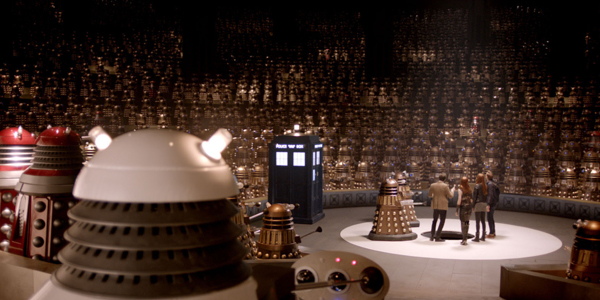 The Doctor fights for peace in a universe at war. That's the show in a nutshell: that lonely Gallifreyan fighting pepper pots, statues, and Peter Kay dressed as snot. And when aliens return to Who, they usually bring something new, but they acknowledge the past with nostalgic nods here and there. The Cybermen in 'Nightmare In Silver' have the same weakness to gold as those in the '60s, and a '60s Cyberman head coincidentally featured in a museum in the first Dalek story of NewWho ('Dalek'). Despite the big reveal of the Dalek floating up stairs in that episode, they previously did so in Remembrance of the Daleks, and the episode ends with the Doctor claiming "I win: how about that?" after the Dalek dies, a line mirrored by the Master in 'The Last of the Time Lords'. Meanwhile in Moffat's era, the Headless Monks are referenced a whole series before their official introduction ('The Time of Angels'), Eleven gives the Great Intelligence the idea of attacking the London Underground in 'The Snowmen', something they did in The Web of Fear, and 'Asylum of the Daleks' mentions Daleks from every era: there are the modern ones from 'Dalek' onwards, the Power Rangers ones from 'Victory of the Daleks', and then there are Renegade Daleks, a Special Weapons Dalek (Remembrance of the Daleks) and an early silver Dalek (The Daleks), as well as the Daleks that were found on Aridius (The Chase), Exxilon (Death to the Daleks), Kembel (The Daleks' Master Plan), Spiridon (Planet of the Daleks) and Vulcan (The Power of the Daleks). That's an awful lot of Daleks. Quite possibly the funniest reference to an enemy though is the Tenth Doctor asking "Are you my mummy?" whilst wearing a gas mask in 'The Poison Sky'. David Tennant forgot his line, and that was the first thing that came to him. It's a good job they kept it, right?
1. The Eleven Doctors (And Their References To Each Other)
