"Hiding behind the sofa" is a past-time almost exclusively associated with one television show. The phrase derives from the early days of Doctor Who, and relates to the reaction that children first had in the 1960's when they saw the Daleks, the Cybermen and other terrors. There were calls that Doctor Who was too scary. Luckily, they soon went away.
The family fright-night reputation that Who earned in the early days was only ever expanded on. Sidney Newman's vision of "No bug-eyed monsters" was lost somewhere, as aliens and foes only became more and more ambitious; the Daleks became as iconic as the big blue box, and to date, every single NewWho episode has contained some kind of evil threat. Often, cast members and writers tease how "This new one's one of the scariest yet!" But all that propaganda aside, which episodes really are the scariest? Here are the top ten scariest episodes in the history of Who, from the Classic to the modern and everything in between. Note, these are episodes picked mostly on their fearsome reputation and the reaction that they had on the viewers of that specific time. Which are your favourites that deserve honourable mentions? Comment below!
10. The Web Of Fear
Before Richard E. Grant and the Great Intelligence's evil masterplan to rewrite the Doctor's history, the GI was a thorn in the Second Doctor's side. The Yeti had made a terrifying appearance in 'The Abominable Snowmen', and 'The Web Of Fear' was a fantastic sequel that only furthered everything that made the villain so horrible. 'The Web Of Fear' was ingenious because it capitalised on the claustrophobia of its audience; rather like Steven Moffat's best episodes - the ones that focus on an existing fear of the audience - 'The Web Of Fear' set monsters in the London Underground. No one wants to be stranded underground, do they? It was the perfect setting to introduce a mystery fungus, and when the Yeti appeared - huge, mysterious and growling emphatically - they cemented themselves in Who history as Classic monsters that are still remembered today. 'The Doctor's Wife' genius Neil Gaiman has claimed he'd love to bring the monsters back. It sounds like a mouth-watering prospect, but he'll have to go some way to making the Yeti as scary as they were in this serial.
9. The Impossible Planet/The Satan Pit
It's perhaps a surprise that he didn't make an appearance in a Doctor Who finale, as the Beast wasn't just one of the most fearsome villains during the reign of Russell T Davies. He was the perfect equal to David Tennant's Doctor; a lonely demi-deity, feared by so many, ancient and the last of its kind. That alone would have been a fascinating premise for an episode, but 'The Impossible Planet' two-parter proved to be more than just a story hinging on a mythical creature. We only see the Beast towards the very end of the hour-and-a-half running time, but we see him possess Toby, tell him "Don't turn around" with bassy depth, and we see him take over the collective mind of the Ood, the gentle slave race of the crew. The language of the Beast is so old not even the TARDIS can translate it, and the creature is suggested to be behind the idea of Satan. It's mysterious, horribly dark and no one's safe: most of the crew die in the end. Series 2 looked deeper at the relationship between Rose and the Doctor, with the moments of darkness coming few and far between. This was a welcome surprise amidst the more soapy storylines; it chilled its audience to the bone, and brought the Doctor even closer to his companion.
8. Spearhead From Space
Jon Pertwee's reign started with a bang. He was to become so many people's Doctor - including future writer Mark Gatiss - and 'Spearhead From Space' was to become the first colour episode of Doctor Who, as well as the first to feature the Autons. The genius of the episode is that it does something all great Who episodes do; it makes the everyday seem extraordinary, and in this case, horrifying. The shots of shop window dummies, tearing the streets apart to conquer Earth, are scenes that scared a generation; these were objects that we took for granted, never to see in the same light again. And anyway, we had a new Doctor to deal with, on top of this invasion. Did he have what it took to defeat these monsters? It was a template that Russell T Davies followed almost to the letter when he constructed his very first Doctor Who episode. The horror of shoppers witnessing this alien attack were lifted straight from the Classic Who pantheon; it's an influential episode, and one that still scares many today.
7. The Waters Of Mars
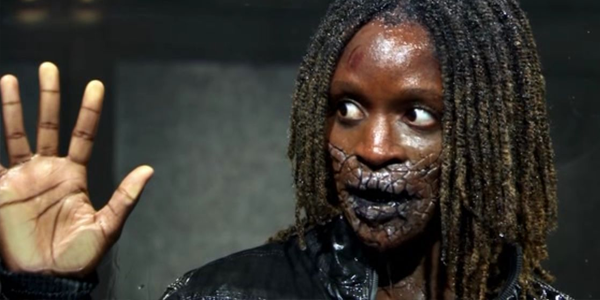
'The Waters of Mars' makes for a fascinating parallel with 'Pond Life', funnily enough. During the Eleventh Doctor's alone time, he ran around the universe having fun, even recording a rap song at one point. Ten however, just became insane with power (feel free to make any Kanye West jokes you feel appropriate). 'The Waters Of Mars' was easily the darkest moment yet for the Tenth Doctor, as he became livid with always losing his friends, declaring himself the "victor" of his extinct race. Russell T Davies turned in an extremely adult script; this was a base on Mars that became infected with a vicious disease, from which no one could escape. Human beings became cracked monsters, vessels for what seemed like an ancient and evil parasite. This was probably what drove the Ice Warriors away from Mars. This was a very real, and ever-growing threat. That threat became just a footnote in the "Dark David Tennant Story". Whether or not anyone actually remembers just how scary the water was though - despite how scary Ten became - it really was one of the most frightening episodes of Davies's tenure.
6. The Caves Of Androzani
Peter Davison's Doctor is generally seen as a lighter one; less alien than his predecessor, much more humble than his successor. But as Davison's time on the show veered towards an end, it became obvious that the Fifth Doctor was heading down an undeniably dusky route. 'The Caves of Androzani', one of the most revered sci-fi stories of all time, is perhaps the darkest regeneration story ever. Sharaz Jek acts as the main antagonist, almost as a Darth Vader figure; he's insane and extremely sinister, keeping a mask on for much of the story before revealing a burned face. He strokes Peri's hair while she's powerless to escape his creepy clutches, and it's at the end of this episode that the Doctor undergoes perhaps his most painful and traumatic regeneration. It's a story that pulls no punches when it comes to the intimidating, and it makes for one of the grimmest atmospheres in any Who story. It's perhaps a direction that Steven Moffat wanted to take Eleven, in 'The Name of the Doctor', and it's certainly a serial that's stood the test of time.
5. Midnight
'Midnight' is a legendarily dark turn for Russell T Davies, and fantastically, it's almost completely unlike anything he'd written for Doctor Who before. The camp melodrama that often spiked his work was gone for this Donna-lite adventure, replaced by a play-like set-up, a creepy force and a study into cabin fever. What makes 'Midnight' so frightening isn't just that the creature was a completely unknown entity; although that's fairly scary to start with, and the chilling way that the monster begins to copy Ten makes for a spine-chilling sequence. 'Midnight' is also an episode that delves into the amorality and fear in human nature: it's a story that takes an ominous mystery and plays with the idea that it can turn ordinary people into murderers. And for much of the story, the Doctor is in serious danger, and no way in control. He's outnumbered, later possessed by the thing, and the man with all the answers clearly has none. All he has is a deep, long look into the eyes of the woman it's just possessed, and we can tell that he's scared. When the Doctor's scared, that's a good time to be worried ourselves.
4. The Empty Child/The Doctor Dances
The superlatives constantly heaped on Steven Moffat's first Doctor Who two-parter are seemingly never-ending, aren't they? In many ways, it's the ultimate NewWho episode, but it's also one of the scariest pieces of television in the Moff's career. The child is extremely creepy, but the way the episode deals with the threat is, well, fantastic. Nine begins looking for clues through the war-torn London streets, ending up in a hospital filled with the undead; there, he meets another Doctor, one who's slowly morphing into the creature itself; there's a terrifying sequence when Eccleston looks on in horror, as Richard Wilson's elderly doctor coughs up a gas mask. The danger, for the most part, is all around and pressing in. The scariest moment by far though is the now-classic moment when the Doctor, Rose and Jack can still hear the child, but the Doctor declares, "The tape ran out thirty seconds ago." It's a scene that didn't just send kids behind a sofa, it curdled blood.
3. The Daleks
The story that formed a legend, the very first Dalek story was a controversial one in many ways. Family TV had never been this scary, and this really wasn't the vision of Doctor Who. It was a landmark for so many reasons, and a petrifying new turn for the show. In only his second ever serial, William Hartnell came face to face with the space-Nazi pepper pots themselves, a group of mutated beasts, scarred from a nuclear war, who hid themselves in metal casing. Their screams were deafening. Their ideology so very similar to that that tried to invade Britain just twenty years' prior. But it was the very first Dalek scene that would go down in history; the camera focussed on a helpless girl, screaming, as a plunger edged closer and closer towards her. A legend was born. 'The Daleks' became the bar. Every monster since has had to compete with Terry Nation's most famous creation, in terms of ingenuity, brilliant design and of course, the fear factor.
2. The Tomb Of The Cybermen
As the Dalekmania swept across the 60's, Who producers decided it was time to rest the Doctor's arch-enemies, and bring in new creations. It was a golden era for sci-fi monsters, as the Ice Warriors and the Yeti would go on to become legendary in their own right, but no Second Doctor foe proved more intriguing than the Cybermen. Technology had been something to fear in fiction for years, but the Cybermen took that idea to new pinnacles. Their third outing was perhaps the one that best summed up the idea behind them; they were chilling nearly-humans, not yet the robotic army of NewWho, and with a more sinister voice than any "upgrade" since. They were a version of us. They were the darkness in humanity, repackaged in a shiny box, and they were terrifying. The cliffhanger when the creatures broke out from their tombs was one that would scare viewers across the country, and it's quite possibly the story that made sure these were creatures that would appear for the next fifty years in the show. The Cybermen might not scare you these days, but they sure as hell frightened your parents.
1. Blink
In modern society, where we're exposed to so much more than we used to be, where we thought that everything had been done... statues really shouldn't have been that scary. The fact of the matter is though, that 'Blink' is regarded as the scariest Doctor Who episode of the modern era; furthermore, it's probably more impressive to have created something that scary, in 2007. And the episode revolves around such a simple premise: these lightning psychopaths are stalking one poor girl who doesn't even have the Doctor to help her, with the final confrontation taking place in a haunted house. It's an incredible piece of TV. The sheer terror of the episode comes from not wanting to blink ourselves, from these vacant-eyed monsters who, despite what the Doctor says, absolutely do not kill you nicely. It was another bar raised for Doctor Who, though many agree the Weeping Angels were never scarier than in their first appearance, we still don't blink when we see statues.